Democratic group lays out environmental, economic roadmap
Sets template for economic and climate concerns in the next Congress
Members of House Democrats’ Sustainable Energy and Environment Coalition and its affiliated nonprofit released a set of policies on Tuesday to serve as a template to address both economic and climate concerns in the next Congress should their party make big midterm gains.
The SEEC Institute’s Thriving Economy Project is presented as “a policy blueprint designed to modernize the economy, charting a path towards growth and prosperity for all Americans.” The proposals include over 800 policy recommendations across nine chapters in areas including agricultural, supply chains, energy infrastructure, financial markets and governance.
The project was created with the recognition that even if Democrats win back both chambers, President Donald Trump will still be in the White House in January. It’s not intended to be a blueprint for a filibuster-proof reconciliation bill in all-Democratic Washington, said Max Frankel, the institute’s executive director.
“This is about what can we do on Jan. 4, what can we do to make concrete environmental progress in a divided government,” Frankel said in an interview.
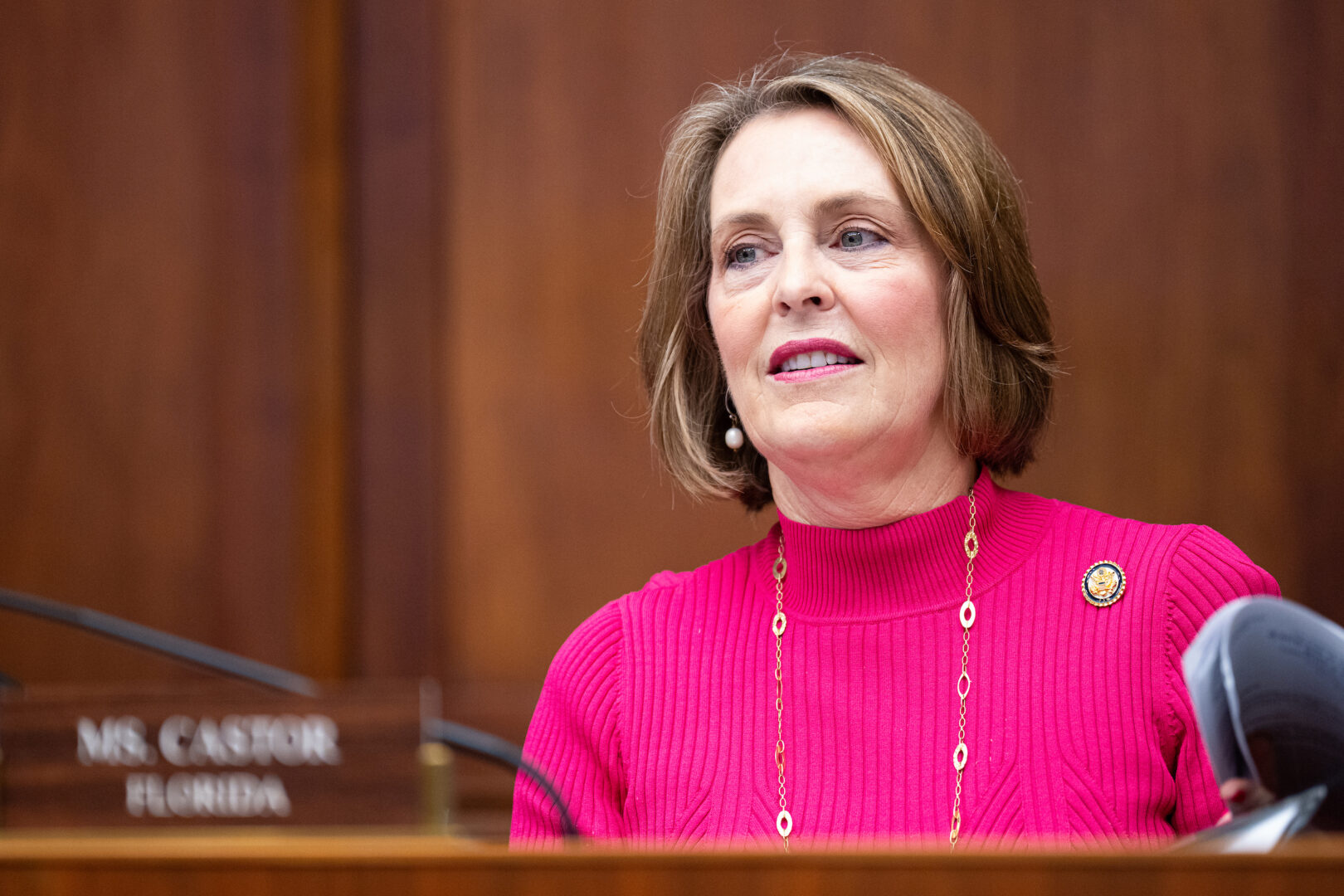
“The report is not intended to sit on a shelf until the year 2029,” Rep. Kathy Castor, D-Fla., said at the project’s unveiling on Tuesday. “These ideas, we believe, represent the best of the United States, a vision of a clean and prosperous future where everyone benefits.”
Castor’s own reelection hopes rest on a knife’s edge after GOP-led redistricting in the Sunshine State; Inside Elections with Nathan L. Gonzales rates her race Tilt Republican.
The institute’s recommendations, a product of research backed in part by Fortune 500 corporate donations, certainly fall short of what advocates for the Green New Deal — an ambitious and costly plan to wean the U.S. from fossil fuels — pushed unsuccessfully during the Biden administration years. It’s a set of smaller and less headline-grabbing policies that authors believe will eventually curb emissions while creating jobs.
The project recommends prioritizing federal financial and technical assistance for projects that retrofit and weatherize existing buildings to lower costs, and modernizing the Low-Income Home Energy Assistance Program to provide assistance during both the coldest and hottest months.
It calls for establishing a national standard that would give each household two free hours of electricity per day, require that data centers disclose their energy and water use and the establishment of a transmission investment tax credit to hasten grid infrastructure build-outs.
And the governance section would attempt to limit future grant and funding cancellations similar to those the Trump administration enacted after taking office. This includes limiting the termination clauses in federal funding agreements so that it can only be for cause, and deploying funding to recipients with records of fiscal accountability instead of retaining these funds in Treasury accounts.
New framing
The SEEC was launched in 2009 by then-Reps. Jay Inslee, D-Wash., and Steve Israel, D-N.Y., with 36 members. Since then, it has grown to 111 members with Reps. Mike Quigley, D-Ill.; Paul Tonko, D-N.Y.; and Doris Matsui, D-Calif., as current co-chairs.
Frankel said it was envisioned in part as a way to continue the work of the Select Committee on the Climate Crisis, established in 2019 after pressure from climate activists and chaired by Castor. It was disbanded when Republicans regained the House in 2023.
The select committee’s work and policy recommendations focused on reducing greenhouse gas emissions, Frankel said. But for this project they took a different framing.
“We wrote on the top of the whiteboard: This is the economy that we want to see in the world and worked backwards from that,” said Frankel, a former Quigley aide. “This is an economic undertaking, as much or if not more than it is an environmental undertaking.”
Frankel said this framing is needed at the moment because there is more interest in addressing affordability concerns than in the world of 2019 where there was greater interest in reducing emissions. However, he said that the project “rejects the dichotomy that you either invest in the economy or invest in the environment.”
When creating the report, the institute paired a House member with a policy lead, many of them former congressional staffers.
Aside from the project, Frankel describes the institute’s role as “working with the soft power of members of Congress,” advising them on issues other than how to vote, as well as providing training to House staff.
The institute also organizes international trips, and this year took five members to Brussels, Belgium, to discuss U.S. and EU cooperation on environmental and climate issues, and plans to take at least 15 members to the U.N. climate conference in Antalya, Turkey, this November.
Frankel said the institute is roughly 50 percent philanthropically funded, with the remainder coming from donors including the Sierra Club, Microsoft, Solar Energy Industry Association, OpenAI and Amazon. They do not accept donations from companies in extractive industries.
“Beyond that, we want to be really inclusive about the conversations that we can facilitate and build the structure to create the opportunity to educate members and have these dialogues,” said Frankel. “That said, our supporters, no matter who they are, don’t influence our work product.”
Its board includes five House members — Matsui, Tonko, Castor, Rep. Jennifer McClellan, D-Va., and Rep. Sean Casten, D-Ill. — as well as former Obama administration Energy Secretary Ernest Moniz.