Warner pitches health care expansion as he preps for swan song
Virginia Democrat has shifted with his party as he campaigns for his expected final term
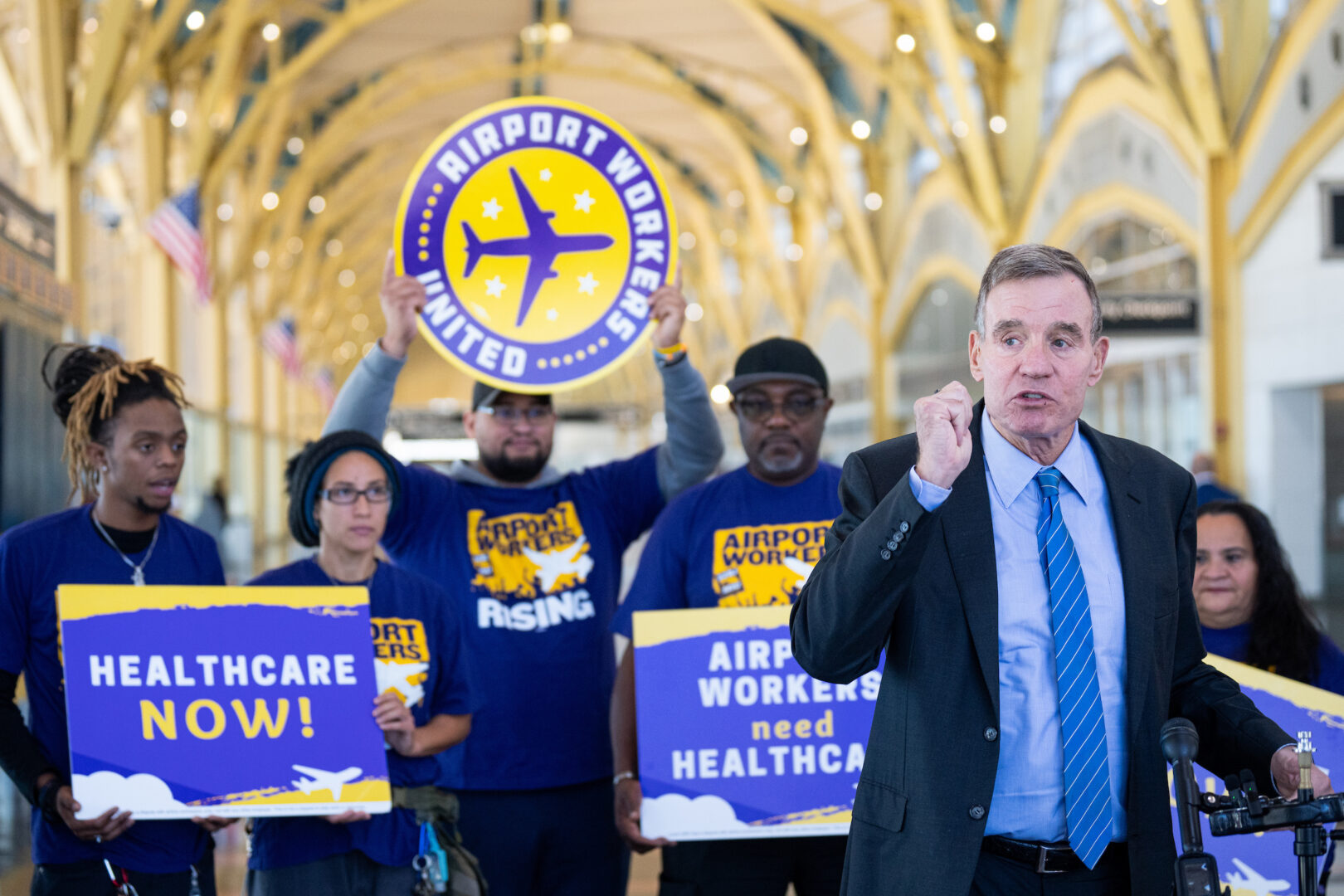
Democratic Sen. Mark Warner of Virginia is leaning into a major expansion of U.S. health insurance coverage as he prepares for what’s likely to be his final term in office, in contrast to his earlier years on Capitol Hill marked by a more centrist approach to health care.
With health coverage for airport workers being debated in Richmond, Virginia’s capital, Warner was on hand Wednesday at Ronald Reagan Washington National Airport to help press for affordable care in light of cuts made to federal aid under the July 2025 reconciliation law.
At a news conference hosted by the 32BJ SEIU property service workers union, Warner advocated for universal health care, saying that effort could take many forms, including Medicare-for-All, requirements for universal coverage through private insurance or other options.
“All these workers go without health care when they get sick,” Warner said. “They’re going to show up for the emergency room and those costs — that’s the most expensive place to access health care — those costs are going to be simply passed on to those of us who have private insurance. It doesn’t make sense.”
Warner is running for reelection in November against GOP candidate Bert Mizusawa, a retired Army major general and Pentagon official, to what he’s said will be his final term. Inside Elections with Nathan L. Gonzales considers Warner a safe bet, ranking the race Solid Democratic.
‘A check and a smile’
The senator’s comments Wednesday came at an event hosted by the union to advocate primarily for state-level legislation in Virginia to support airport workers who have no health care or are at risk of losing their care. The efforts are focused around airport service workers, including wheelchair agents, ramp workers and baggage handlers.
Warner said he supports the group’s efforts and would try to weigh in on the matter in Richmond. But the issue of health coverage is a national one with less than a month before the midterms, and Democrats nationwide are using the time to contrast their policies with the cuts imposed by President Donald Trump’s budget package Republicans initially called the “big, beautiful” bill.
A 32BJ SEIU survey of airport service workers at Dulles International Airport as well as Reagan National showed that 44 percent reported having no health care, while those who have coverage rely overwhelmingly on government programs including Medicare and Medicaid. Ninety percent of workers surveyed who reported having coverage rely on these programs, the union said.
One of the workers present Wednesday, Cameron Hansberry, works as a baggage handler for one of the contractors at DCA. He said in an interview that he is a double liver transplant recipient who will soon lose the insurance coverage he currently gets through his parents’ plan.
After that happens, he is not sure how he will pay for his anti-rejection medication and other treatments required to maintain his health. He said he is unable to receive health care through work.
“Aviation as a whole is a very strict system. They’re very stringent on time and safety, and the Federal Aviation Administration is not playing with a lot of people,” he said. “The fact that you have — everyone’s lives depend very heavily on you guys, you would think that they would give us more than a check and a smile.”
Affordability has been a major concern for voters this election cycle, with consumers across the country contending with rising costs for everything from health care to groceries, electricity and gasoline.
Hansberry said the stress over losing his health care coverage also comes on top of wages that he said were not keeping pace with rising expenses in other areas.
“It’s just not sustainable,” he said. “You work to sustain yourself. If it’s not sustaining yourself, there’s no point in really working.”
Delayed impacts
The reconciliation law established new requirements to receive coverage, including Medicaid work requirements and eligibility restrictions that go into effect on Jan. 1.
Warner noted that the cuts to the health programs were enacted last July, “but they made the cuts to Medicaid only effective after the election.” He said the timing had to be “because voters are totally against these cuts.”
Cuts to projected Medicaid spending over a decade under the GOP law are estimated at roughly $1 trillion.
Further, Republicans allowed expanded tax credits to purchase health insurance on the Affordable Care Act exchanges to lapse in January, shrinking projected health care subsidies by another $350 billion over 10 years.
Warner introduced a bill last month that would reverse the GOP law’s Medicaid cuts and restore the larger ACA premium tax credits.
He said Wednesday that hundreds of thousands of Virginians could lose coverage as a result of the cuts, in addition to tens of thousands more who dropped benefits when the expanded ACA credits expired.
‘Real change’
Warner, a prolific fundraiser with no outward presidential ambitions or designs on a top party leadership slot, is facing Virginia voters for the last time in a state that has swung back and forth since he first won his Senate seat in 2008 — the year a Democratic presidential candidate, Barack Obama, turned Virginia blue for the first time since 1964.
The electorate has evidently shifted further left on health care since his last serious challenge in 2014, when voters had soured on “Obamacare.” Warner won that year’s race by less than 1 percentage point against Ed Gillespie, a former Republican National Committee chair and adviser to President George W. Bush.
Whereas Warner had a hand in drafting the ACA and endorsed what was considered a dramatic expansion of federal coverage at the time, he held back support for a more ambitious role for government, declining to endorse a public insurance option to compete with private insurers.
But as his party has increasingly pushed for a bigger government program, Warner has adapted.
The bill he introduced last month to repeal the “big, beautiful” GOP cuts would go further. Some provisions include:
- Requiring the Department of Health and Human Services to create a “low-cost” public option.
- Reinstating the ACA’s higher federal match when states expand Medicaid and apply it retroactively.
- Increasing Medicaid assistance for states and territories experiencing economic downturns.
- Adding hearing aid coverage to Medicare.
- Expanding the number of prescription drugs subject to Medicare price negotiation.
“It’s time for America to move towards universal health care,” Warner wrote in a Substack piece this week touting his new bill. “Let’s fight for real change. Let’s get this done and then get to universal coverage.”