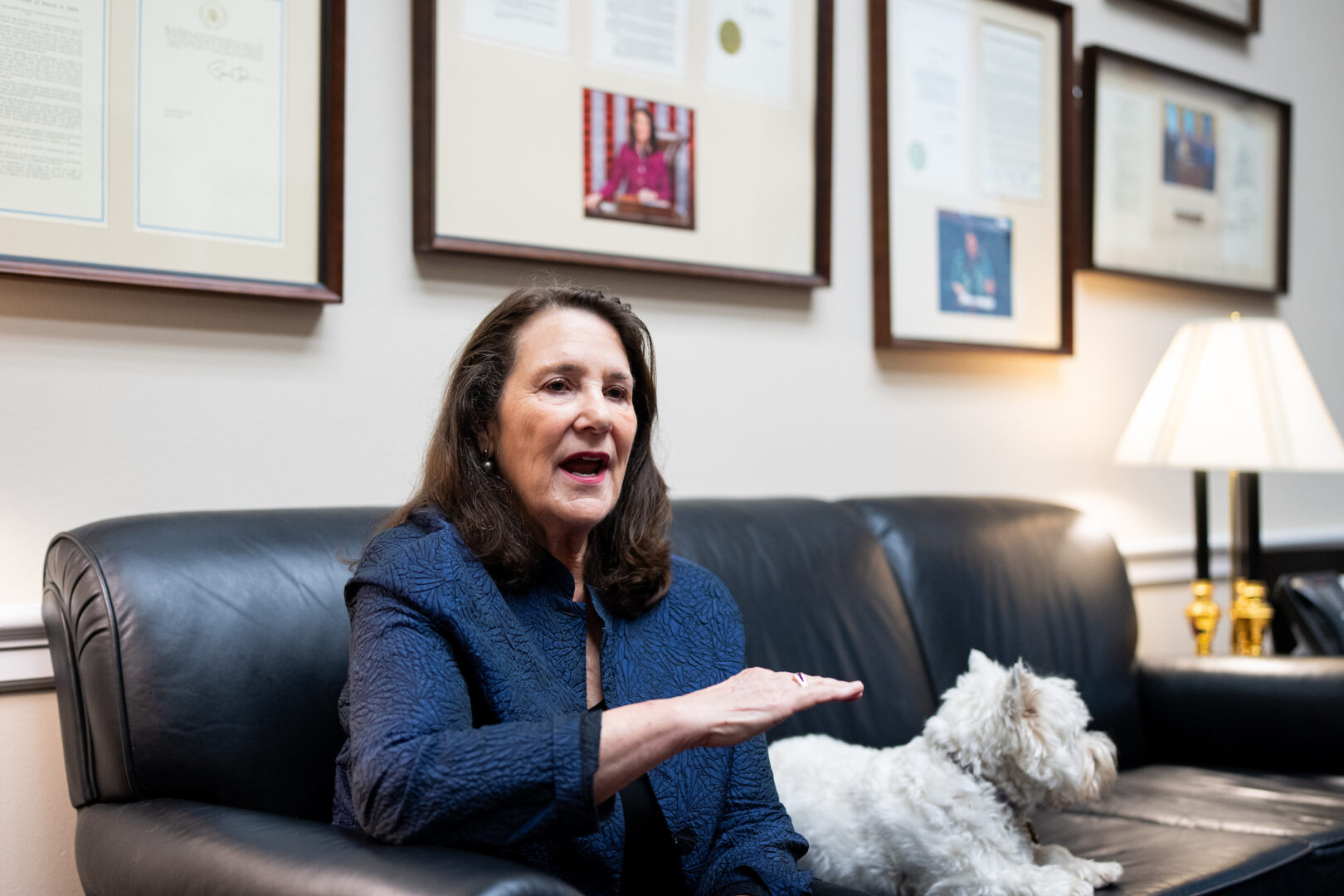
Rep. Diana DeGette has a message for the new blood in the Democratic Party. The wave of hard-left candidates who are eyeing seats in Congress will face a stark political reality if they pursue a premature and overly ambitious health care agenda right off the bat. “All of these radicals who are coming to the House, thinking they're going to be able to pass a very broad bill like Medicare for All right away, they're going to run into a brick wall immediately,” the fourth-generation Coloradan said in a wide-ranging interview reflecting on her 30-year tenure on Capitol Hill. Much of her career was focused on health care policy, an area where big changes weren’t won in a day. The message might not be one some Democratic voters want to hear — the incoming crop of far-left lawmakers may be in for a comprehensive process that requires planting the right seeds and building coalitions. Some have attributed DeGette’s summer primary loss to a push for youth — her voter base has trended younger — or the acceptance of PAC money. But voters may have felt she lacked progressive bona fides despite, by many measures, her strong progressive record on health care: key parts in negotiating the Affordable Care Act and expanding the Children’s Health Insurance Program. She says she would’ve been pushing for more this past Congress, had there been the opportunity. But “less informed” voters may not understand that the minority party, which Democrats have been in the House since 2023, doesn’t have much say in legislation that comes to the floor. “If I could pass Medicare for All unilaterally in the minority, I would do it, because I'm an original co-sponsor of that bill. But the frustration people are feeling is with the whole system,” said DeGette, the ranking member of the House Energy and Commerce Health Subcommittee. DeGette was referring to legislation introduced by Rep. Pramila Jayapal, D-Wash., with over 100 co-sponsors, in April 2025. She views the idea as a worthy goal, however, and hopes congressional leadership will understand how frustrated Americans are about health care prices, and will "really start putting together a package to move us towards affordability." It's unclear how much influence the progressive wave will have. Democrats are currently in the process of landing on their next big health care proposal, though they have yet to come to a consensus on what it should be. Some have floated lowering the age of Medicare eligibility or creating a public health insurance option. House Minority Leader Hakeem Jeffries, D-N.Y., earlier this year convened a health affordability working group, led by Reps. Terri A. Sewell of Alabama and Alexandria Ocasio-Cortez of New York. The group submitted its report to leadership last month, containing wide ranging proposals for Medicare for All; expanding Medicare coverage to vision, dental and hearing; and bolstering the health care workforce. Major wins Among her first forays into health policy came as a freshman lawmaker in 1997, when she was an original co-sponsor of legislation that became the basis for the original State Children’s Health Insurance Program, or SCHIP. Run by states, the program provides low-cost or free coverage to children whose families can’t afford private insurance but are above the threshold to qualify for Medicaid. Congress dropped the "S" in the 2009 expansion measure, and now the program is just known as CHIP. “The CHIP program now is just accepted by everybody, but back then, it was really innovative,” she said in an interview last week, accompanied by her West Highland terrier, Fiona, whom she dubs her “paw-licy” adviser. Later, when her younger daughter was diagnosed with Type 1 diabetes at age 4, DeGette got involved in the Congressional Diabetes Caucus. At the time, President George W. Bush issued an executive order limiting embryonic stem cell research as anti-abortion advocates opposed using embryos for such purposes. She led a bill, alongside former Rep. Michael N. Castle, R-Del. — who died last year — to remove restrictions on the research. While the bill was twice-vetoed by Bush, DeGette eventually worked with President Barack Obama on an executive order to restore the research. Now researchers at Harvard University are using the embryonic stem cells to make insulin-producing islet cells to find a cure, she noted. She also has championed the Special Diabetes Program, which authorizes funding at the National Institutes of Health for Type 1 diabetes. On her list of bills she’d like to see passed before she leaves Congress is one that would cap the out-of-pocket cost of insulin at $35 per month in commercial insurance. Sens. Susan Collins, R-Maine, and Jeanne Shaheen, D-N.H., are spearheading the effort in the Senate. Kudos across the aisle In a bipartisan showing at a markup in July, House Energy and Commerce Chairman Brett Guthrie, R-Ky., offered praise for DeGette’s career on health policy, noting her work on the 21st Century Cures Act. DeGette led the bill, which was signed into law in 2016, with then-House Energy and Commerce Committee Chairman Fred Upton, R-Mich. The law established new pathways for biologics and medical devices to come to market, and it created the FDA’s Oncology Center of Excellence, which brings together experts from across the agency to expedite reviews of cancer therapies. “It completely changed the way we do health care in this country, and brought treatments to the marketplace quicker during our last pandemic,” Guthrie said. “It wouldn’t have happened without your leadership. …Thanks for your hard work. It really is a legacy.” That kind of nuts-and-bolts policy that garners bipartisan support isn’t necessarily what voters will be looking for in the midterms and in 2028, David Kendall, senior health fellow at the centrist think tank Third Way, said in an interview. “She's done it all, and the sad part is that voters don't necessarily remember all that success,” he said. “Elections are about the future.” DeGette also had a heavy hand in negotiating the Affordable Care Act, Democrats’ signature health care achievement from the last few decades. Serving as vice chair of the Energy and Commerce Committee at the time, and as chief deputy whip, she helped spearhead the public option provision that was folded into the House version, but was ultimately stripped out by the Senate. “I think if we had been able to keep that in, we would have had much cheaper health care in this country today,” DeGette said. Shifting base DeGette’s voter base trends young. As of 2024, about 40 percent of Denver’s population was between the ages of 25 and 44, according to the U.S. Census Bureau, a higher proportion than the national average of about 27 percent. DeGette said that if she had retained her seat and served as chair of the Health Subcommittee at Energy and Commerce, she would have started to put together a coalition to craft a proposal for a single-payer health care system. While she declined to speak specifically about her opponent, 29-year-old democratic socialist Melat Kiros, she said that as the Democratic Party shifts to the left on health care, lawmakers need to work across the aisle. She sees an opportunity for the party to move on health care affordability, even if a bigger push for a single-payer system doesn’t come to fruition in the immediate future. “If you're going to be doing quality health care legislation, you should be able to do it in a bipartisan way,” she said. Third Way's Kendall said that voters who are feeling their health care costs go up are looking for “big, bold” leadership to address it. “Big stuff usually comes from one party or the other,” Kendall said. “The big stuff doesn’t usually come out of a bipartisan effort.” Kiros ran on a commitment to not accept corporate PAC money in her campaign and pledged not to support anyone for Democratic leadership who has done so. “It’s about political will — and that means we have to vote out any of the incumbents that are standing in our way by taking that kind of corporate PAC money,” Kiros told Politico following her win. Now and beyond With a few months left in Congress, DeGette says she’d like to get more of her health care bills over the finish line. One in the works, which she co-sponsored alongside Rep. Mariannette Miller-Meeks, R-Iowa, would create a national Hepatitis C elimination program. She also introduced a bill, co-sponsored by Rep. John Joyce, R-Pa., that would require Medicare Advantage to submit more data about its costs and services. The bill advanced out of the House Energy and Commerce Committee in July. Beyond Congress, DeGette said she has plans to stay in the health policy area but is still finalizing plans. “I'm already talking to some different think tanks and some organizations about how I could help impact health care policy at the national level,” she said.