He assassinated James Garfield. The story doesn’t end there
Upheaval of 1880s has lessons for today, say Candice Millard and Nick Offerman
At the beginning of the Netflix limited series “Death by Lightning,” about the rise and fall of President James Garfield in 1880–81, his soon-to-be assassin tries to excuse his checkered past before the parole board of the infamous New York prison known as “The Tombs.”
“Are we not a nation built wholly from rogues and migrants and freethinkers?” Charles Guiteau proclaims, with a phrase that might be used to sum up America’s entire history as its 250th birthday approaches on July 4.
Even though Guiteau was considered to have mental illness, his character and that of the 20th president provide insights relevant to almost any period in U.S. history, but especially today as another major test of democracy’s strength plays out, according to the author of the book that inspired the four-part series.
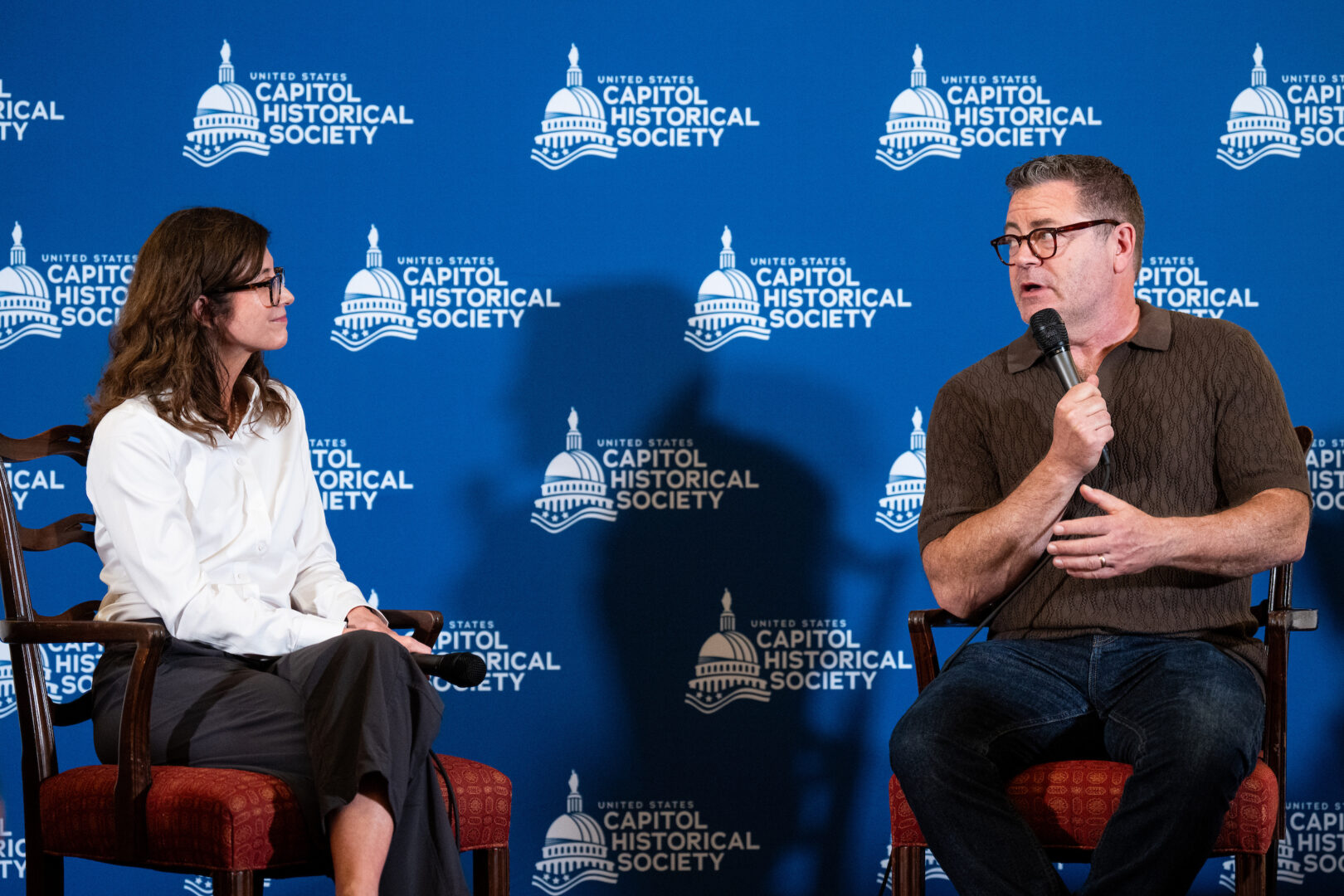
Garfield personified the American ideal of a politician who rose to power without seeking it and responded by trying to “do some good things” once in the White House, said “Destiny of the Republic” author Candice Millard, joined by actor Nick Offerman at a U.S. Capitol Historical Society discussion last week.
The congressman, played in the series by Michael Shannon, had gone to the 1880 Republican National Convention in Chicago as campaign manager for a fellow Ohioan, Treasury Secretary John Sherman. But after giving a speech that included a call that “all men, white or black, shall be free, and shall stand equal before the law,” Garfield himself was drafted for the nomination and went on to defeat Democrat Winfield Hancock in November.
“Garfield was really an extraordinary president in a lot of ways, but part of it was because he had never intended to become president, and so he had never kind of compromised his values, his ideals, his principles along the way,” Millard said.
“He was incredibly progressive, he was kind, he was modest, he was a decent human being,” she said. “He described himself as a poor hater, which I think is really a wonderful thing to be.”
Just the opposite kind of character was Guiteau, a Midwesterner with a sense of entitlement who constantly tried to shortcut his way to success through fraud, theft and deception. He is portrayed in “Death by Lightning” by actor Matthew Macfadyen.
“He was a guy who tried everything and failed at everything,” Millard said. “He tried law, he tried journalism, evangelism, he tried a free-love commune. He failed even there.”
Guiteau backed former President Ulysses S. Grant for a third term in the White House in 1880, mainly because Grant had established a strong patronage system for federal jobs when he was president from 1869 to 1877. Guiteau wrote a speech supporting Grant, thinking it would be his ticket to a top post in the government, Millard said.
When Garfield topped Grant for the Republican nomination, Guiteau simply changed the names of the candidates in his speech and had hundreds of copies printed up after the convention in Chicago.
“He has these sort of delusions of grandeur,” she said. “And he thinks that if he gives even one speech for Garfield and Garfield wins, then ‘Thank you, spoils system! I would be happy to take the ambassadorship to France.’ I mean, really, he thinks that. And so when Garfield wins, Guiteau goes to Washington and begins to stalk him, and he becomes more and more caught up in his own madness.”
After being repeatedly rejected by Garfield’s staff, Guiteau buys a pistol on borrowed money, waits for Garfield to show up at a Washington train station for an announced vacation trip in July 1881 and shoots him twice — once in the arm and once in the back.
Garfield survived for nearly three months, but ultimately succumbed after doctors bungled his treatment and infected him with sepsis. Guiteau was tried for murder and hanged at the D.C. jail in June 1882.
There is one other key character in “Death by Lightning” who provides an example of a politician who goes from being considered an agent of corruption to an agent of change.
Chester A. Arthur spent years as an enforcer of Grant’s patronage system at the power-laden Port of New York, but was tapped as Garfield’s running mate to help unite factions of the Republican Party. His political leanings were divided as vice president, to the point where he asked Garfield to fire him for being disloyal, but Garfield stuck with him.
Then after Garfield was shot, Arthur struggled with the prospect of becoming president, and only came around after a young shut-in from New York, Julia Sand, wrote him letters of encouragement, said Offerman, the actor who played Arthur in the series.
“Listen, buddy, it’s time to put your head on straight and stand up and be a big boy,” Offerman said Sand told Arthur in a series of letters. “The nation needs you. This is your chance to be a good man and lead our country.” Arthur went to visit Sand, “and somehow her sort of affirmation spoke to him,” he said.
“Chester Arthur was the best part of the show because he had the most sort of emotional arc,” Offerman said. “I got to play a lot of different colors of humanity.”
Arthur went on as president to eliminate the patronage jobs he once doled out and helped establish the civil service system that is the backbone of the federal government today.