At the Races: Keystone State holds midterm keys

Welcome to At the Races! Each week we bring you news and analysis from the CQ Roll Call campaign team. Know someone who’d like to get this newsletter? They can subscribe here.
We’ve entered a two-month stretch of primaries that will set key matchups for November and offer clues about where each party’s base is roughly six months until the midterm elections.
Pennsylvanians go to the polls in less than two weeks, and Democrats see the state as an opportunity to win back voters they lost in 2024, when Donald Trump carried the state, Dave McCormick unseated a Democratic senator and Republicans flipped two House seats. With Gov. Josh Shapiro at the top of the ticket, Democrats argue, it could be a chance for the party to bounce back in the Keystone State.
While Democrats are targeting four Republican-held House seats, just one of those has a competitive primary this month. Four Democrats are facing off in the 7th District to take on Republican Ryan Mackenzie, who flipped the Allentown-based seat in 2024 and is one of the most vulnerable members in the country.
Bob Brooks, a retired firefighter and union leader, has earned endorsements from Shapiro as well as Sen. Bernie Sanders, showing support from across the party’s ideological spectrum. He’s one of several candidates in competitive primaries who this week was named to the DCCC’s “Red to Blue” program for promising recruits.
That led to pushback from some House Democrats and candidates who are still running. Former federal prosecutor Ryan Crosswell, the leading Democratic fundraiser in the 7th District at the end of the first quarter, said voters are skeptical of Brooks’ candidacy.
“The more voters learn about him, the more trouble he’s in,” Crosswell said in a statement. “And that’s why his establishment backers are pouring dark money into the race.”
Brooks on Thursday hit back against “MAGA Dark Money” directed against his campaign, citing spending by a super PAC that ostensibly supports another primary rival.
“Any Democrat who fails to condemn attacks funded by Donald Trump’s allies is unqualified to be the Democratic nominee in this race,” he said in a statement.
Elsewhere in Pennsylvania, Democrats are also hoping to unseat Republican Reps. Brian Fitzpatrick, Rob Bresnahan and Scott Perry. The party has largely consolidated behind their expected Democratic opponents, although Republicans remain optimistic about their chances in all four battleground races, pointing to engaged incumbents with strong fundraising.
Democratic voters in Philadelphia are also set to pick the successor to retiring Rep. Dwight Evans in the 3rd District on May 19.
Starting gate
Redistricting roundup: Tennessee Republicans on Thursday passed a new congressional map, which splits Memphis three ways to give the GOP the chance to win all nine of the state’s House seats. Meanwhile, Louisiana Gov. Jeff Landry postponed the state’s House primaries, which had been scheduled for May 16, to give legislators more time to redraw the state’s congressional map after the Supreme Court invalidated it last week. And Florida Gov. Ron DeSantis signed the state’s new House map, which could give Republicans the chance to flip four seats. Legal challenges have since followed.
Show me the money: Meanwhile, the DCCC said it saw its best fundraising stretch of the year so far in the roughly 48 hours after the Supreme Court invalidated Louisiana’s map and limited the scope of the Voting Rights Act, suggesting the decision may have energized the party’s base.
Election night: Tuesday was primary day in Ohio and Indiana. Republican voters in the Buckeye State’s battleground 9th District chose former state Rep. Derek Merrin to take on longtime Democratic Rep. Marcy Kaptur, setting up a rematch of their 2024 contest. Another significant Ohio contest was officially set Tuesday, with Democratic former Sen. Sherrod Brown taking on appointed Republican incumbent Jon Husted in the race to fill out the remainder of Vice President JD Vance’s term. Next door in Indiana, Trump’s push to punish state senators who rejected his redistricting effort yielded results, with five of the seven who were targeted by Trump losing their reelection bids, and a seventh race still uncalled as of Thursday afternoon.
Georgia special: Voters in Georgia’s deep-blue 13th District will head to the polls on July 28 to pick a successor to the late Rep. David Scott, who died last month at 80. His daughter, Marcye Scott, is running in the special election.
Election Day debate: The Supreme Court’s work for the term is far from over, and midterm watchers will be keeping an eye out for a decision on whether the federal Election Day statute should mean that’s the actual deadline for receiving ballots. Our colleague Michael Macagnone has more on that case and the rest of what remains on the justices’ to-do list.
ICYMI
Biden’s back: Former President Joe Biden waded into the midterm conversation with endorsements of former members of his administration: Keisha Lance Bottoms, who is running for governor of Georgia, and Dan Koh, who is seeking the open 6th District seat in Massachusetts.
Endorsements: Leaders We Deserve, which backs young progressives, has endorsed Sacramento City Councilmember Mai Vang in her primary challenge against Democratic Rep. Doris Matsui in California’s 7th District. The Congressional Black Caucus endorsed Denise Powell in Nebraska’s 2nd District, saying she can protect the state’s coveted “blue dot” electoral vote. BOLD PAC, the campaign arm of the Congressional Hispanic Caucus, is backing West Sacramento Mayor Martha Guerrero in the crowded race for California’s open 6th District. Former Transportation Secretary Pete Buttigieg is supporting former Hartford Mayor Luke Bronin in his primary bid against Democratic Rep. John B. Larson in Connecticut’s 1st District. Both Bronin and Buttigieg have similar backgrounds as Rhodes scholars, Navy intelligence officers and former mayors of mid-size cities. And in Michigan, former Sen. Debbie Stabenow and Colleen Ochoa Peters, the wife of retiring Sen. Gary Peters, both backed Democratic Rep. Haley Stevens’ Senate bid.
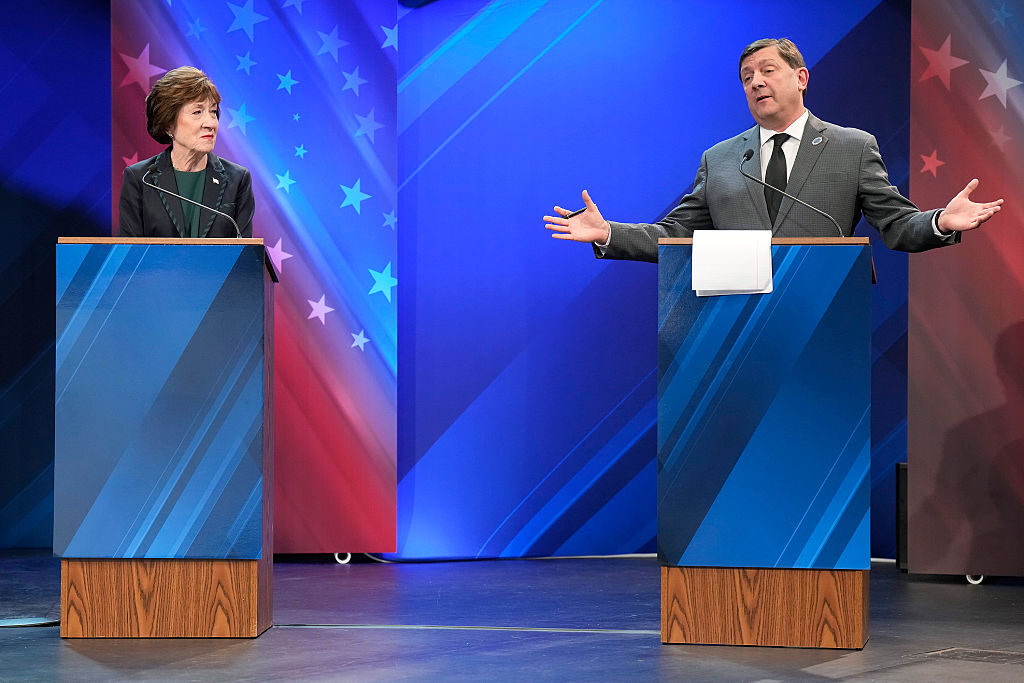
#MESEN: Maine Sen. Susan Collins, who is seeking a sixth term, told News Center Maine that she has a benign essential tremor, which she treats with medication. Collins said the tremor has no bearing on her ability to do the job. Meanwhile, her campaign released its first ad of the cycle, which highlights her work to secure federal funding to replace the Eastport Breakwater. Graham Platner, the presumptive Democratic nominee, released a new ad attacking Collins for “performative politics.”
Ad watch: One Nation, the nonprofit arm of Senate Republicans’ super PAC, launched a six-figure digital advocacy campaign focused on law enforcement and border security, with ads running in Alaska, Georgia, Michigan, Ohio and Washington, D.C.
Nathan’s notes
Republicans and Democrats are locked in a redistricting battle for the ages, and there’s bipartisan complaining about various parts of the process, Roll Call elections analyst Nathan L. Gonzales of Inside Elections writes.
But to find a solution, both sides would need to agree on one definition of what constitutes “fairness,” according to Nathan.
What we’re reading
#NY12: New York magazine examines the four leading candidates in the race to succeed retiring Democratic Rep. Jerrold Nadler. The race for the Manhattan-based 12th District got even more expensive last week, when, as The New York Times reports, tech billionaire Chris Larsen said he would spend $3.5 million to boost state Assemblyman Alex Bores, whose presence in the race has sparked significant spending by the AI industry.
From the Markeyverse to Tehran: The Globe Magazine goes long on the strange political journey of Calla Walsh, a onetime campaign wunderkind who was part of Massachusetts Sen. Edward J. Markey’s volunteer army in 2020. She now lives in Lebanon, “where she spends her days amplifying the communiqués of the Iranian proxy militia Hezbollah and cheering the deaths of US soldiers to her more than 72,000 X followers.”
Political trading: NPR reports on the ethically slippery — and potentially illegal — practice of campaign staffers placing bets based on inside information. One anonymous campaign worker told the outlet about a bet based on an unreleased poll. “Myself and others started placing bets before that poll came out,” said the staffer. “And then, sure enough as soon as that poll came out, the stock went up and everybody made money.”
Abortion politics: While 2028 Democratic presidential contenders spoke out last week after a federal court temporarily curbed access to the abortion drug mifepristone by mail, The Washington Post reports that many congressional candidates didn’t immediately weigh in, even as some Democrats see a chance for a renewed political focus on abortion.
The count: 25 percent
That’s the percentage of Americans who said states should be allowed to draw congressional districts to help minority candidates get elected, according to a May 1-4 Economist/YouGov poll.
Forty-three percent of survey respondents were opposed, and 32 percent weren’t sure, the survey found.
Key race: #TX33
Candidates: The realities of redistricting are butting up against the political ambitions of two prominent Democrats in a redrawn House district in North Texas. Rep. Julie Elizabeth Johnson and former Rep. Colin Allred are competing in a May 26 primary runoff after neither candidate cleared the 50 percent threshold in the first round of voting on March 3.
Why it matters: Allred, a civil rights attorney and former NFL linebacker, was first elected to Congress in the 2018 blue wave, unseating longtime Republican incumbent Pete Sessions in the 32nd District. He held his seat for three terms but left to run for Senate in 2024. Johnson, a former state representative, succeeded him.
After Allred’s run against Sen. Ted Cruz fell short, he launched a second Senate bid last year, this time against Sen. John Cornyn. Allred later dropped out of that race, endorsed Rep. Jasmine Crockett and pivoted back to running for the House.
There’s another wrinkle to the race between Allred and Johnson: The Texas legislature, at Trump’s urging, redrew the state’s congressional map last year, shifting a deep-blue chunk of the 32nd District into the neighboring 33rd, which is currently held by retiring Democratic Rep. Marc Veasey. Johnson opted to run in the 33rd, which Kamala Harris would have carried by 33 points in 2024, according to calculations by Inside Elections. And so did Allred, setting up a clash between the incumbent and her immediate predecessor. More than 70,000 voters cast ballots in the first round, with Allred netting 44 percent to Johnson’s 33 percent.
Cash dash: Allred raised $6.4 million through March 31 in his campaigns for Senate and House, while Johnson brought in just under $2.1 million. Heading into the final stretch, Johnson entered April with $487,000 in the bank, while Allred had $679,000.
Backers: Johnson, the first openly LGBTQ member of Congress from a Southern state, has the support of the political arm of the Congressional Equality Caucus, EMILY’s List, House Democratic leadership and more than 50 of her House colleagues. Allred has Crockett’s endorsement, as well as that of the Texas AFL-CIO’s Committee on Political Education.
What they’re saying: The race between the two Democrats has been combative. Allred has attacked Johnson for trading stocks from Palantir Technologies, the federal contractor that has been key to implementing the Trump administration’s immigration policies. “Voters can’t trust Julie Johnson to hold Trump and ICE accountable because they make her too much money,” Allred’s campaign says on its website.
Johnson has painted Allred’s tenure in the House as ineffective, saying he only launched his run after his Senate ambitions fizzled. “He views the district as a consolation prize,” her campaign states. “Women only make up 28.5% of Congress, but Colin Allred thinks women are placeholders for men who have failed to advance.”
Terrain: The redrawn Dallas-centred district is deep-blue. Whoever wins the primary would be heavily favored to win the seat in November.
Wild card: Voting in March was marred by chaos, with at least 12,674 Dallas County voters showing up at the wrong polling place after local Republican officials forced the elimination of countywide polling sites on Election Day, according to an analysis by Votebeat.
In addition to the potential for voter confusion, the runoff falls on the Tuesday after Memorial Day, and turnout is expected to be low.
Coming up
Primary elections continue next week with voters in Nebraska and West Virginia picking their nominees for the November elections.
Photo finish
Subscribe now using this link so you don’t miss out on the best news and analysis from our team.