Trump’s trip to China doesn’t move the needle on low approval ratings
Oil rose again on Monday with no Hormuz deal in sight
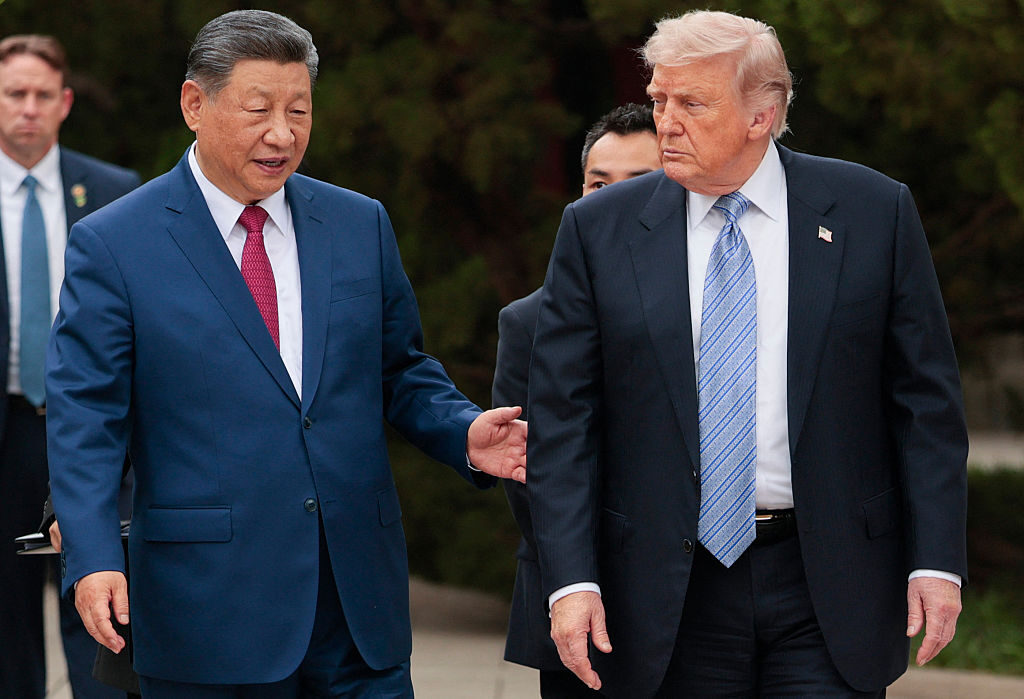
President Donald Trump returned from China with few concrete wins, and his refusal to owe Xi Jinping a favor in return for the Chinese president’s help reopening the Strait of Hormuz highlights his lack of a plan to ease Republicans’ gas prices concerns as Democrats hammer his 79-day-old conflict.
After a quick two days of meetings, dinners and garden tours in Beijing, the U.S. leader returned home for a weekend of golfing at his Sterling, Va., club near Washington. After departing China, he revealed to reporters on Air Force One that the subject most on the minds of American voters — how the war is impacting prices at home and how Xi could help — didn’t come up. Oil prices rose again on Monday, as of midday, as a new trading week opened with the strait still largely shuttered and no deal in sight.
“I’m not asking for any favors. Because when you ask for favors, you have to do favors in return and we don’t need favors,” Trump said after a reporter asked if Xi offered any firm commitment to pressure Iran to fully reopen the strait, a key global energy chokepoint.
So far, Trump has been unwilling to engage in the kind of global horse-trading that might entice third-party countries to try convincing Tehran’s current leaders to cease attacks on ships that attempt to traverse the strait.
Speaker Mike Johnson on Sunday suggested Trump could have strategically stumbled by denying Xi’s offer to help get the Strait of Hormuz fully operational again. Energy analysts have said that would have a major influence on lowering gasoline and diesel prices, which drive up the costs of other goods as companies’ transportation costs skyrocket.
“Well, that would be a concern, if it’s true, and I think we’re trying to sort all that out,” the Louisiana Republican told “Fox News Sunday.”
He then appeared to try giving Trump some cover, but ended his answer with a call for cooperation to find a resolution to the conflict.
“Iran is the largest state sponsor of terrorism, okay? They have wreaked havoc around the world. They’ve killed hundreds of Americans over the last few decades,” Johnson said. “We’ve got to make sure that we get that sorted out, and every freedom-loving person around the world and all of our NATO allies, and, of course, the Middle Eastern neighbors over there in that region have a direct interest in that. So we should all work together to get it done.”
On the conflict, 64 percent of those surveyed for the New York Times-Sienna poll released Monday morning said the Iran war was a mistake — including 73 percent of the key independent voter bloc. Notably, 70 percent of respondents who identified as Republican supported Trump’s military action, while 93 percent of Democrats called it a mistake.
On the strait’s closure, “this is the big one,” Samantha Gross, director of the Brookings Institution’s Energy Security and Climate Initiative, said on a recent podcast for the think tank. “Whereas what Iran has shown in this conflict is they can easily close the strait, and also they can close it selectively. … But a few drones, some missiles, some small attack boats, a lot of threats and occasionally making good on it means that [commercial] boats can’t insure themselves, and so they don’t go through the strait because they can’t get insurance.”
Meantime, Trump and White House officials offered vague explanations of what was discussed and agreed to, with Trump also contending he shut down Xi’s desired chat about whether the administration would defend Taiwan should conflict erupt there.
Trump defended his coyness as strategic, but new polling suggests voters have become increasingly frustrated by his war in Iran and its economic tentacles. Collectively, Trump’s China trip appeared to do little to reverse his shortening political coattails heading into general midterm elections in November and voters’ views of the health of the economy.
His approval rating fell to 37 percent in the Times-Siena poll, a second-term low. Such surveys less than six months from a midterm election have historically been a guide for how a president’s party will perform.
In a blow to Trump and GOP candidates, 76 percent rated the state of the economy as fair or poor, with 22 percent calling it good or excellent. Almost half (49 percent) called the health of the economy poor.
Trump himself has described warmer U.S.-Sino relations, especially a more balanced trading relationship, as a way to rev up the American economy.
U.S. Trade Representative Jamieson Greer was asked Sunday on “Face the Nation” by CBS moderator Margaret Brennan to respond to a piece from the conservative Wall Street Journal editorial board that criticized Trump’s China talks.
“Mr. Trump boasted about fantastic Chinese purchases of U.S. soybeans and aircraft, but China didn’t confirm the sales,” the WSJ board wrote. “And, by our count, this is the second time China has bought the same American soybeans. Or is it the third?”
Brennan inquired whether team Trump was playing “a shell game here” and called the descriptions of alleged agreements “vague.”
Notably, Greer did not point to any new deals secured last week in Beijing — just the possibility of one.
“So we have the existing soybean deal that they may be referring to. And then, over and on top of that, we have these agricultural products, as well. And all of that will be facilitated by Board of Trade discussions with the Chinese,” he said, referring to a U.S.-China working group Trump and Xi agreed to establish, one of the visit’s few concrete developments.
Some Democratic lawmakers criticized the trip for both its lack of what diplomats call “deliverables” and what some saw as a potentially dangerous transfer of U.S.-made artificial intelligence chips to Chinese companies.
“When NVIDIA’s billionaire CEO received a last-minute invite to board Air Force One in Alaska, we all knew what was coming. As he continues to lose his self-inflicted trade war with China, President Trump is handing Xi Jinping some of our most advanced AI chips,” Massachusetts Democratic Sen. Elizabeth Warren said in a statement, referring to NVIDIA head Jensen Huang.
“That might help the president curry favor with Xi or NVIDIA’s billionaire CEO, who is helping to bankroll the Trump ballroom. But it also gives NVIDIA a green light to prioritize China over U.S. customers,” she added, calling a potential China-NVIDIA deal “a disaster for long-term American prosperity and security.”
While China and the tech giant have not announced any new deals since Trump departed Chinese soil, the U.S. president on Friday left the door very much open.
“It didn’t come up, but as you know, Jensen was there. He’s an amazing guy, NVIDIA. … He would be inclined, you know, they have much higher-level [chip] than the H-200, but the H-200 is good,” he said on Air Force One. “China needs it. And, so yeah, it came up. But we haven’t budged … because they chose not to. They want to try and develop their own. But it did come up. And I think something could happen on that.”