Sovereign wealth fund tax on AI companies unveiled by Sanders
Proposal envisions dividend payments, money for housing and other public needs
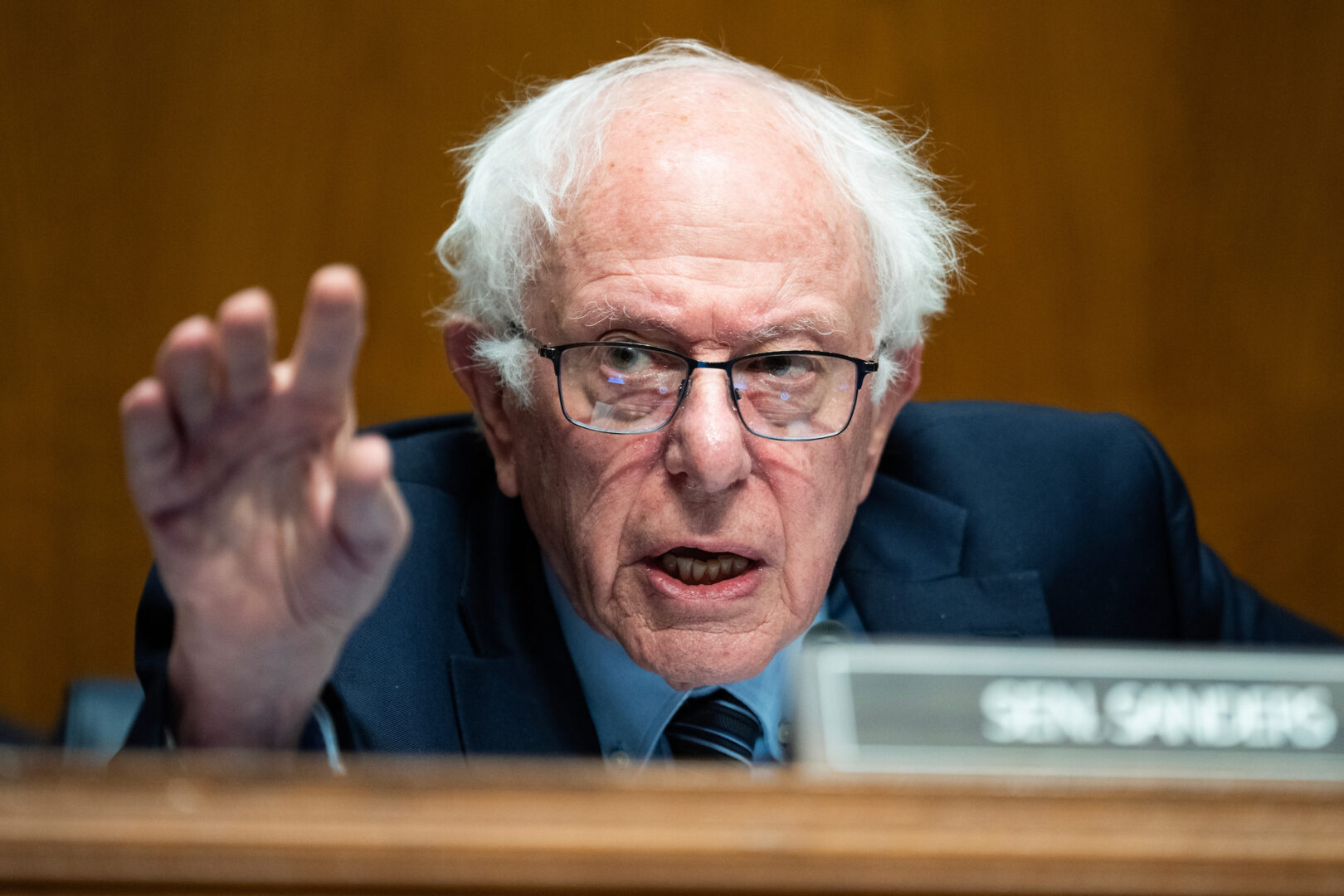
Newly released text offers details on legislation from progressive Sen. Bernie Sanders, I-Vt., for the federal government to take a 50 percent share in leading artificial intelligence companies.
The text of the as-yet unnumbered bill, released Thursday, would put a one-time tax on AI companies with more than $200 million in annual sales, to be paid in stocks. The resulting sovereign wealth fund would then be used to pay dividends to taxpayers and to fund social priorities like education, health care and housing.
The bill, titled the “American A.I. Sovereign Wealth Fund Act,” is unlikely to become law under Republican control of Congress, but the idea of creating a system for the public to benefit from AI profits has supporters within the industry and on both sides of the political spectrum.
Speaking to reporters on Thursday, Sanders said that by establishing public control over voting shares in AI firms, the bill would give “the American people the ability to prevent AI developments which will negatively impact their lives.”
Under the legislation, the fund would be overseen by a seven-member board appointed by the president and confirmed by the Senate.
“The decisions they make will be accountable to the public, which we do not have right now,” Sanders said, adding that board members could work to stop decisions that could lead to widespread job loss.
Sanders first previewed the bill earlier this month in an op-ed for The New York Times. At that time, he did not offer specifics on a size threshold for companies to be subject to the tax, or on how the federal government’s shares would be governed.
The bill would require companies that operate AI-related and non-AI elements of business to implement “structural separation” so that the tax would only be on AI businesses. It also contains rules to prevent companies from “from moving offshore to avoid the tax,” according to a summary.
The bill would authorize annual appropriations from the fund of 5 percent of the stocks’ average market value. Sanders estimated that initial annual dividends would be about $1,000 per person.
The fund would not be allowed to sell the stocks. Sanders said the appropriations would come from shareholder dividends, though he acknowledged that many AI firms are not currently profitable.
“Some people have some doubts about the potential financial successes of these companies,” he said.
The bill would ban using the fund to provide bailouts to AI companies.
Sanders said that while he has not spoken with the White House about his bill, he is in conversation with other senators. He pointed to what he said is a “growing understanding” across parties and chambers “of the consequences of AI and the need to do something.”
Trump’s ideas
The idea of a public stake in the AI industry has a supporter in the White House.
Earlier this month, President Donald Trump told reporters he’s meeting with AI companies “in the very near future” to discuss the possibility of federal government stakes in the firms.
“There’s so much money and it’s so big that there are concepts where pieces could be given to the American public, where the American public essentially becomes a partner,” Trump said.
The more general idea of using AI profits to benefit the public and potentially mitigate economic harms caused by AI has support within the industry.
In an essay last week, Anthropic CEO Dario Amodei wrote that “fast economic growth should create the tax base for shared prosperity.”
“If AI-driven labor displacement ends up being large in magnitude and permanently drives down the demand for labor, it will likely be necessary to go beyond mere incentive programs to long-term income support for a significant fraction of the labor force,” Amodei wrote. “Mechanisms such as universal basic income could be financed through taxes on relevant companies or raising the capital gains tax. Universal capital accounts offer another vehicle.”
OpenAI, whose CEO Sam Altman recently met with Sanders, released a plan earlier this year for “Industrial Policy for the Intelligence Age,” which it said would address societal risks from AI, including disruption of the workforce.
The company suggested the creation of a “public wealth fund” that “provides every citizen — including those not invested in financial markets — with a stake in AI-driven economic growth.”
Despite the possibility of industry support, Sanders said that conversations with AI executives are hindered by the companies’ ability to spend against their political opponents in elections.
He also said that he sees a need to go further than what Altman has advocated by giving the public “the ability to stand up and say no” to AI developments that could cause harm.