Dashed dreams for consensus group ahead of stock-trading vote
‘I’ll pray on it,’ one Republican member says
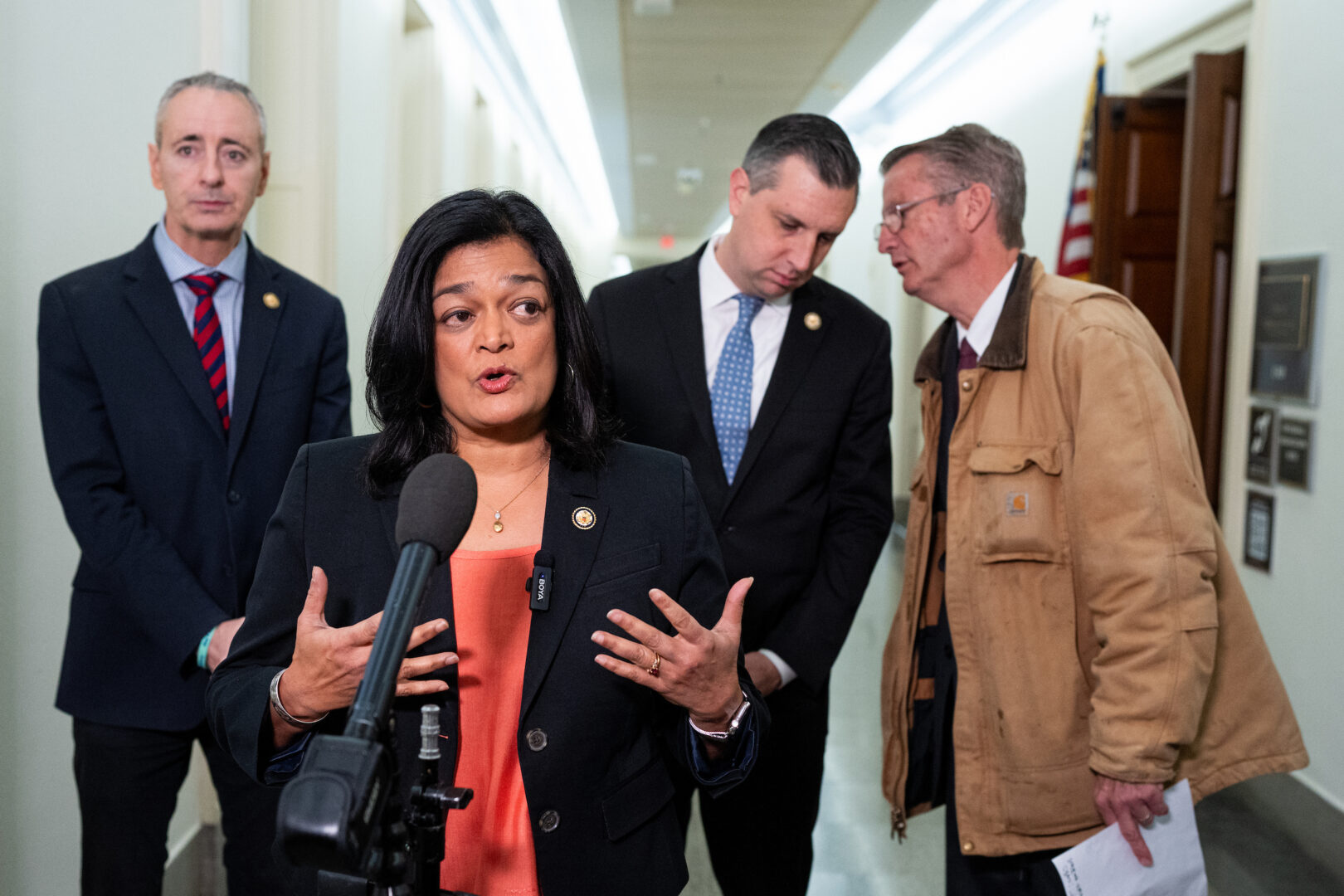
An upcoming vote on reining in stock trading by members of Congress is serving as a painful reminder of what could have been for a bipartisan working group who hoped to ban stock ownership by lawmakers entirely.
Members who spent months working on the effort described lingering frustration this week as a bill backed by Republican leadership heads to the floor.
“We had a bipartisan consensus bill that we had introduced that was ready to move forward. Instead, they’re doing something that they hope will make it seem like they’re addressing it — but they’re not addressing it at all,” said Rep. Pramila Jayapal, D-Wash.
Dubbed the Stop Insider Trading Act and led by House Administration Chair Bryan Steil, R-Wis., the GOP-led bill would prohibit members of Congress, their spouses and dependent children from buying new individual stocks. But unlike the consensus proposal, it would not require divestment of existing ones.
“It’s a terrible bill. It doesn’t ban stock trading in Congress or anywhere else,” said Rep. Seth Magaziner, D-R.I.
Complicating any shot at Democratic support, Republican leadership added unrelated language to the bill at the last minute that would require voters to produce photo ID at the polls, a signature issue for President Donald Trump. Even for members of the bipartisan group who want to see stronger voter ID requirements, it’s put them in a tough spot.
“I would rather it be a little bit stronger, but it’s a good bill, a good step forward that I’m proud to support,” said Rep. Chip Roy, R-Texas. “I would rather not have the SAVE Act on it because I’d rather just have a straight up or down vote on stock trading.”
Even before that, the stock-trading issue had taken a partisan turn, when Democratic leadership rolled out their own proposal at the end of last year that would ban stock trading not just for members of Congress, but also for the president and the vice president — a tougher sell for Republicans with Trump in the White House.
Jayapal pushed back on the idea that Democrats are to blame for the effort falling apart.
“The real problem was when the discharge petition was introduced by Anna Paulina Luna, who was not one of the group of us that determined the bill,” said Jayapal, referring to the Florida Republican who was among the original co-sponsors.
A discharge petition for the group’s bill was filed by Luna in December in an effort to sidestep leadership and force a vote on the floor. As of Tuesday, it has 84 signatures, short of the required 218.
“We all had within our group, Republicans and Democrats, had said we were willing to include the president. We were going to do it as an amendment to the bill because the most important thing was getting the members taken care of, and then if we could get the votes for the president, we would have done that,” Jayapal said.
“My general position is it ought to apply to everybody across all three branches, and that it ought to be as strong as it can be,” Roy said.
At least one Republican from the consensus group is still unsure how to vote on the bill on the floor this week — Rep. Tim Burchett, R-Tenn.
“I just have a lot of questions about the bill, and nobody seems to want to answer,” he said.
While Roy supports Steil’s bill, he said he knows it’s not what they originally wanted and understands the anger of some of his Democratic colleagues.
“I think if I were Seth [Magaziner], I’d be frustrated. We worked in good faith with some of our colleagues on the other side of the aisle on this, and had a good product that we were trying to work on together. I’m disappointed that it’s now going to be kind of a political vote rather than a straight up or down vote on stock trading,” Roy said.
Calls to ban stock trading in Congress over the years have repeatedly fizzled out, and the debate doesn’t fall neatly along party lines. Some members argue that existing requirements are enough to deter insider trading, while others are reluctant to give up a key source of income.
Despite the departure from the group’s original vision, Roy found a silver lining in the addition of the voter ID provisions.
“There are some of my Republican colleagues who don’t support it … who are now probably going to vote for it,” he said.
For his part, Burchett said he’s still conflicted about how to vote on what he sees as a watered-down version of a proposal he once championed and is unsure what it would take to change his mind.
“I’ll pray on it,” he said.