AI threats confront a Congress far from erecting guardrails
Consensus elusive as Trump remains opposed to regulation
In the wake of recent dire warnings from industry about the national security risks of frontier artificial intelligence models, lawmakers have been quick to express concern and call for industry or legislative guardrails.
But action before the midterm elections looks unlikely as neither party has coalesced around a legislative plan on AI, or even, in some cases, on the need for action by Congress.
At a press conference on Tuesday, Speaker Mike Johnson, R-La., said that concerns from the tech industry about AI wiping out humanity are overstated, following up on similar comments he made on Sunday.
“They can self-police, they can self-regulate. They don’t need the government to tell them to slow it down. If they want to slow it down, they should,” Johnson said. “But we cannot have a moratorium on the development of AI, okay, because then we will lose our edge to China.”
Meanwhile, President Donald Trump has called the issue a “hoax” and “sick conspiracy” on social media, in line with his opposition to action by Congress to impose restrictions on American artificial intelligence companies.
“The only control or ‘guardrails’ that AI needs is a STRONG AND SMART (High IQ!) PRESIDENT, and the U.S.A. has that, in spades!” he posted Monday, going on to add that “We already have tremendous CRIMINAL and REGULATORY power over these companies!”
Some safety-focused legislation has already been introduced, including a bipartisan measure from Reps. Jay Obernolte, R-Calif., with Lori Trahan, D-Mass., but no bill seems to have a critical mass of support.
Republican hesitancy
Johnson said Tuesday that he and Trump “are summoning” AI leaders to the White House for a meeting, possibly within the next week.
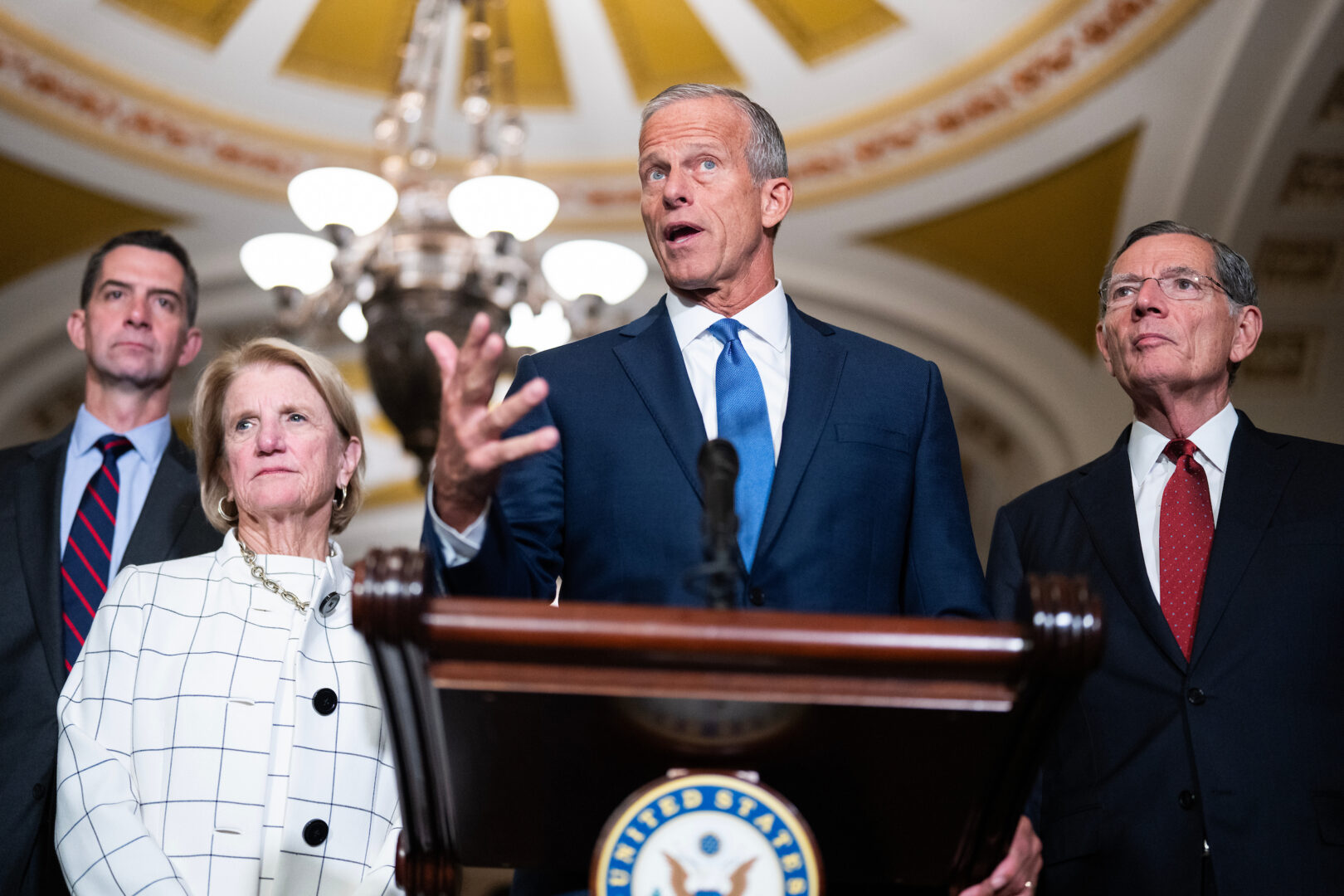
Action in the Senate is also uncertain. Majority Leader John Thune, R-S.D., told reporters Tuesday that he’s continuing to work with Sen. Amy Klobuchar, D-Minn., on an AI bill that he thinks is the “right approach.”
“But we’ll see if, with everything going on right now … if it gets any traction,” Thune said. That bill and its details have yet to be released, but builds upon similar legislation the duo advanced out of committee last Congress on AI innovation and accountability, aides said.
Majority Whip John Barrasso, R-Wyo., said discussions around AI are ongoing, but that “I don’t see a solution to the point that it’s going to have a vote,” noting the tight timeline this work period and pointing to other legislative priorities.
Senate Commerce Chairman Ted Cruz, R-Texas, who is also working on the Thune-Klobuchar bill, said his committee is “working hard” on a possible AI-focused markup, but added, “the question is, do we get bipartisan agreement?”
Commerce ranking member Maria Cantwell, D-Wash., is not part of those negotiations at present but has given feedback in the past. She has said she’s opposed to a light-touch approach and to state preemption if a federal standard is too weak.
“We need our colleagues to say, ‘Stop with saying the industry can do what it wants’ and let’s put together the infrastructure at the federal level that not only has strong federal standards, but also has independent testing and real safeguards for the American people,” she said from the Senate floor on Tuesday.
Republicans have emphasized the need for industry involvement in any federal standard.
Retiring Sen. Thom Tillis, R-N.C., pushed back on the “hoax” framing from Trump, but said that regulation should start as industry-led.
“I think the industry needs to get a kind of Manhattan Project going, figure out what they need to do to self-regulate, and then what they need in order to enable them to have a consequence if people fall outside of those regulations. … We could codify some of them,” Tillis said.
But despite the sense of urgency, the topic of AI regulation was not discussed in depth at the GOP’s policy luncheon on Tuesday, according to several senators.
Legislative options
Several bipartisan AI safety measures have yet to garner sufficient support to move forward to floor action, but more keep popping up.
The most overarching is the Obernolte and Trahan measure, which would require large frontier developers to establish public frontier AI frameworks, including information on whether a model could pose a “catastrophic risk.” The bill would also preempt certain state laws related to frontier AI risk transparency, incident reporting and third-party auditing and verification.
Speaking at an event titled the “Pro-Human AI Assembly” in Washington on Tuesday that also featured former Trump adviser Steve Bannon and Sen. Bernie Sanders, I-Vt., Trahan said that her bill should “just be the start.” She also said that the bill would put responsibility for AI safety within the Commerce Department “out in the open where the public can see it, rather than buried inside the national security apparatus.”
A draft version of the bill set a three-year span for more broad preemption language, but that language was narrowed and the time window was removed in the introduced version. The changes were made to address concerns raised by critics.
House Minority Leader Hakeem Jeffries, D-N.Y., on Monday pointed to Trahan’s work as an example of his party’s work on AI.
Sen. Josh Hawley, R-Mo., pointed to his bill with Sen. Richard Blumenthal, D-Conn., as a possible safety route. That bill would require the Energy Department to establish a program to test advanced AI and evaluate the risk of adverse incidents, including loss of control.
“I think the administration is doing some of this informally. which is good. I’m glad they are doing it,” Hawley said. “I’d like to put a little more process around it and firm it up so we know that it’s going to be done going forward.”
Democratic Caucus Vice Chair Ted Lieu, D-Calif., on Tuesday urged support for his bill with Rep. Nathaniel Moran, R-Texas, that would require powerful frontier AI models to have a “kill switch” and would also give the Department of Homeland Security new power to order model shutdowns.
“It’s based on a very simple principle, which is that humans must be in control of AI, not the other way around,” Lieu said. “And that means, at a minimum, humans have to be able to turn off any AI model or agent.”
Lieu also noted that Sen. John Kennedy plans to introduce his own kill switch measure in the Senate soon. The Louisiana Republican told reporters he planned to bring up his kill switch plan via a unanimous consent request on Wednesday.
“We persist in doing the dumbest thing possible that won’t work in terms of the issues that we want to address for the American people,” he said of his upcoming request. “I’m just going with a kill switch on AI, which isn’t regulation. Doesn’t put the government in charge of it.”
“This will address the second fear, what I call the Terminator,” he said.
It’s not clear what Johnson’s cautions against a “moratorium” on AI development are targeted at.
However, earlier this month, Sanders and Rep. Greg Casar, D-Texas, who chairs the Congressional Progressive Caucus, announced plans to unveil a bill that would ban artificial superintelligence and pause advanced AI development until a federal regulatory body is in place. Sanders told reporters on Tuesday that he expects to release text for the bill next week.
Speaking at the same event as Trahan, Casar said the measure would be “common sense national security” legislation.
“The answer is simple: we ban AI systems that are too powerful for humans to control,” he said.
The House Democratic Commission on AI and the Innovation Economy, which Lieu leads alongside Reps. Valerie P. Foushee, D-N.C., and Josh Gottheimer, D-N.J., doesn’t yet have a timeline on its AI recommendations, Lieu said Tuesday.
“We’re in process now, working with Leader Jeffries on a document that we’ll be going to caucus to consider,” Lieu said. Jeffries indicated on Monday that he expected conversations with the group this week.
Senate Minority Leader Charles E. Schumer, D-N.Y., told reporters on Tuesday that “There are many different ways to approach AI” when asked if he’d support some of these piecemeal efforts.
“We’re not going to get these done [if we] don’t do them in a bipartisan way,” he continued, also calling for Thune and the White House to hold a secure briefing for members in the Senate around the threats of the technology.
Part of the Congress’ possible slowwalking on providing a federal standard, some senators say, is also their misunderstanding of it.
“No,” Tillis said when asked if senators understand AI. “A lot of them can’t spell it.”
The description of state preemption provisions in the Obernolte-Trahan bill was corrected in this report.