As GOP revives anti-trans playbook, Dems try to turn the page
‘They’re running to win,’ one senator says of Democrats
Republicans are returning to a familiar 2024 playbook in the final weeks before the midterms, stoking fears about transgender people in sports, schools and beyond.
But this time, Democrats are striking back. Some candidates running in red states have tried to distance themselves from their party’s commitment to transgender rights. Others have taken a different approach, dismissing GOP attacks as a ploy to distract voters from the sputtering economy.
President Donald Trump has called denouncing trans athletes one of Republicans’ greatest “sound bites of all time” — and a strategy he wants to keep in reserve as November nears with control of Congress on the line.
“I don’t like to do it much before the election. I like to wait,” he said at this month’s GOP convention, because he is “petrified” that Democrats will change their messaging and say, “You know what? Men should not be playing in women’s sports.”
“And that will really hurt us,” Trump said.
Support for trans athletes has emerged as a growing fault line within the Democratic Party. While the number in high school or college interscholastic sports is vanishingly small, a Pew Research Center survey last year found that 73 percent of Americans were uncomfortable with the idea of athletes competing on teams that don’t match their sex at birth.
Democrats across the ideological spectrum, from California Gov. Gavin Newsom to House candidates running in battleground districts to Senate candidates competing in purple-shaded states, are seeking to reframe the issue.
“Boys should not play in girls’ sports,’’ Democratic Rep. Marcy Kaptur, who is running for a 23rd term in a northwest Ohio battleground that grew a shade redder after recent redistricting, said in a new ad.
Her stance drew a sharp response from some Democratic leaders in Toledo, who objected to Kaptur’s “hurtful language,” including expressing her opposition to “transgender ideology,” mimicking a phrase used by Republicans.
“This is the type of harmful ad we expect from Derek Merrin and the Republicans,’’ the Lucas County Democratic Party wrote in a social media post, referring to the GOP candidate running against Kaptur. The group noted that it has asked Kaptur’s campaign to take down the ad.
Blake Gendebien, a farmer running for retiring GOP Rep. Elise Stefanik’s seat in New York’s North Country, used similar language in a recent ad. “I served on the school board and coached JV basketball,’’ he said. “I’ve always been clear, boys shouldn’t play on girls’ sports teams.”
And Sarah Trone Garriott, a state senator and an ordained Lutheran minister running against Republican Rep. Zach Nunn in Iowa, ran an ad saying she opposes “letting men in women’s locker rooms” and voted in the legislature “to let parents, not politicians, make decisions for their kids.”
Rep. Mark Takano, who co-chairs Equality PAC, the political arm of the Congressional Equality Caucus, acknowledged the political realities that some battleground Democrats face.
“We recognize that no member will agree with us on every vote, and that is part of the legislative process,’’ the California Democrat said in an emailed statement. “It is imperative that we continue to welcome ‘imperfect allies’ to facilitate meaningful and lasting change for the LGBTQ community.”
But, he added, “there is a clear line: we will not accept candidates or members using Republican rhetoric that actively harms members of our community — particularly transgender Americans, who have been the target of sustained attacks from the Trump Administration.”
Tyler Hack, executive director of the Christopher Street Project, which backs candidates that support trans rights, said the sports question is “a wedge issue manufactured” by Republicans.
“This is how they start rolling back all of our rights,’’ Hack said. “They started with a restriction that was most politically feasible and most popular among voters. … The fact is, Trump and his cronies have spoken very clearly that they want to eradicate transgenderism.”
Party priorities
The issue has also reemerged in several Senate competitive races — and a hearing on Capitol Hill this week provided fresh fodder.
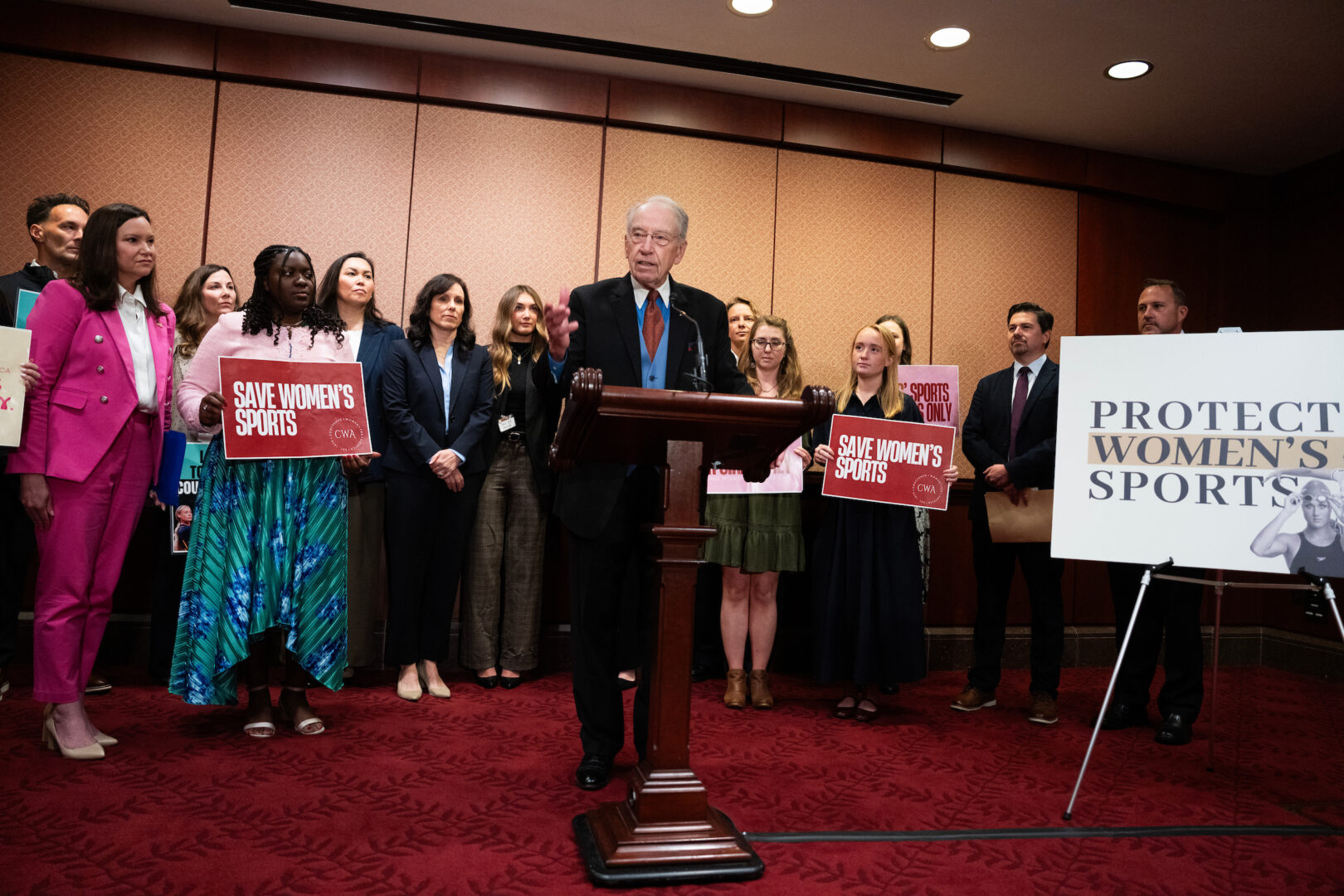
“The Democrats are choosing to let their two witnesses’ seats go empty. That says a lot,” Judiciary Chairman Charles E. Grassley, R-Iowa, said as he accused his colleagues of blowing off the hearing, titled “Standing Up for Women in Sports.”
Sen. Darline Graham, a Republican member of the Judiciary panel who is facing an unexpectedly robust challenge from Democrat Annie Andrews in South Carolina, seized on the occasion. Her campaign issued a press release Wednesday highlighting her participation in the hearing and Andrews’ previous social media posts on the topic, calling her a “flip-flop queen.”
“I am a volleyball mom and proud defender of women’s athletics,” Graham said. “Unfortunately, my opponent is not.”
At the hearing, Judiciary ranking member Richard J. Durbin, D-Ill., called for “honesty and compassion” around the topic while simultaneously trying to neutralize it.
“If you ask the American people, ‘What are the priority issues you hope Congress will address as soon as possible?’ the issue of this hearing would not be in the top 10, maybe not the top 20,” he said.
That dynamic has played out on the campaign trail as Senate Democrats look to expand the map and compete in unexpected places. They need a net gain of four seats to retake the chamber.
In Texas, Democrat James Talarico struck a note of regret for past comments about God being “nonbinary,” playing defense as opponent Ken Paxton ran an ad featuring an AI-generated Talarico reciting his previous remarks on gender identity and religion. Outside groups have also dusted off a phrase Trump deployed against Kamala Harris in 2024 — accusing the Texas Democrat of being “for they/them, not you.”
“What I was trying to say is that you can’t use human categories to define God,” Talarico explained during a Fox News interview, adding he would oppose trans student-athletes competing in girls’ sports “if it endangers safety or fairness.”
But he also tried moving from defense to offense, saying the reason Republicans “want to talk about six sexes is because they don’t want to talk about $6 diesel.”
Ohio Democrat Sherrod Brown is making a similar play in his comeback bid against GOP Sen. Jon Husted, accusing Republicans of seeking to deflect attention away from the war in Iran and the rising cost of living.
“With everything going on, that’s what they’re talking about?” a voter says in a recent Brown ad, while another observes that “in Ohio, it’s against the law to perform transgender surgeries on kids. That’s right, it’s illegal.”
“Jon Husted, why don’t you start working for us?” voters ask in the ad.
Some Democrats have opted for a more nuanced approach. Lindsay James, an Iowa state lawmaker running in an open battleground seat, called for “commonsense rules to keep sports fair.” But James, a Presbyterian minister, noted that “all children are made in the image of God.”
Even some blue-state Democrats have walked back their support for trans rights. Newsom, a longstanding supporter of LGBTQ rights, drew criticism last year when he told the late conservative activist Charlie Kirk that it was “deeply unfair” for trans athletes to participate in girls sports.
And the issue became a dominant theme in the recent Democratic Senate primary in Massachusetts. Sen. Edward J. Markey embraced trans rights and credited the issue for helping him defeat Rep. Seth Moulton, who told The New York Times in 2024 that he didn’t want his daughters “getting run over on a playing field by a male or formerly male athlete.” (He later apologized.)
Off-year example
The topic of transgender athletes in women’s sports may be less politically potent now than it was in 2024 — at least if elections since then are any indication. In the 2025 Virginia governor’s race, for example, Republican Winsome Earle-Sears’ campaign spent millions on ads attacking Democratic now-Gov. Abigail Spanberger on trans issues, to no avail.
Still, Republicans in tight races are hoping it continues to have legs. In the battle for Iowa’s open Senate seat, GOP Rep. Ashley Hinson ran ads this summer claiming Democrat Josh Turek supports “sex changes for kids.” Turek, a two-time Paralympic gold-winning wheelchair basketball athlete, told The New York Times in July, “As someone that spent a lot of my life in high-level sports, I don’t believe that biological males should compete against females in sports.”
Ahead of the hearing on the Hill this week, Connecticut Sen. Richard Blumenthal said Republicans “don’t have a constructive proposal” to take home to voters, a claim echoed by Vermont Sen. Peter Welch, a fellow Democrat on the Judiciary panel.
Republicans “want to change the topic from their failure to address affordability to culture war issues,” Welch said.
Asked about Democratic candidates moving to the center on this issue, he said, “They’re running to win.”