Trump ties ethanol boon for farmers to a Marshall win
‘I’m only doing it for him,’ Trump says about making year-round E15 permanent
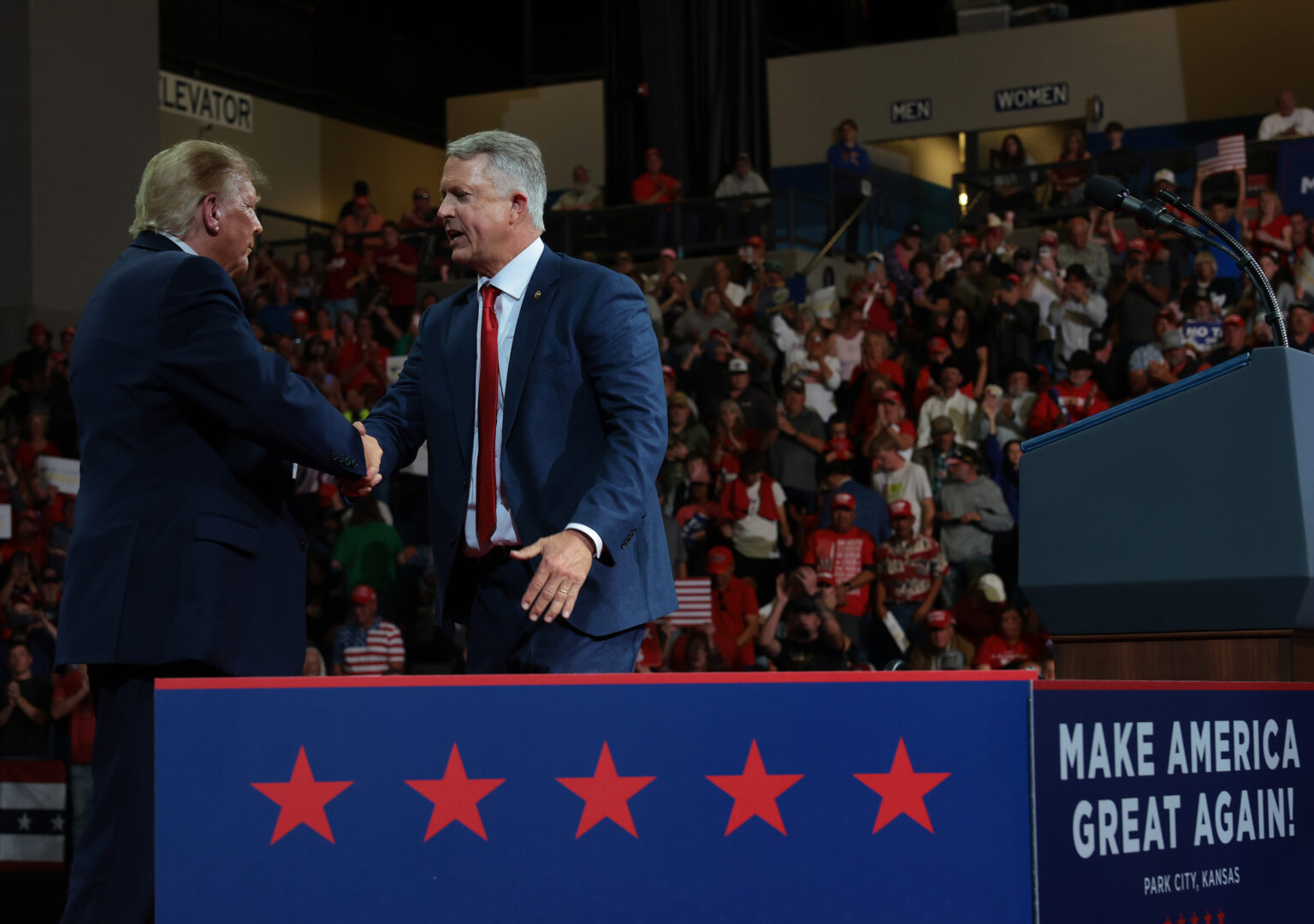
President Donald Trump announced $8 billion in aid to farmers struggling with high diesel prices while also tying his support for increased ethanol content in gasoline — a boon to Midwest corn growers — to the reelection of a Kansas senator.
Trump made the proclamation Monday while stumping for the embattled Sen. Roger Marshall, who’s trying to avoid being the first Republican in his state to lose a Senate race in 94 years, in his race against pastor and first-time political candidate Adam Hamilton, a Democrat.
“With Roger Marshall in the Senate, we will make year-round E15 permanent. But if Adam Hamilton is in, I’m not doing it,” Trump said. “That’s it. I’m only doing it for him.”
Republican lawmakers and candidates from well beyond Kansas have been advocating for changing the law to allow the year-round sale of E15 gasoline, which contains more ethanol blended in than the typical 10 percent ethanol content. E15 sales in the summer can be permitted under current law with an EPA waiver.
It was not immediately clear if Trump would block such waivers in the summer of 2027 if Marshall loses, or if he would oppose enactment of the Senate’s farm bill provision that would amend the Clean Air Act to make E15 blends generally permissible. That’s a big deal to the corn ethanol industry as it would provide certainty that more of their product can get to market without relying on EPA determinations.
The president has also mentioned the ethanol issue in a video message endorsing Rep. Zach Nunn, R-Iowa, for reelection. There are plenty of hotly contested races in the Midwest, including Rep. Ashley Hinson running for Senate in Iowa and Sen. Pete Ricketts, R-Neb., who faces a strong challenge from Dan Osborn, an independent.
Oil vs. corn
Negotiations are still underway to try to find a farm bill compromise that can pass the House, Senate and become law in 2026. Trump has already endorsed year-round E15, signing an executive order on the first day of his second term to require the EPA to grant annual summer waivers.
But oil refiners, who are on the hook to demonstrate compliance with renewable fuel mandates even if consumers don’t want to purchase E15 or have vehicles that can support the higher-octane fuel, oppose codifying a permanent waiver. They’re willing to consider a deal allowing year-round E15, but only in exchange for more generous relief from quotas under the renewable fuel standard, or RFS.
In May, after farm groups and representatives of oil producers, marketers and larger refiners reached a deal with House leadership, the House voted on a bill that would amend the CAA to allow year-round E15. The bill passed 218-203, with the split falling along geographic lines as many oil and refinery state members voted against the bill — including Louisiana Republicans Speaker Mike Johnson and Majority Leader Steve Scalise — due to opposition from midsize refiners.
The American Farm Bureau Federation, Renewable Fuels Association and American Petroleum Institute all supported the bill. However, some smaller and midsize refiners, including those represented by the Fueling American Jobs Coalition and Small Refineries of America, argued that the bill could force more than 20 refineries out of business because of new caps on small-refiner exemptions and changes to the definition of small refinery.
The Senate Agriculture Committee included year-round E15 in its version of the farm bill, which the panel approved 12-11 on Sept. 16, along with some RFS changes intended to ease small refiners’ burden.
But even some oil industry players that backed the House’s E15 bill, which would eliminate reallocations of exempted obligations to larger refiners, opposed the Senate language, which provides much more modest reallocation relief. Key GOP senators whose constituents include oil refineries, such as Majority Whip John Barrasso of Wyoming and Commerce Chairman Ted Cruz of Texas, opposed the Senate’s E15 compromise.
The political maneuvering became more complicated after the EPA released refinery exemptions that left both sides of the debate unhappy in August, and a draft rule that would reallocate all renewable fuel volumes earlier this month.
EPA Administrator Lee Zeldin announced the reallocations during a tour through the Midwest that included a roundtable with Hinson.
Recognizing the political realities on both sides of the ethanol debate, on the same day as Zeldin’s RFS announcement, Vice President JD Vance said the administration would use Defense Production Act authorities to expand a 77,000 barrels-per-day refinery in Tyler, Texas, at a stop with GOP Senate candidate Ken Paxton.
The refinery, owned by Delek US Holdings, also received an exemption from RFS blending quotas.
The farm bill itself has a long way to go, even if oil and farm groups can strike an acceptable balance. Democrats and Republicans remain at odds over changes to the Supplemental Nutrition Assistance Program, which threaten to stall a full reauthorization and could mean a more simple temporary extension.
From Washington, with cash
Marshall, the GOP incumbent, is facing a significant enough reelection challenge that Trump was deployed to rally supporters Monday in the Sunflower State. It’s a state Trump carried by 16 percentage points in 2024, and yet the political environment is making it difficult even for the Republicans there.
The president announced a plan to provide $8 billion in assistance to farmers facing high costs for diesel fuel during the harvest season, with the ongoing conflict with Iran continuing to elevate the cost.
Unlike the president’s comments on E15 regarding post-election activity, it appears the farm aid program will get underway immediately, with a notice from the Agriculture Department saying potential farmer beneficiaries should make sure they have up-to-date Login.gov credentials ahead of the rollout.
According to AAA, diesel prices remain above $6 per gallon in Kansas. That’s compared to about $3.39 per gallon just one year ago.
During Trump’s Kansas appearance, he credited Marshall for helping to make the funding a reality.
“Roger Marshall is the leader who fought for that to happen,” Trump said.