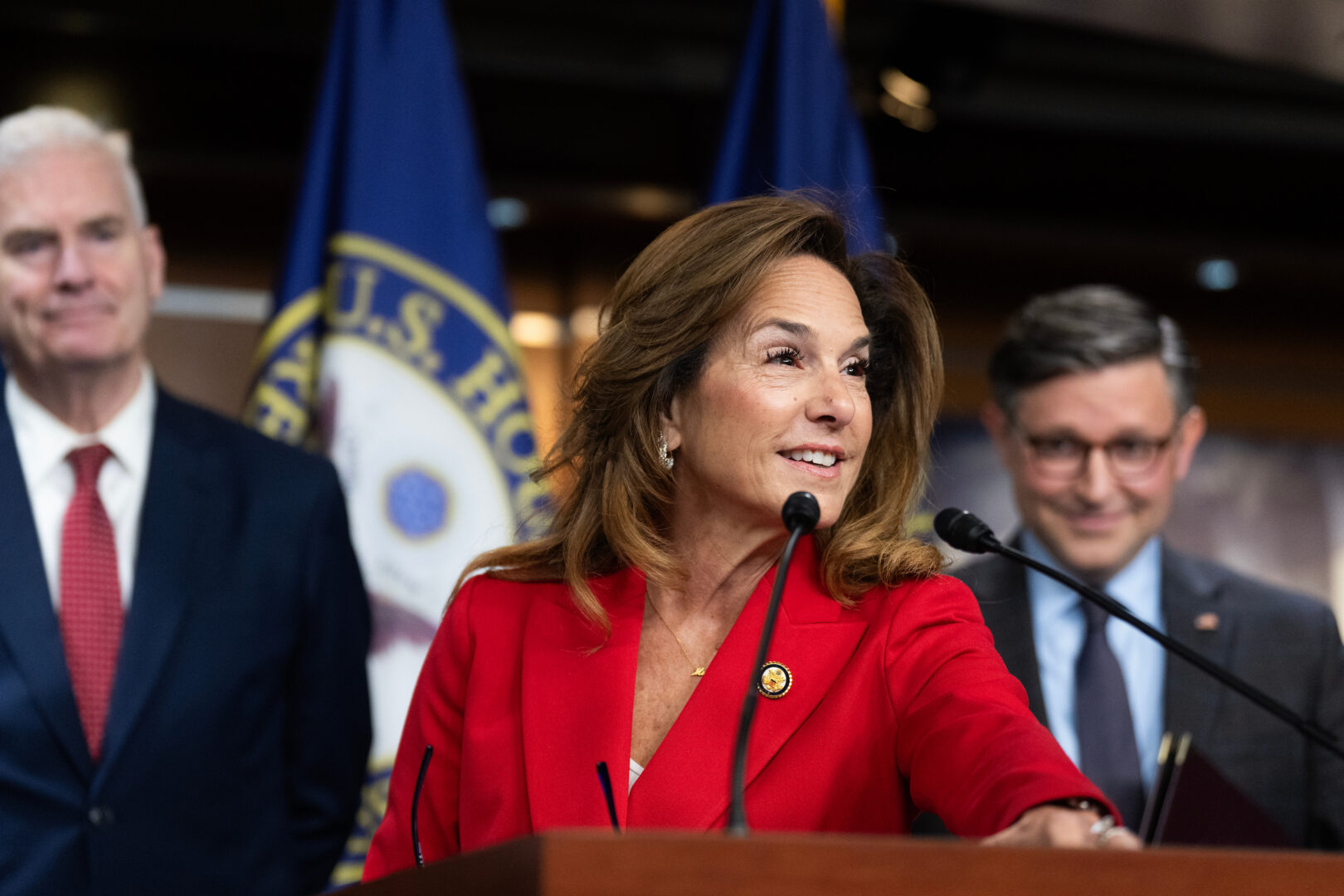
GOP emerges from ‘hell week’ with deep divisions between Senate and House
They pulled off legislative wins, but some complain of ‘no respect’
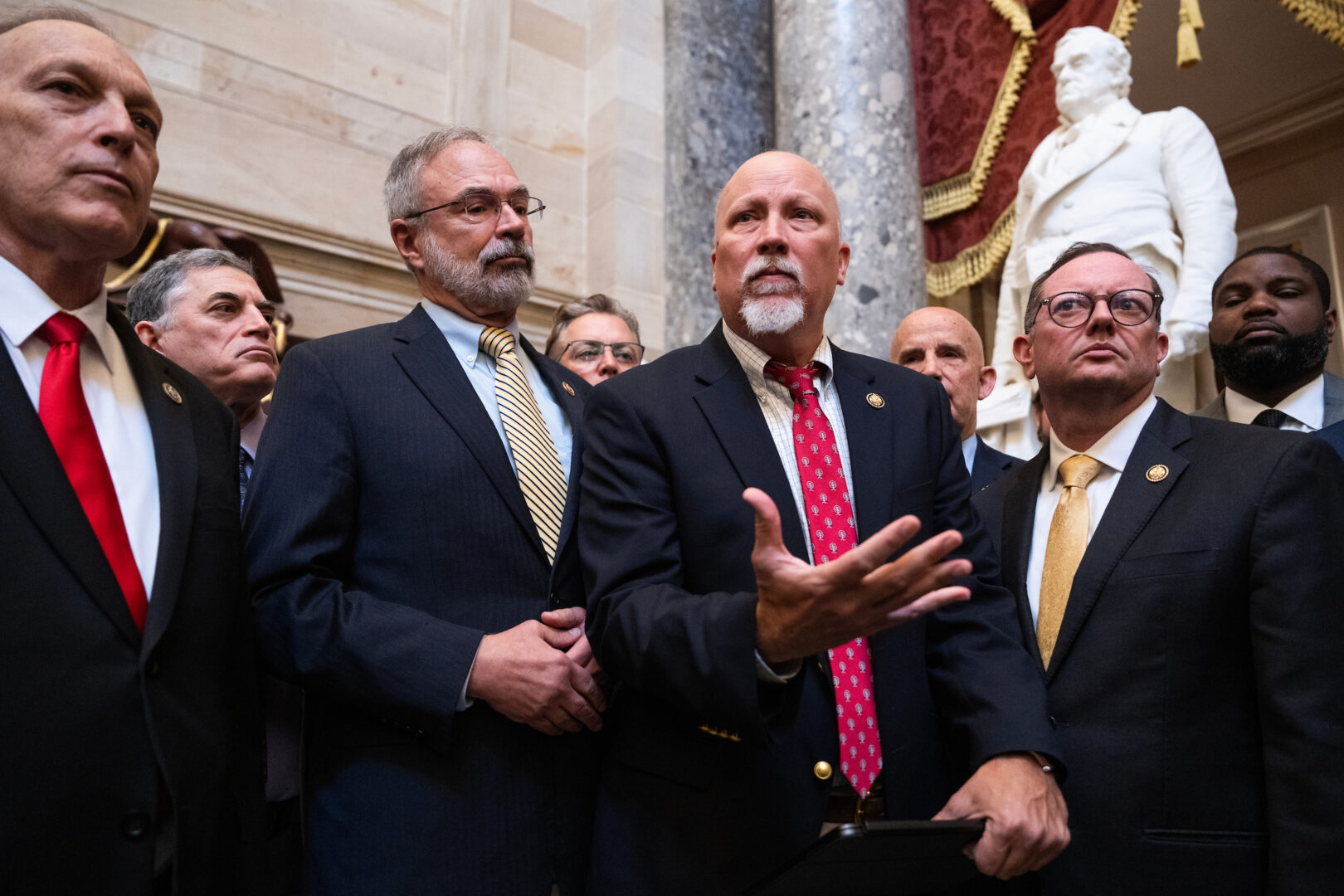
During the final vote to close out the House’s “hell week,” a handful of Republicans had a message for the Senate: You’re responsible for the “suffering” agenda.
Standing on the steps outside the Capitol on Thursday, House Freedom Caucus members loudly aired their grievances with the Senate. Republicans there have shown them “no respect,” they said, and Majority Leader John Thune, R-S.D., needs to “get control” of his chamber.
“The agenda of the American people is suffering and lagging behind, and the Senate, unfortunately, is just responsible for that,” said Rep. Scott Perry, R-Pa.
The feud between Republicans in the House and Senate reached a fever pitch this week as leadership faced high-stakes deadlines for expiring spy power authorities and Department of Homeland Security paychecks. They managed to figure things out — but not without stepping on each other’s toes.
“Where the hell is the Senate? I mean, again, the greatest deliberative body in the world? When are they deliberating?” Rep. Chip Roy, R-Texas, asked. The Senate had gaveled out less than an hour prior, effectively jamming the House with a short-term extension of Section 702 of the Foreign Intelligence Surveillance Act.
“That’s what I want to know, because the House is doing its job,” Roy said.
It has created a touchy situation for legislating on Capitol Hill, even before the real work begins on finishing a budget reconciliation package by a White House-imposed June 1 deadline.
“Yeah, I feel like we’ve got to work on the [relationship],” Sen. Thom Tillis, R-N.C., said of the House.
The friction comes as Republicans are trying to defend their trifecta this November amid sagging polling numbers. And some are warning the discord in D.C. could hurt them back home.
“Between now and November, we’ve got to be pretty crisp,” said Tillis, who previously served as North Carolina’s state House speaker. “Where we have the gavels in Washington and we have the White House, we’ve got to execute.”
One jam too many
The House has often accused the Senate of “jamming” them, or passing a bill right before a deadline without signoff from House Republicans and then skipping town. The tactic tends to leave Speaker Mike Johnson, R-La., scrambling to scrape together enough votes with his thin majority — and he doesn’t always pull it off.
For example, the Senate came up with a bipartisan plan to end the DHS shutdown over a month ago. After senators passed it in the middle of the night by voice vote and left for recess, House Freedom Caucus members announced the next morning they opposed the bill.
House Majority Whip Tom Emmer, R-Minn., at the time criticized the Senate for passing the bill “at 3 a.m. in the morning, when Americans are sleeping, and the news is not necessarily focused on it.”
“This is what Americans get so upset about when we talk about politicians, this is literally what they are mad about,” Emmer said.
The plan then stalled out for over a month. House Democrats, who said they would vote for it, urged Johnson to bring it to the floor. Johnson instead began negotiations to appease holdouts within his own ranks.
Until Thursday, when Johnson brought it to the floor. It cleared easily by voice vote.
Roy said after the vote that Freedom Caucus members let it slide since the House had started the reconciliation process earlier that week to further fund Immigration and Customs Enforcement and the Border Patrol, which had been zeroed out in the funding bill.
“Well, I’m glad they passed it,” Thune said Thursday of the House.
“Yeah…” Thune said, his voice trailing off after he was asked for a reaction to the House also clearing it with a voice vote, the same way the Senate did weeks ago. “I probably shouldn’t.”
But in the House, the sting from the Senate’s earlier snub hadn’t worn off. Then, later Thursday, the Senate did it again.
On the House steps, Roy and Freedom Caucusers were upset the Senate jammed them with a short-term spy powers reauthorization bill that, with the help of Democrats, passed easily in the House. By the time of the fly-out-day vote, over four dozen members had already skipped town, ending what Rep. Troy Nehls, R-Texas, had warned would be “hell week.”
“If the Senate thinks they’re going to keep rolling over us, it’s just not going to happen, because we’re not going to pass something that’s a long-term clean reauthorization,” Roy warned of Section 702. “I think that’s been taken off the table.”
The House passed its own version of a FISA reauthorization bill 235-191 on Wednesday with some privacy provisions — but not a warrant requirement — and attached language that also would prohibit the Federal Reserve from issuing a central bank digital currency.
Senate Republican leadership called it “DOA” before the gavel had even dropped in the House due to the currency provision, and proceeded to send over the short-term extension.
“Rather than even debate it, Leader Thune went to the floor and said, ‘No respect. Not even going to give it the time of day,’” said Rep. Warren Davidson, R-Ohio. “The Senate sent over something to say, ‘Let’s just keep the status quo going for 45 days.’ We came here to say we reject that approach. We’ve asked for reform, and we passed reform in a bipartisan way.”
Filibuster fracas
At the center of many House Republicans’ frustration is that Thune, in their eyes, is yielding too much power to the Democrats and not taking advantage of his 53-47 majority.
“The Senate Democrats have far too big a voice here, and it’s time for Leader Thune to get control of the Senate,” Davidson said.
But Senate leadership has not budged on changing the fabric of the chamber’s procedure, despite pressure from both House Republicans and President Donald Trump to nuke the filibuster’s 60-vote threshold or require senators to hold the floor in what’s known as a “talking filibuster.”
Rep. Anna Paulina Luna, R-Fla., said Wednesday, “John Thune’s an issue, and I don’t care if he hates me.”
She intends to keep pressing him on the Trump-backed voter ID and election overhaul package known as the SAVE America Act, which the Senate has now quietly set aside after a lackluster extended floor debate.
Luna said she “confronted” Thune on the House floor Tuesday as King Charles III was visiting Congress to give a historic address.
“I actually asked him on the floor, I told him, ‘You need to get SAVE America done,’” Luna said. “I think that some of these senators … need to consider different leadership.”
Thune’s office did not provide a comment on the interaction.
Other lawmakers say the relationship within the party is still workable.
“We’ll get stuff done with them,” Sen. Mike Rounds, R-S.D., said of the House. “Look, if our Democratic colleagues would have simply voted for the appropriations process, a huge amount of this stuff would not be a problem for us today.”
Thune said Johnson “knows the challenges we face over here. We obviously have a 60-vote threshold. We need Democrats. You know, he doesn’t need Democrats, but he needs every Republican. That’s a real challenge on a good day.”
“Sometimes there aren’t a lot of good days around here, so you just have to do the best you can. I know that, he knows that,” he continued. “So we work through the differences, but recognize that part of it is just institutionally, by design, the way the two bodies function is very different.”
Nina Heller contributed to this report.