House NIL bill gets benched
Eyes turn to the Senate amid fight over the future of college sports
House Republican leaders have once again scrubbed plans to vote on legislation that would usher in substantial changes to college sports, leaving an uncertain path ahead.
Attention is now turning to the Senate, where Sens. Ted Cruz, R-Texas, and Maria Cantwell, D-Wash., are reportedly preparing their own bipartisan proposal to address a landscape transformed by name, image and likeness deals.
It comes after an initial version of the House bill, known as the SCORE Act, was pulled from the floor in December. In the months since, GOP leaders, including Speaker Mike Johnson, R-La., have worked behind the scenes to assuage concerns from Republican and Democratic members.
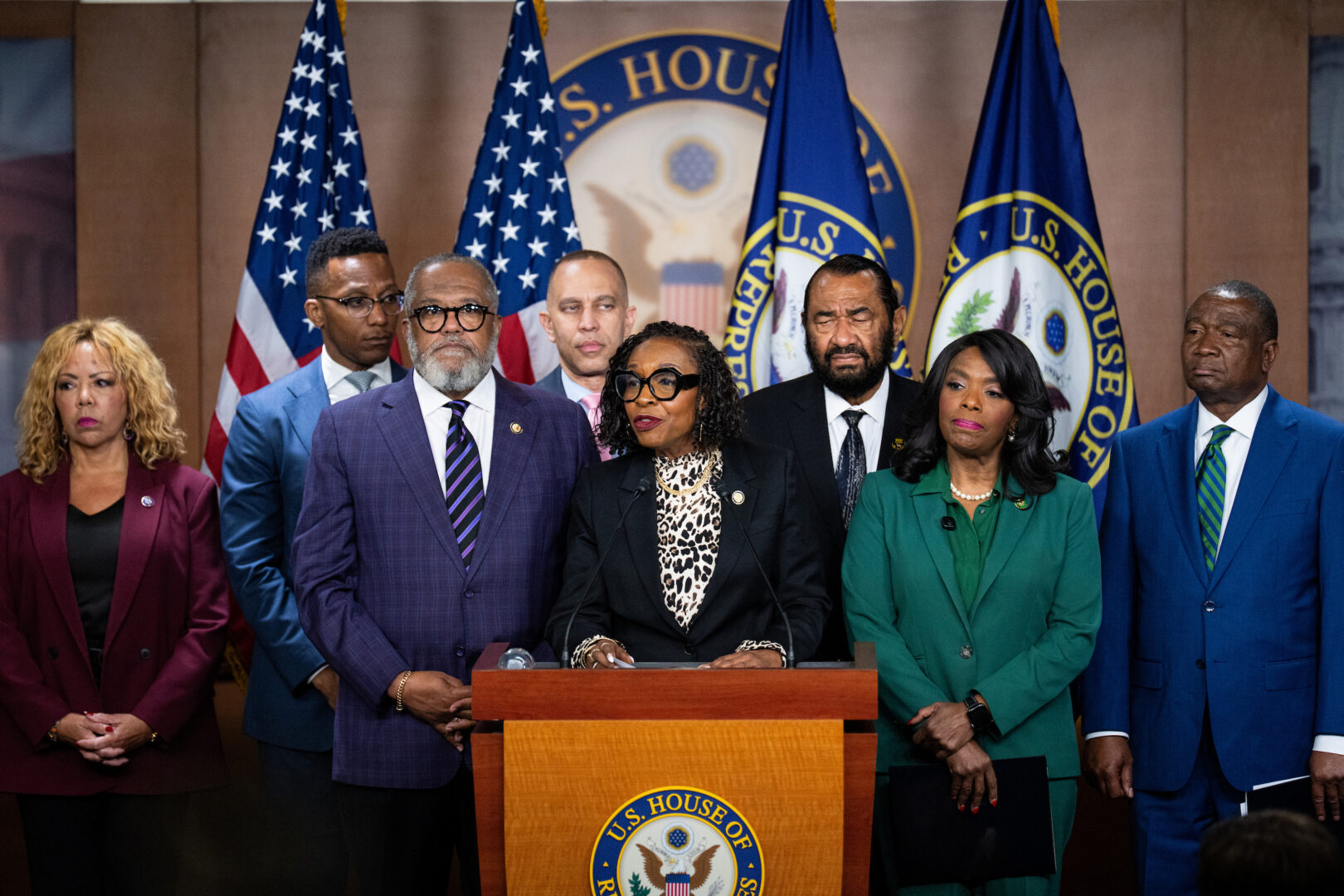
But those efforts weren’t enough, and on Monday afternoon, the influential Congressional Black Caucus announced all its members were “united” in opposing the revised bill.
“For generations, Black athletes have helped build college athletics into one of the most powerful and profitable industries in American life,” the group’s chair, Rep. Yvette D. Clarke, D-N.Y., said in a statement. “Yet at the very moment those same communities face coordinated attacks on their democratic representation, too many leaders across college athletics have chosen silence.”
While two CBC members — Reps. Shomari Figures, D-Ala., and Janelle Bynum, D-Ore. — were original co-sponsors, they are no longer supporting the bill.
Derrick Johnson, president and CEO of the NAACP, joined House Democratic leader Hakeem Jeffries, D-N.Y., and others at a Tuesday press conference to slam the bill and urge a boycott by Black athletes of public universities in states that are working to “minimize our right to vote.” The call comes as some states move to redraw majority-minority congressional districts after the Supreme Court’s seismic Louisiana v. Callais decision last month.
“Fifty-five percent of all African Americans live in the former Confederate South,” he said. “But we will not tolerate a Confederate mentality on our labor, on our ability to contribute and our ability … to have representation.”
The CBC said it had sent letters to the commissioners of the Southeastern and Atlantic Coast conferences — which have member institutions in a list of Southern states that are redrawing their House maps — and the NCAA, the governing body of college sports.
The NCAA, however, has lost some of its influence over college football in recent years, with the so-called “Power 4” conferences — the SEC, ACC, Big 10 and Big 12 — and their major television partners gaining more and more power.
“Institutions that profit from Black talent and Black communities have a responsibility to stand with those communities when their fundamental rights are under attack,” the CBC’s Monday statement said. “Silence in the face of injustice is not neutrality — it is complicity.”
Bumpy road
A handful of House Republicans had also opposed the initial SCORE Act in December, prompting Johnson and other Republican leaders to try again.
That work led to an updated bill that had been slated for a Rules Committee meeting Tuesday and floor votes later in the week.
“Consideration of SCORE has been postponed,” a Rules Committee spokesman said in an email Tuesday when asked if the panel would still take up the measure.
The bill would create a national framework for college athlete compensation and significantly expand the authority of college sports governing bodies, while imposing new limits on student-athlete transfers, booster-backed NIL payments and student athletic fees.
It preserves the nonemployee status of college athletes despite the expansion of direct compensation mechanisms, and would slap new revenue- and expenditure-reporting requirements on colleges and universities, potentially giving congressional committees unprecedented amounts of data about individual athletic programs.
It would also create a formal “pool limit” system that would allow an “interstate intercollegiate athletic association” — effectively the NCAA or a potential successor entity or entities — to cap athlete compensation based on institutional athletics revenue.
Power 4 push
The envisioned compensation cap would have had to equal at least 22 percent of the average annual athletics revenue generated by the 70 highest-earning member institutions. Notably, there has been some talk in college sports circles that two to four of the most-wealthy and -powerful conferences could break away from the other conferences to form their own super-league.
There are currently 68 member institutions in the Power 4 conferences. Adding the University of Notre Dame, a major revenue generator with a massive fan base and its own television deals despite having no conference affiliation, would make 69.
Even if the House were to pass the bill, it would face headwinds on the other side of the Capitol, where Cruz and Cantwell — the chair and ranking member of the Senate Commerce Committee — have reportedly been crafting their own legislation.
In a twist, several participants in a March roundtable at which President Donald Trump urged Congress and stakeholders to address college athletics’ blemishes on Monday wrote to the pair of senators to endorse their work on that proposal, which they have yet to release.
“The overwhelming majority of the President’s Roundtable on Fixing College Sports is pleased to express its strong support to you to complete the bipartisan college sports reform legislation,” the group wrote.
That letter was printed on letterhead from the New York Yankees, a Major League Baseball franchise, and was signed by its president, Randy Levine. It also was signed by Cody Campbell, board chair of the Texas Tech University System and a former student-athlete; Texas Tech is a Big 12 power in several revenue-generating sports.
Former Alabama football head coach Nick Saban, now an analyst on ESPN, which has large contracts with the Power 4 conferences, also signed the missive, along with others.
The group urged the House to also pass college sports legislation — but it did not endorse or name the SCORE Act.
The proposal pulled from the House floor this week includes proposed transfer portal restrictions. The portal has benefited many Power 4 institutions, which have greater resources and alumni bases from which to pay athletes, leaving smaller institutions with less talent on their rosters.
It would authorize athletic associations to require athletes to remain at an institution for one full academic year before transferring, absent any extenuating circumstances. Student-athletes would retain one immediate eligibility transfer during a five-year collegiate eligibility window, and one additional transfer — but only after earning a bachelor’s degree.
Valerie Yurk contributed to this report.