Tensions over prediction markets dominate Senate hearing
Senators push back on derivatives stance
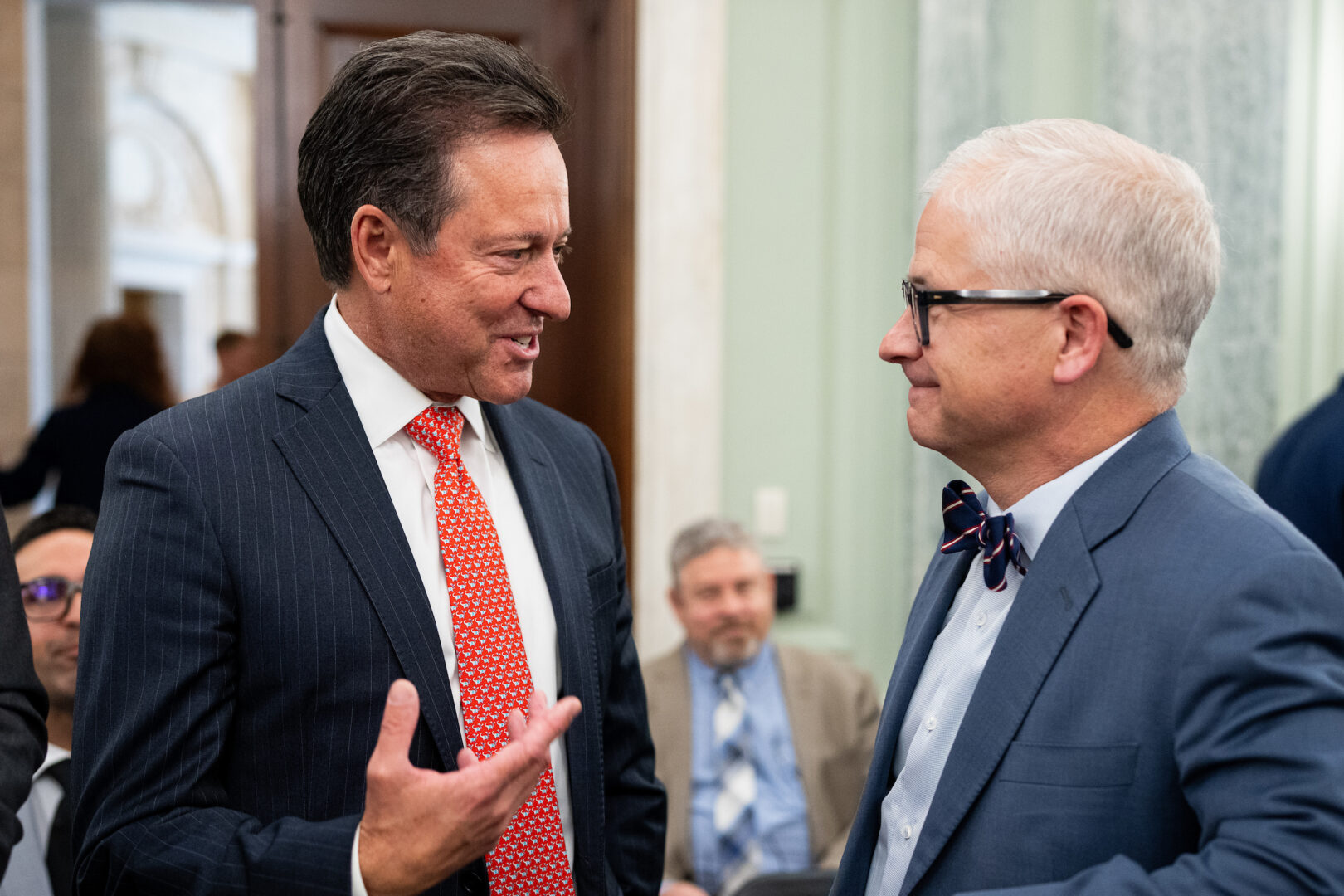
Senators at a Commerce Committee panel hearing aired concerns Wednesday about rapidly growing prediction markets, appearing largely unswayed by industry arguments that they are not a form of betting subject to state regulation.
Members of the committee’s Consumer Protection, Technology and Data Privacy Subcommittee were in agreement at a hearing that sports “event contracts” on prediction markets bear a strong resemblance to traditional sports betting. They also shared worries about all forms of betting affecting the integrity of sports.
The subcommittee heard from representatives of the sports betting and prediction market industries, as well as stakeholders focused on sports integrity, gambling regulation and gambling addiction.
Subcommittee Chair Marsha Blackburn, R-Tenn., expressed her concern about betting’s impact on the integrity of sports, as well as potential additional risks presented by prediction markets.
“While prediction markets represent financial innovation across many sectors, there are real concerns that they function much like traditional sports betting without the enforcement of state regulators and attorneys general,” Blackburn said.
Later, Blackburn, who is running for governor in Tennessee, said that witness testimony could inform potential regulation by the committee, “and also looking at the division of what should be federal and what should be state and preserving those states’ rights.”
The prediction market industry says its platforms are more similar to trading in agricultural futures than traditional casino betting and are therefore under the jurisdiction of the federal Commodity Futures Trading Commission, rather than state gaming regulators.
Former Rep. Patrick T. McHenry, R-N.C., now a senior adviser for the industry group Coalition for Prediction Markets — which is led by fellow former Rep. Sean Patrick Maloney, D-N.Y. — told the committee that the business models are “fundamentally different products.”
“In a casino or sportsbook, the house sets odds and profits when customers lose. In a prediction market exchange, participants trade with one another while the platform earns transaction fees for facilitating the market,” McHenry said.
But Bill Miller, president and CEO of the American Gaming Association, was critical of prediction markets.
“We’re part of the entertainment economy. These so-called prediction markets are deceptively calling sports betting ‘financial contracts’ and ‘investment.’ Despite messaging designed to beguile policymakers and the public, they are increasingly being exposed as backdoor sports betting operations,” he said.
Sen. Ted Cruz, R-Texas, who chairs the full Commerce Committee, pointed to discord over the federal government’s role.
“There is serious disagreement about whether the CFTC can unilaterally allow prediction markets to offer sports event contracts pursuant to the Commodity Exchange Act,” Cruz said. “Many simply see prediction markets as a workaround to state gambling laws.”
Sen. John Curtis, R-Utah, said that McHenry’s explanation of the difference between prediction markets and sportsbooks wouldn’t pass muster at a Utah town hall.
“They’re going to say to me, tell me how that is not gambling. It seems to meet every definition of gambling,” he said.
The CFTC contends that “event contracts” offered by prediction markets are a form of derivative and therefore fall under the commission’s jurisdiction.
The panel’s ranking member, Sen. John Hickenlooper, D-Colo., opposed allowing the commission to regulate sports betting on prediction markets.
“The CFTC has literally no experience in regulating sports betting. Even worse, CFTC has failed to use the authority it does have to protect sports betting from insider trading, market manipulation, predatory advertising and financial stability.”
CFTC actions
President Donald Trump and his family have a personal interest in prediction market regulation. Truth Social, a platform owned by Trump Media and Technology Group, has said that it will expand into prediction markets, though in its latest quarterly filing it said that at launch, Truth Predict “will primarily entail marketing and promotion collaboration with OG.com — a new prediction market experience announced by Crypto.com in February 2026.”
Both Curtis and Hickenlooper are in favor of legislation to regulate prediction markets.
Curtis is a co-sponsor of a bill led by Sen. Adam B. Schiff, D-Calif., that would prohibit companies registered with the CFTC from offering sports betting or casino-style games.
In March, Hickenlooper co-sponsored a bill by Sen. Christopher S. Murphy, D-Conn., that would prohibit wagering on acts of terrorism, assassinations, wars, government actions or actions a person can control or know the outcome of in advance. Rep. Greg Casar, D-Texas, introduced companion legislation in the House.
The CFTC has exercised what it says is its jurisdiction over prediction markets by suing states that attempt to regulate the industry.
On Monday, Democratic Minnesota Gov. Tim Walz signed into law a measure to ban prediction markets in the state starting on Aug. 1, 2026. The CFTC then sued to block the law.
The CFTC has also sued Arizona, Connecticut and Illinois to prevent them from enforcing state criminal laws against prediction markets, arguing that the laws are preempted by the CFTC’s enforcement of federal laws around derivatives.
In April, the U.S. Court of Appeals for the 3rd Circuit enjoined New Jersey’s enforcement of its gaming laws against prediction market Kalshi, noting the court’s opinion that the platform has a “reasonable chance of success” in arguing that state laws are preempted by the Commodity Exchange Act.
Cruz noted recent court decisions and said that “unless Congress acts, the Supreme Court may have to decide the issue.”
Kids safety
The hearing also covered concerns that sports betting can threaten the integrity of game outcomes or encourage athletes to take particular actions.
Much of the discussion centered on micro prop bets, which allow for wagers on actions as small as whether a pitcher throws a ball or a strike. Witnesses told the committee those types of bets are easier for a single player to manipulate the outcome of and that they can also be particularly addictive.
Blackburn questioned why sportsbooks and markets who say they don’t advertise to kids continue to advertise on social media, where she said algorithms mean the companies can’t guarantee their ads won’t be shown to minors.
“Americans, including young people, are being inundated with advertisements on social media. Their favorite influencers and sports figures are introducing minors to betting,” Blackburn said, going on to highlight teenagers saying that gambling content was shown to them through social media algorithms. “It was served up to them. They didn’t search for it. This is not safe. It needs to stop, and advertising to minors is disgusting.”
Hickenlooper called the onslaught of gambling marketing “the hounds of hell.”
“To let that untethered prey on our young people — I think it’s unconscionable. I think it’s irresponsible,” Hickenlooper said.
FiscalNote, the parent company of CQ and Roll Call, has announced a product expansion into political prediction markets.