Trump’s Wallet: From golf clubs to crypto, a decade of presidential finances
How a president's financial portfolio evolved during his years in office
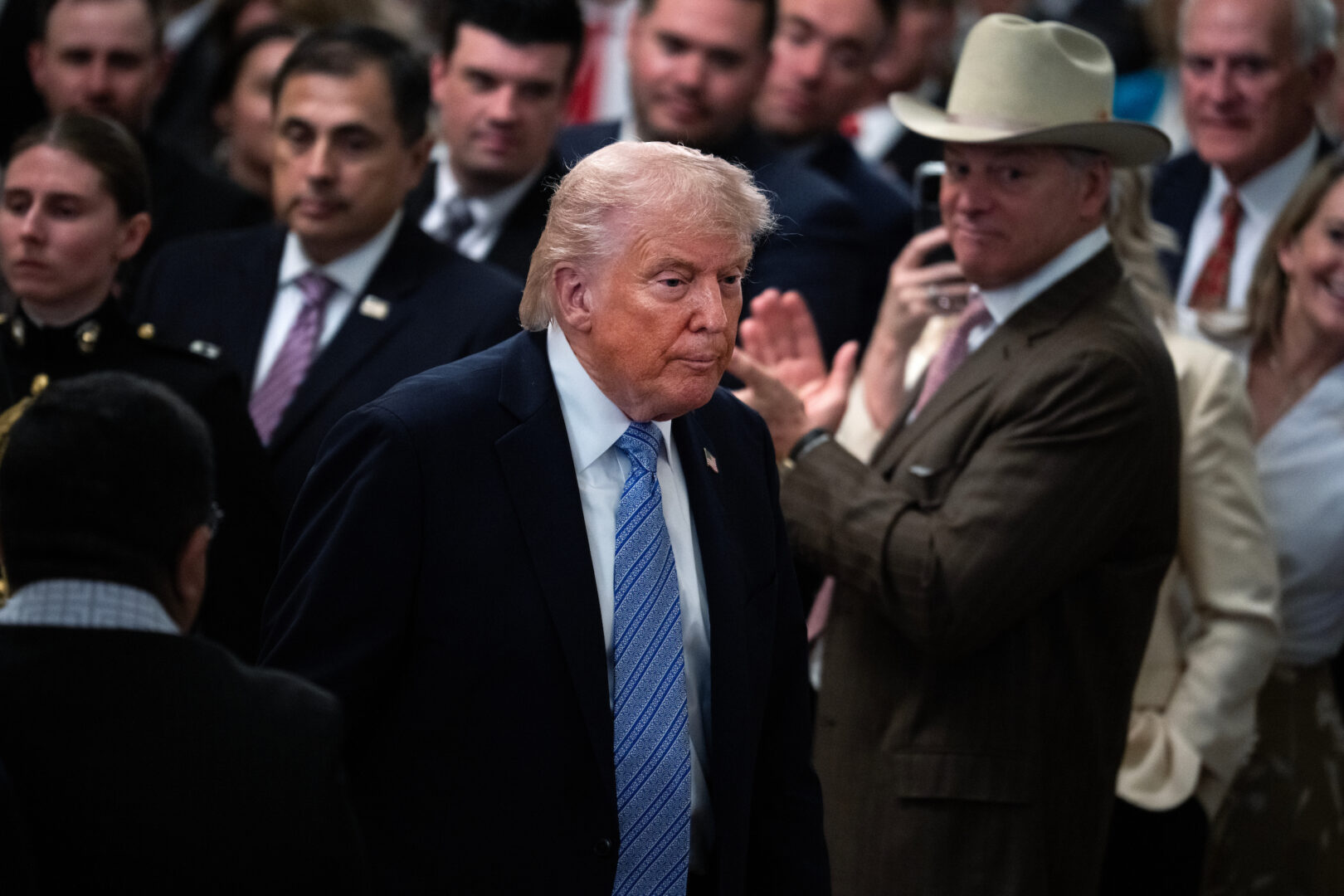
President Donald Trump’s personal finances have undergone a fundamental transformation since he first sought the presidency a decade ago — from golf clubs and hotel licensing fees to cryptocurrency token sales, Saudi licensing payments and tens of thousands of securities trades.
In 2016, when Trump was elected to his first term, the portfolio was built almost entirely on what Trump had run for decades: real estate, golf clubs, hotels and licensing agreements.
Brokerage and securities holdings like municipal bonds and stocks generated minimal income. Cryptocurrency did not appear at all.
But the picture began to shift by late 2024, according to an analysis of information compiled by Trump’s Wallet, a project of Hunter Index, a nonprofit news organization.
Golf and resort income remained the largest category, led by Trump Endeavor 12 LLC — the entity behind Trump National Doral — which reported $160.8 million in business income, the single-largest disclosed income line in a candidate disclosure form covering January 2023 through August 2024.
Securities holdings had expanded dramatically, representing 15.4 percent of Trump’s total disclosed assets by value in 2024 — up from just 2.0 percent in 2016.
The most dramatic shift appears in the 2025 annual form, covering calendar year 2024. For the first time, cryptocurrency emerged as a top-three income source. World Liberty Financial Inc., Trump’s crypto venture, reported $57.4 million in token sales — a category that generated essentially nothing in any prior filing.
The Trump’s Wallet project cross-references five federal financial disclosure filings dating from Trump’s 2016 campaign to trace how the president’s assets’ reported values and income have changed over time.
No official government tool does that. The Office of Government Ethics receives and certifies Trump’s disclosures. But it does not maintain a cross-year tracking system and does not flag when an asset’s income spikes or collapses in ways that might warrant scrutiny.
Rep. Ro Khanna, D-Calif., a member of the House Oversight and Government Reform Committee, said that gap poses a fundamental problem.
“It hurts our efforts to enforce transparency and accountability,” he wrote in an email. “We need reforms to increase reporting.”
The current system was designed for an era when presidents voluntarily divested or used blind trusts. Every president from Lyndon Johnson through Barack Obama either used an independently managed blind trust, held assets in broad index funds or, in Jimmy Carter’s case, liquidated personal holdings entirely.
Trump has done none of those things.
Anna Kelly, deputy press secretary at the White House, wrote in an email: “President Trump only acts in the best interests of the American public.” She continued, “President Trump’s assets are in a trust managed by his children. There are no conflicts of interest.”
The five filings that were submitted to the Office of Government Ethics, Federal Election Commission and the White House provide snapshots of varying time periods between 2015 and 2024. The Trump’s Wallet’s analysis of those five filings shows a decade of profound change in how Trump generates income — visible only when the disclosures are read together.
By 2024, for example, speaking fees, which produced an estimated $12.6 million in the 2022 filing period, had contracted to negligible levels for Trump. Book deal income had similarly faded.
What replaced those streams — crypto token sales, sneaker and watch royalties, NFT licensing — represents a category of presidential income with no modern precedent and, as yet, no dedicated oversight mechanism.
Foreign licensing income, meanwhile, reached $35.1 million in the 12 months covered by the 2025 form — an election year.
That represented a record across all five filings — driven by a new Saudi Arabia deal, a new Dubai licensing deal and a previously undisclosed Vietnam agreement — up from an annualized $5.4 million in the 2024 filing. The surge coincides with a structural portfolio transition: The $220 million annualized income from Trump Old Post Office LLC — a one-time figure tied to the sale of the Washington hotel lease — is gone from the books.
The Hunter Index analysis comes as a new annual disclosure covering calendar year 2025 is expected this summer, and as Congress pushes for greater scrutiny of a presidential portfolio that ethics experts say has no modern precedent and no adequate oversight mechanism.
A few examples
Several assets illustrate what year-over-year tracking reveals.
Mar-a-Lago. Trump’s Palm Beach resort, which doubles as his primary residence and a venue for official meetings, has appeared in every filing.
Across five filings, its disclosed income tells a specific story: Income for Mar-a-Lago spiked in the 2022 filing period, which includes the period when Trump announced his 2024 presidential campaign. Some of the world’s titans of industries pay membership fees to a club the president owns, lives in and uses for official business.
World Liberty Financial and the UAE. The database’s $57.4 million World Liberty Financial entry takes on additional significance in light of a Wall Street Journal investigation published in January 2026.
According to the Journal, on Jan. 16, 2025 — four days before Trump’s inauguration — an investment vehicle controlled by Sheikh Tahnoon bin Zayed Al Nahyan, the United Arab Emirates’ national security adviser, secretly signed an agreement to purchase a 49 percent stake in World Liberty Financial for $500 million.
The Journal reported that the deal would direct $187 million to Trump family entities and at least $31 million to entities tied to Steve Witkoff’s family. Witkoff serves simultaneously as a World Liberty co-founder and as Trump’s special envoy to the Middle East.
The Trump administration subsequently reversed Biden-era restrictions on advanced artificial intelligence chip exports to the UAE, approvals that directly benefited G42, an AI company controlled by Sheikh Tahnoon, and had previously been blocked over concerns about technology diversion to China.
On May 1, 2025, Eric Trump and Steve Witkoff’s son, Zach, announced at a Dubai cryptocurrency convention that another Tahnoon-controlled firm, MGX, would be using World Liberty’s USD1 stablecoin to settle a $2 billion investment in the Binance cryptocurrency exchange. “We thank MGX and Binance for their trust in us,” said Zach Witkoff, “It’s only the beginning.”
Later that month, the Securities and Exchange Commission announced that it was dismissing with prejudice a lawsuit filed in the Biden era against the exchange and its founder, Changpeng Zhoa, that had accused the exchange of wash trading.
Massachusetts Sen. Elizabeth Warren, the ranking Democrat on the Senate Banking Committee, and Oregon Democratic Sen. Jeff Merkley sent letters to World Liberty and both MGX and Binance asking that they preserve records and provide information regarding the deal.
Nearly six months later, Trump went a step further and pardoned Zhao, who had pleaded guilty in late 2023 to failing to maintain an effective anti-money-laundering program within the cryptocurrency exchange.
Though Trump himself reported no direct ownership stake in Binance across any of his five disclosed filings, Forbes reported in February that Binance had accumulated 87 percent of World Liberty’s stablecoin.
Corey Frayer, a cryptocurrency adviser to the SEC during the Biden administration, wrote in an email that “Trump’s stablecoin was built on Binance technology, inexplicably used by the UAE to buy a stake in Binance and otherwise mostly sits dormant in a handful of Binance controlled crypto wallets.”
He continued, “Oddly, it’s both the huge transactions related to Binance and the tiny volume of transactions on Binance’s exchange that show USD1 isn’t used for payments, it’s used almost exclusively to buy favors from the President.”
There is no evidence of a quid pro quo, and Trump told reporters he was unaware of the UAE investment.
Khanna, who is also ranking member of the House Select Committee on the Chinese Communist Party, launched a formal investigation, sending a letter to World Liberty Financial demanding 16 categories of records and arguing the arrangement “may represent a violation of multiple laws and the United States Constitution,” citing the Emoluments Clause.
As of early June, Khanna said World Liberty Financial had not complied with his document request.
“I will continue to follow up and demand answers,” he wrote.
The Saudi licensing deal. The filings also disclosed $15.9 million in income for calendar year 2024 from DT Marks KSA LLC — a Saudi Arabia licensing entity that did not exist in any prior filing — the largest single foreign licensing payment in the five filings.
The payment predates the Trump administration’s sweeping May 2025 agreements with Riyadh — a $142 billion arms deal and broader $600 billion investment package covering defense, AI and civilian nuclear cooperation — but its appearance in the same disclosure cycle raises the question OGE’s system cannot answer: whether a sitting president’s undisclosed foreign business relationships informed the policy decisions that followed.
Khanna said the payment raises broader concerns about the president’s foreign business dealings.
“It is concerning that these deals financially benefit the President’s family and are a clear conflict of interest,” he wrote. “The American people deserve to know if these ‘licensing fees’ are really ’emoluments’ or ‘pay offs.’”
Wollman Rink. Trump operated the Central Park ice skating rink under a concession agreement with the New York City Department of Parks and Recreation from 1985 until 2021.
In 2016, the contract generated $12.9 million in disclosed income. On Jan. 13, 2021 — seven days after the Capitol riot — Mayor Bill de Blasio announced the city would terminate all Trump Organization contracts with the city. By the 2022 filing period, only $2.8 million in residual income remained.
Trump tried to reclaim the concession in late 2024; in October 2025, the city awarded it to a competing bid made by a partnership between real estate firm Related Companies and the operators of 14 pickleball courts on the site of the rink.
Problems with oversight
Financial disclosure forms are the primary public tool for assessing whether a president’s personal financial interests conflict with his administration’s decisions.
But those forms have significant structural limitations.
Each is a static snapshot. OGE certifies the forms but does not maintain a cross-year tracking system, does not independently verify reported values and does not flag relationships between a disclosed asset and a policy decision made in the same period. Those connections must be established through reporting, subpoenas or investigation — none of which are triggered automatically.
In the first quarter of 2026 alone, a brokerage account in Trump’s name executed more than 3,600 individual securities transactions — roughly 60 per market day.
Both periodic transaction reports covering that activity were filed late; both noted the filer paid a late fee of only $200.
“OGE is committed to transparency and citizen oversight of government,” said Patrick Shepherd, OGE spokesperson. “However, OGE does not respond to questions about specific individuals. OGE publishes ethics disclosures and associated documents to its website as soon as practicable.”
But Khanna said the trading patterns already suggest improper overlap with administration policy.
“The trades include defense contractors impacted by the Iran war and countless other companies benefited by presidential policy,” he said, adding that Congress could launch an investigation into whether trading intersected with official decisions.
The Trump organization has previously said the accounts are managed by third-party financial institutions with “sole and exclusive authority over investment decisions.”
“President Trump’s investment holdings are maintained exclusively in fully discretionary accounts managed by independent third-party financial institutions,” said a spokesperson for the Trump Organization.
“These institutions have sole and exclusive authority over all investment decisions, including asset allocation, trading, rebalancing, and portfolio management. Investments are executed and allocated through automated, model-based portfolios and direct indexing strategies administered entirely by those firms.
“Neither President Trump, his family, nor The Trump Organization has any role in selecting, directing, approving, influencing or soliciting specific investments,” the spokesperson continued. “They receive no advance notice of trades, cannot alter or override the managers’ strategies or models, and provide no input regarding investment decisions or portfolio operations.”
The spokesperson said the structure “was intentionally designed to maintain a clear separation between President Trump and the independent third-party investment managers overseeing the accounts and avoid even the appearance of any conflict of interest.”
The limits of self-reported data
Any analysis of Trump’s disclosed finances must contend with a finding already established by the courts.
A New York state court found that Trump and the Trump Organization fraudulently inflated the value of properties — including Mar-a-Lago and his Trump Tower penthouse — to mislead lenders and insurers.
An appellate court vacated the $355 million penalty in August 2025 as an unconstitutional excessive fine but upheld the underlying finding. When the Trump’s Wallet database records an asset value, it is recording what Trump disclosed — not an audited figure.
What Congress can and cannot do
The presidential conflict-of-interest exemption under Title 18, Section 208, means the legal mechanisms available to other executive branch employees do not apply to Trump.
What Congress retains are oversight authorities — the ability to investigate, subpoena, hold hearings and issue reports.
Don Fox, former general counsel and acting director of OGE, said Trump has not technically violated the conflicts statute — because he is exempt from it — but has exploited that exemption far beyond what its architects envisioned.
“Despite being exempt, however, Presidents in the post-Watergate era have generally organized their financial lives as though they were subject to conflicts of interest,” Fox said. “Trump has broken with that norm of Presidential behavior as he has in so many other areas.”
Fox suggested one solution could be to “enact legislation limiting the kinds of financial interests that the president – and other officials exempt from conflicts of interest – the vice president, members of Congress, federal judges – may hold while in office.”
Khanna suggested his five-point ethics and political overhaul plan — which includes a ban on congressional stock trading — as a potential framework.
“Americans on the right and the left want to root out corruption in Washington,” he said. “We need a political reform agenda that eliminates conflicts of interest for the President, Congress, and anyone serving in public office.”