Bitter rivalry? At the Congressional Baseball Game, sort of
Research shows the tradition may boost bipartisan bills
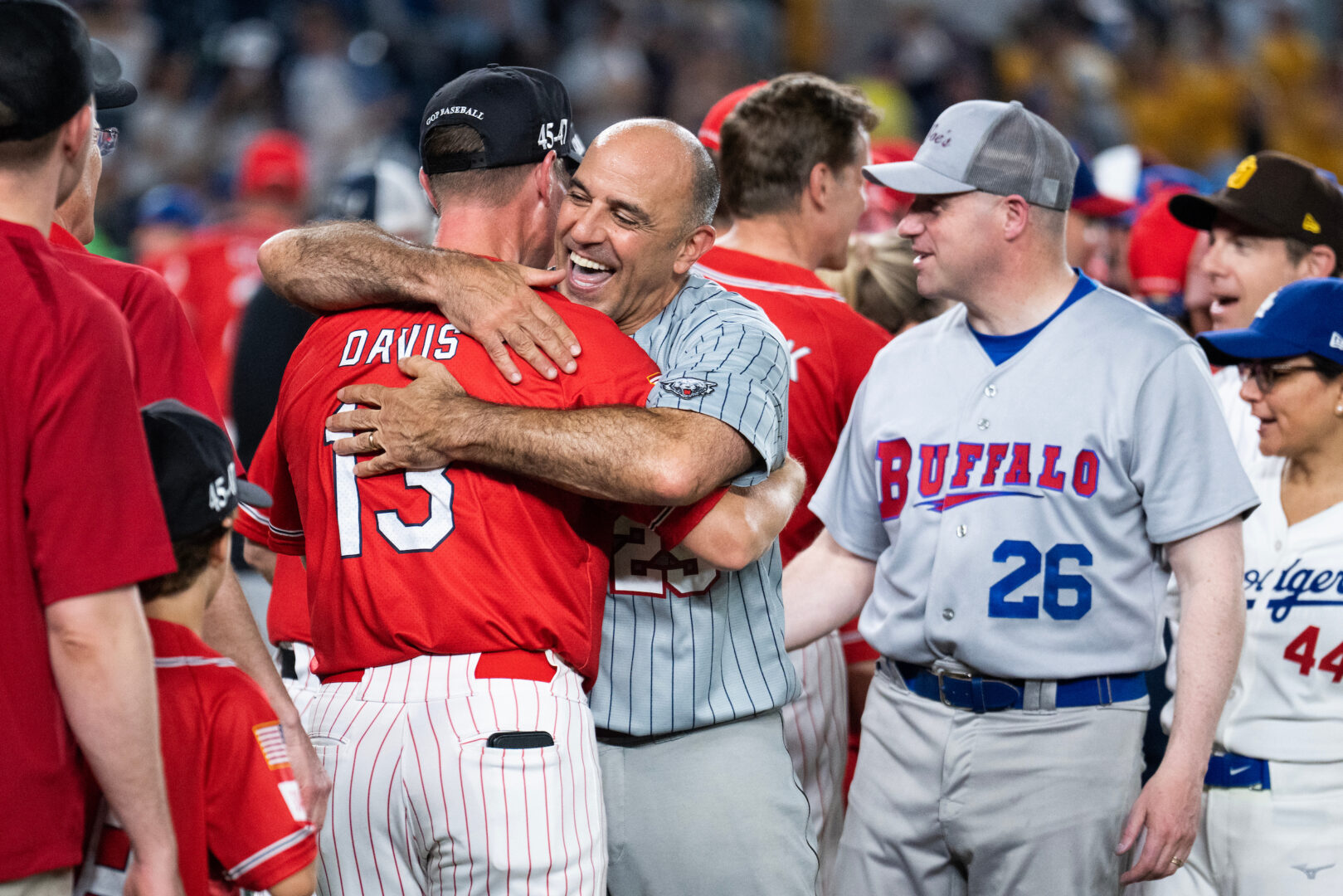
Democrats are looking to break a five-year losing streak at Wednesday night’s Congressional Baseball Game, hoping a revamped roster will be enough to beat Republicans.
But partisan rivalry aside, research suggests the game may boost legislative collaboration.
Playing baseball gives legislators the chance to forge bonds outside the halls of the Capitol, according to SoRelle Wyckoff Gaynor, an assistant professor of public policy and politics at the University of Virginia.
Gaynor got the idea when former Reps. Tim Bishop, D-N.Y., and Charles Boustany, R-La., spoke to an undergraduate class she was teaching and seemed glad to see each other. They explained they had become friends through the Congressional Baseball Game.
“After class, one of my students and I were like, this is interesting, I wonder if this is a one-off thing or not? So we tracked down all the rosters with the clerk’s office, and we also collected every co-sponsorship that occurred in the House … and matched up the data.”
Crunching the numbers, they found that congressional baseball players were more likely to sign on to legislation together, even across party lines. For example, when two members of the 117th Congress participated in the game, the likelihood of a bipartisan co-sponsorship of legislation together was 56 percent.
“There is research on co-sponsorship and what makes people more likely to co-sponsor, and a lot of it is that there’s already an existing shared connection — like females are more likely to co-sponsor with one another, or people from the same state. But the effects of playing on the baseball team were even higher,” said Gaynor, whose findings appeared in a recent issue of American Politics Research. “So, there’s something to be said for being removed from the Capitol, removed from a formal caucus meeting and just becoming friends first.”
Still a rivalry
Rep. Roger Williams of Texas, a Republican team coach, isn’t so sure.
“Everybody says it’s bipartisan, and it is, but it’s not,” he said. “The Democrats are practicing every day like we are. They want to beat us, we want to beat them. There’s bragging rights at stake.”
Williams ought to know. The GOP has come out on top for the past five games in a row, often in a rout. Last year, Republicans won 13-2, which was actually a modest victory by congressional baseball standards. In 2024, the elephants walloped the Democrats 31-11.
Given that success, Williams has no intention of changing the team’s formula. In fact, he plans to run the same starting lineup as last year, with Rep. Greg Steube, R-Fla., on the mound to start the game.
Democrats are keenly aware of their past failures on the baseball diamond, but their coach, Rep. Linda T. Sánchez, D-Calif., says the team has worked to be more competitive this year.
“Last year, we really suffered from things that were beyond our control in terms of substituting players in and out,” she said. “So this year I think the guys have taken it a lot more seriously. A lot of them have been practicing a lot more outside of our team practices, and the individual work that they have put into it is clearly having benefits.”
The Democrats have made some significant roster changes as well. More than a quarter of last year’s squad will not be returning this year, some by choice, others because of scandal, such as former California Rep. Eric Swalwell.
A few rookies will take their places, including Democratic Reps. Sarah Elfreth of Maryland, Christian Menefee of Texas, Josh Riley of New York and Suhas Subramanyam of Virginia.
“I think our guys are looking particularly good at the plate, so hopefully it’ll be an exciting slug fest,” said Sánchez.
Likewise, Williams thinks fans will get a good show Wednesday night.
“I’ve got people coming up from Texas, and they asked me this question: ‘What’s it going to be like when I see the game?’ I said, it’s just like the Red Sox and Yankees, exactly the same thing, except for one key difference — it’s in slow motion.”
While the talent is a far cry from the majors, last year’s game sold more than 31,000 tickets at Nationals Park, surpassing the Nationals’ own average attendance of less than 24,000. It also raised a record-breaking $2.8 million for charity. Funds raised from ticket sales and donations go to Congressional Sports for Charity, a foundation that supports D.C.-area nonprofits and scholarships.
“If you’re not [at] the baseball game, you’re nowhere,” said Williams. “Remember when you were in high school and you were playing your in-town rival, and nobody wanted to be in class, the teachers didn’t want to teach, everybody wanted to get out to the ballpark? It’s kind of that way on game day here now.”
This year the event falls during a busy week for Congress that is expected to include House action on a Senate-passed budget reconciliation bill and tense negotiations over extending section 702 of the Foreign Intelligence Surveillance Act.
The game begins Wednesday at 7:05 p.m. at Nationals Park.