Trump’s picks win Senate runoffs in Georgia and Alabama
But president’s choice for Peach State governor loses to political newcomer
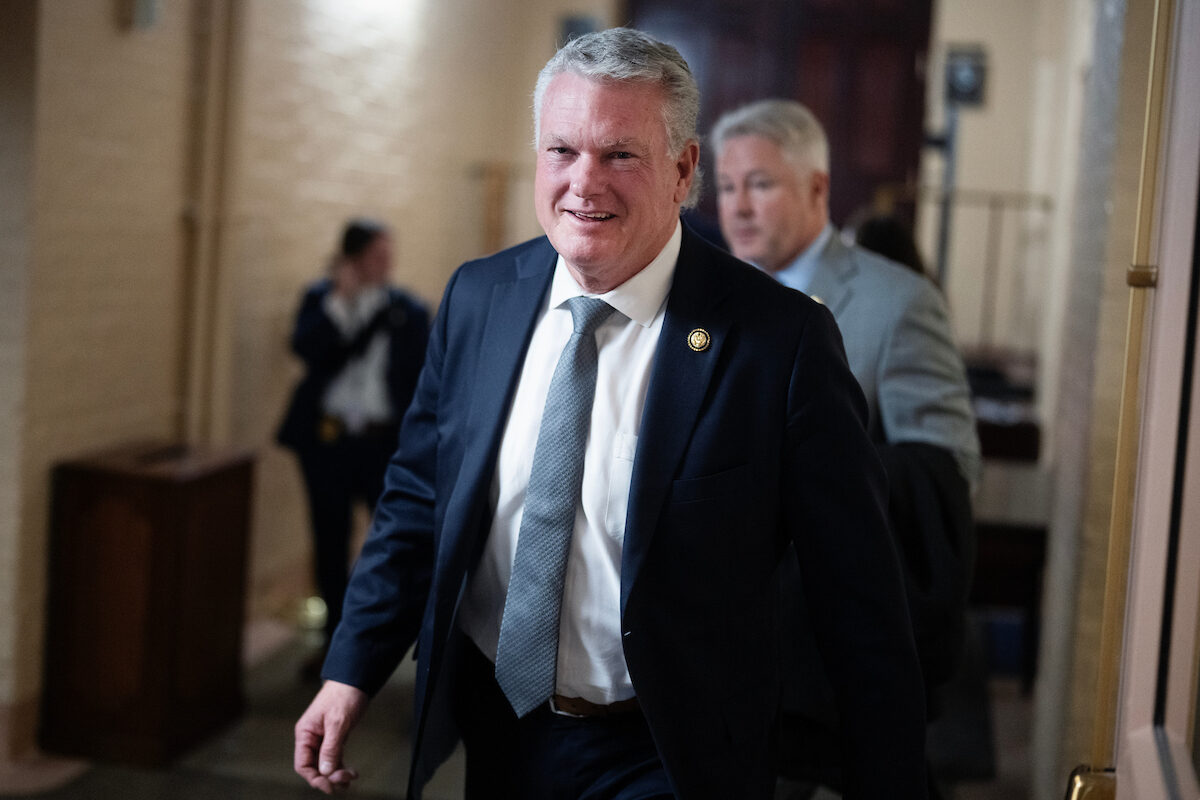
A pair of Republicans endorsed by Donald Trump won their Senate primary runoffs Tuesday, but the president suffered a setback in a Republican gubernatorial contest for the second time this month.
In Georgia, Rep. Mike Collins claimed the GOP Senate nomination, two days after picking up Trump’s support, while the president’s pick in neighboring Alabama, Rep. Barry Moore, comfortably prevailed in his runoff in the deep-red state.
But Trump’s choice in Georgia’s open governor’s race, Lt. Gov. Burt Jones, lost to wealthy health care executive Rick Jackson, who poured millions of dollars of his own money into the race to succeed retiring Republican Gov. Brian Kemp. Jackson will face Democrat Keisha Lance Bottoms in November.
Jones’ defeat follows GOP Rep. Randy Feenstra’s loss in the gubernatorial primary in Iowa earlier this month just days after securing Trump’s support.
Collins was leading former football coach and first-time candidate Derek Dooley, 56 percent to 44 percent, just after 8:30 p.m. Eastern when The Associated Press called the race. He will take on Democratic Sen. Jon Ossoff in a high-stakes November contest that could determine which party controls the Senate.
Collins and Dooley both aligned themselves with Trump, but their styles were a study in contrasts. Collins, the founder of a trucking company and the son of a former congressman, has staked out a hard-line stance on immigration. He’s also a prolific social media user who’s drawn criticism for incendiary posts and faces a House Ethics Committee investigation over allegations of improper hiring and the misuse of congressional resources.
Dooley pitched himself as a political outsider, a profile he said would have made him more electable in a purple state against a well-funded Democratic incumbent. Dooley had the backing of the state’s popular Gov. Brian Kemp, a longtime friend who recruited him to run and campaigned extensively with him in recent months.
Republicans haven’t won a Senate race in Georgia since 2016, and Ossoff has the benefit of incumbency, a unified Democratic Party and a massive war chest. On the campaign trail, he has largely ignored both Collins and Dooley and focused on Trump, a strategy that has sparked talk of a potential 2028 presidential run.
But South Carolina Sen. Tim Scott, who leads the Senate Republican campaign arm, predicted that Ossoff’s political ambitions “will come to a screeching halt this November.”
“Georgia is now uniting behind Mike Collins, because he fights for the future of the Peach State and knows how to win,” Scott said in a statement. Trump won Georgia by 2 points in 2024.
Ossoff, meanwhile, dismissed Collins in a statement as “a notorious bigot [and] antisemite … who is only a congressman because his daddy was a congressman.”
Alabama and Oklahoma
In Alabama, Moore was leading former Navy SEAL Jared Hudson, 59 percent to 41 percent, at 10:17 p.m. Eastern time when the AP called the Republican primary runoff. The seat is being vacated by Republican Sen. Tommy Tuberville, who opted to run for governor this year.
Moore, a member of the hard-line conservative Freedom Caucus, will be the heavy favorite in the general election in a state Trump won by 30 points in 2024. He secured the president’s backing earlier this year and leaned heavily on that endorsement throughout the primary campaign.
“Barry has been a powerhouse in Congress, and Alabamians made it clear that they are ready for his voice in the U.S. Senate,” Scott said in a statement Tuesday.
The Republican primary for Senate in deep-red Oklahoma will not be heading to a runoff after Rep. Kevin Hern easily vanquished four largely unknown opponents Tuesday, according to the AP. Hern enters the general election as the front-runner for the seat previously held by Republican Markwayne Mullin, now Trump’s Homeland Security secretary.
Also in Oklahoma, the GOP primary for the open governor’s race is moving to an Aug. 25 runoff after no one took more than 50 percent of the vote. Attorney General Gentner Drummond and former state Sen. Mike Mazzei, who has Trump’s backing, will face off for the Republican nomination, the AP projected. The winner will take on Oklahoma House Minority Leader Cyndi Munson, who easily won the Democratic primary Tuesday.
House contests
Hern’s Senate run opened up his 1st District seat, which is anchored by Tulsa in northeast Oklahoma. State Rep. Mark Tedford and Trump-endorsed pastor Jackson Lahmeyer were leading a crowded Republican field with 32 percent and 26 percent, respectively, when the AP projected the race would move to an Aug. 25 runoff.
Lahmeyer, who launched the group Pastors for Trump before the 2024 presidential race, said this week that he had “crossed a boundary” by sending text messages to a former Miss Oklahoma USA, who had worked as a fundraiser for his campaign. After the allegations were reported by The Daily Mail on Sunday, Trump reaffirmed his support for Lahmeyer, who unsuccessfully challenged GOP Sen. James Lankford in 2022.
In Georgia’s open 11th District, neurosurgeon John Cowan defeated former congressional aide Rob Adkerson, the AP reported, in the GOP runoff for the seat of retiring Republican Rep. Barry Loudermilk. With 91 percent of the vote in, Cowan had 65 percent to 35 percent for Adkerson, who was Loudermilk’s chief of staff. Cowan, who is heavily favored to prevail in November, lost a primary for a neighboring House district in 2020 to Republican Marjorie Taylor Greene.
In California, the special election for the seat Democrat Eric Swalwell vacated amid sexual assault allegations is heading for an Aug. 18 face-off between the top two finishers, with no one projected to take a majority of the first round vote, according to the AP. Democratic state Sen. Aisha Wahab, who was leading the all-party primary with 42 percent shortly after midnight, took one of those spots. The other remains uncalled, with Democrat Melissa Hernandez, the president of the Bay Area Rapid Transit board, in second place with 17 percent. Wahab and Hernandez advanced out of the regular primary for the seat earlier this month and will compete in November for a full term.
And Democrats in the nation’s capital picked D.C. Councilmember Robert White as their nominee to succeed Del. Eleanor Holmes Norton, who is retiring as D.C. nonvoting House delegate. White’s victory all but guarantees him a general election win in the deep-blue stronghold.