GOP leaders tried to quell McConnell health questions. It’s not working
With public trust near record lows, Congress needs to do more, transparency advocates say
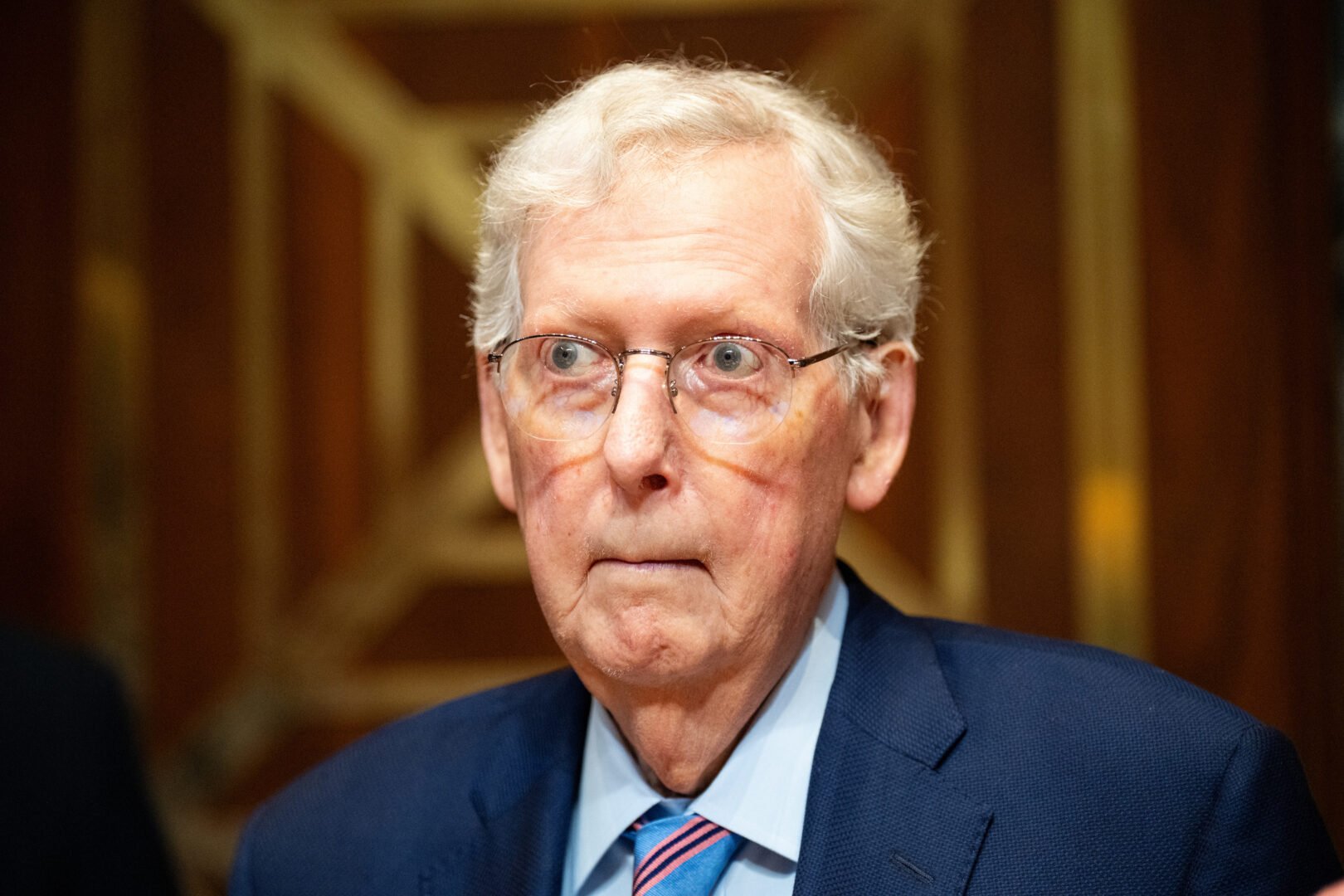
As online speculation swirls over Sen. Mitch McConnell’s hospitalization and scant public updates from his staff, the Kentucky Republican’s top allies spoke up this week, insisting he remains alert. But those assurances have done little to quash demands for proof of life, including from the state’s governor.
The episode has reignited a debate over lawmakers’ medical privacy in an era when experts warn that silence can quickly turn into misinformation and spiral out of control.
McConnell, 84, was hospitalized on June 14 with unspecified health issues. His office has said he “continues to improve” but disclosed no details. Paramedics performed CPR on an individual experiencing a “cardiac arrest” at a known address for McConnell, multiple news outlets reported, citing police scanner audio.
Since then, it’s mostly been crickets from his office.
Kentucky’s Gov. Andy Beshear on Wednesday sent a letter to McConnell’s office requesting an update on the “current status” of his health.
“Allowing speculation to continue in the media is not fair to the Senator or to Kentuckians,” Beshear, a Democrat, said in a statement.
Lawmakers are not bound by ethics rules to share any medical records with the public, and a hush-hush culture around their health is nothing new in D.C. But the recent absences of McConnell and Rep. Thomas H. Kean Jr. have frustrated transparency advocates and highlighted how politicians are struggling to control today’s AI-supercharged online ecosystem.
Rumors have continued to spread wide. One post from conservative activist Laura Loomer claimed the senator is in a “vegetative state” — resulting in a factcheck page from Snopes calling it “unproven” — while others proposed nefarious reasons his wife, Elaine Chao, would have remained in China for days while McConnell was hospitalized.
As public trust in government bottoms out, elected officials aren’t grasping the urgency and need to do more, some say.
“This vacuum of information is what misinformation feeds on. It’s the fuel for conspiracies, because when people don’t have answers and they don’t have facts, they’re going to make up their own,” said Abigail Bellows, senior policy director for anti-corruption and accountability at Common Cause.
On Tuesday, in what appeared to be a belated attempt to stop the speculation, several Republicans released statements citing recent conversations with McConnell.
A spokesperson for Senate Majority Leader John Thune, R-S.D., said he and his predecessor spoke by phone Monday. “They had a lengthy and substantive conversation that covered a variety of topics, including national security.”
Senate Majority Whip John Barrasso spokeswoman Kate Noyes said he and McConnell had a “lengthy,” roughly 20-minute phone call early Tuesday afternoon, adding he “was fully engaged and is eager to get back to the Senate.”
Similarly, GOP strategist Scott Jennings posted to X that the two “talked for just shy of 20 minutes” on Tuesday “about IRAN, UKRAINE, the unfolding situation in MAINE, my visit to the TR Presidential Library, and even a little bit of Senate history. I told him we want to see him back at work as soon as possible.”
But it did little to dampen the rumor mill, with some noting similarities between the statements.
Rep. Thomas Massie, R-Ky., joked on X he also spoke to “McConnell for about 20 minutes this morning,” quipping the senator “said we should end the war with Iran, quit giving aid to Israel, stop spying on Americans without a warrant, and he’s really sorry about how my primary turned out.”
‘Nowhere else in America’
While people may expect their elected representatives to be transparent, there are few ways to enforce it — leaving constituents on their own, said Sarah Binder, a senior fellow in governance studies at Brookings and a professor of political science at George Washington University.
“When there’s a lack of reputable information, people spin stories, and it’s very easy to do that in a world of social media,” she said.
McConnell’s absence comes after Kean, a Republican from New Jersey, put House GOP leaders in an uncomfortable spot, refusing to provide details of his whereabouts for almost four months as he missed more than 140 roll call votes.
When he returned to D.C. on June 30, he revealed he was being treated for depression.
“If it were me, I would have been more specific about that, and I encouraged him to be,” Speaker Mike Johnson said at a news conference.
Kean’s staff had offered limited updates and done little to tamp down conspiracy theories, telling the New Jersey Globe in March that the congressman was addressing a “personal health matter” and later saying, “There’s no cameras where Tom is.”
In a brief speech on the House floor marking his return, Kean described himself “a private person by nature,” fueling debate about the right to privacy and how much elected officials should be allowed.
While some on the Hill, including veterans with post-traumatic stress disorder, have challenged political taboos in recent years and moved to talk openly about their mental health, aging remains a more delicate topic. McConnell is not the first octogenarian to miss Senate work with little explanation.
Binder noted the case of the late Sen. Dianne Feinstein, D-Calif., whose office didn’t disclose full details of the severity of complications from a shingles outbreak before her return from an extended absence. And former Rep. Kay Granger, R-Texas, missed votes in 2024 and was found by local reporters weeks later at a senior living facility, with her son describing “dementia issues.”
Meanwhile, the average age for members in both chambers has ticked up in recent decades, landing last year at 64 in the Senate and 58 in the House.
“An aging Congress — or an aging Senate, in particular — is more likely to generate these types of health episodes,” Binder said.
A more than five-decade age gap separates the Senate’s oldest and youngest lawmakers: Sens. Charles E. Grassley, 92, and Jon Ossoff, 39. “That means that there’s lawmakers who are at different points in their lives. We have to find a common-sense approach that still respects some degree of privacy as lawmakers contend with health challenges, but tilts far more in the direction of transparency,” Bellows said.
Some, like Bellows, want to see the chambers establish rules for handling lawmakers’ extended absences, along with health disclosure requirements for political candidates. But asking members of Congress to police themselves can be a tall order.
“I don’t quite see any real enforcement mechanism that lawmakers themselves would be willing to vote for,” Binder said.
Even if Congress were to set down rules in writing, they would be “a floor, not a ceiling,” Bellows said. “Really, the onus is on lawmakers to go above and beyond to meet what their constituents expect in order to preserve public trust.”
Congress’ job approval neared record lows this April, according to Gallup polling, while Pew research last fall showed just 17 percent of Americans said they trust the government in Washington to do what is right most or all of the time.
“This is a time when Congress has diminishingly low public trust ratings, and so Congress has some work to do,” Bellows said. “Nowhere else in America can you miss work for weeks on end without telling the person you work for where you are and when you’ll be back.”
Nina Heller contributed to this report.