How to serve up a year-old bill
Both Republicans and Democrats search for a midterm recipe
Standing on the stage of a local high school in his reliably red Nebraska congressional district last week, Republican Rep. Mike Flood replied to a constituent who asked about disability benefits.
“Well, under the one big beautiful bill —” he began on the livestream, then paused. The crowd had erupted into boos at the mention of the bill.
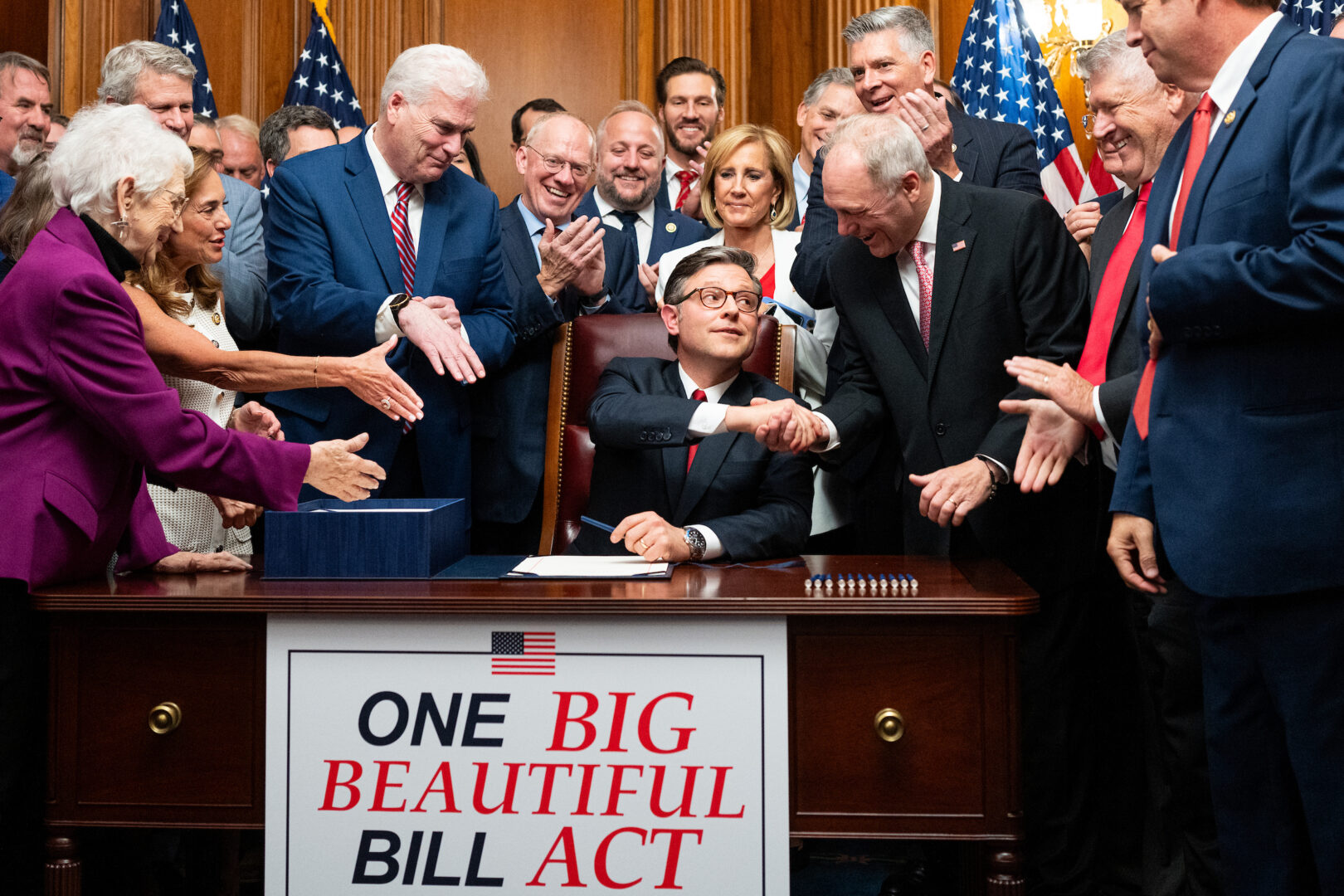
A year after President Donald Trump signed into law the party’s flagship reconciliation measure dubbed the “one big beautiful bill,” Republicans are repackaging it into bite-sized messages that are centering the party’s platform ahead of tough midterm elections.
That’s even as the sweeping law as a whole — which enacted permanent tax cuts and temporary breaks promised by Trump while slashing Medicaid, federal food stamps and student loan programs — has polled poorly in key battleground districts.
Republicans pivoted, renaming it the “Working Families Tax Cuts” measure and advising GOP members to treat it as a “menu” of policy, picking specific provisions that will resonate with their unique districts.
Meanwhile, Democrats are taking the easy opportunity to double down on the law, labeling it as a “political albatross” for vulnerable Republicans and calling it the “big ugly bill.”
But for both parties, a struggle remains: How do you get voters to care about legislation that passed over a year ago when most of them only begin to engage in the midterm election cycle after Labor Day?
Trump 1.0, Biden
If campaigns of years past are any indication, it’s a tough feat to pull off, said David Winston, a Roll Call columnist who is a Republican strategist and pollster.
The party faced a similar dilemma in Trump’s first midterm cycle with the previous iteration of his sweeping tax cuts, Winston said, because there “was not a clear understanding that the Tax Cuts and Jobs Act of 2017 was in fact going to lower taxes for everybody.”
That measure — which permanently cut corporate tax rates and temporarily reduced individual rates and increased the standard deduction — did not have an outsize impact on the midterms, Winston said. “By the time you got to the 2018 elections, only about a third of the country thought they had gotten a tax cut,’’ he said.
In other words, big bills don’t always help the party in power, especially if voters aren’t feeling the promised benefits.
Democrats had a similar issue with the Biden-era pandemic relief law and the party’s landmark climate, tax and health care law called the Inflation Reduction Act, which together unlocked trillions in investments for American communities. Ahead of the 2024 presidential election, a Washington Post-University of Maryland poll on climate policy reported 71 percent of voters said they knew “little” or “nothing at all” about the Inflation Reduction Act.
In another parallel to the “big beautiful bill,” Democrats also had naming regrets. Amid reports that the Inflation Reduction Act wasn’t reducing inflation, Biden said at a 2023 fundraiser, “I wish I hadn’t called it that because it has less to do with reducing inflation than it has to do with providing alternatives that generate economic growth.”
Slicing and dicing
Mike Marinella, press secretary for the National Republican Congressional Committee, said Republicans are taking a 50-50 approach, looking back at the big beautiful bill while promising more to come.
“The message is, ‘Look at all the things that we did this Congress — in just the two years we turned this ship around from Joe Biden’s disastrous inflation,’” he said. “‘Give us two more years to finish the job.’”
Instead, Republicans are treating the “Working Families Tax Cuts” as an a la carte menu, where members can choose which provisions to highlight in their districts. Among the most popular: the “no tax on tips” deduction for some workers, the creation of Trump Accounts, the increases for the standard tax deduction and the child tax credit.
As for the town hall, Flood said in an interview that the hecklers were “performative Democratic operatives” in the room who were “encouraged and motivated to throw shade at the one big beautiful bill.”
“To some extent, the Democrats have gotten out front with some of their messaging,” he said. “But when you start listing off what the bill does, it resonates with people.”
In his district, for example, Flood touts the law’s expansion of low-income housing tax credits and cap increase on the federal estate and gift tax exemption, which he called a “huge win” for farmers and ranchers.
“Anytime you use reconciliation, it’s a one-party process. From the first day that reconciliation starts, there’s going to be angst and messaging against it, and that’s the problem with where we’re at right now,” he said, referring to the budgetary maneuver that both parties have relied on in recent years to push through their priorities. “Democrats have done a good job of fearmongering.”
For one thing, the name change does get confusing, Flood admits.
“The challenge is the die has been cast. You gotta call it what people know it by,” he said. “As you saw in [the town hall], I said the ‘one big beautiful bill.’ I probably should have used the other name.”
Some of the law’s flashier highlights, like the new tax break for tips, have gotten more attention, Winston said, but the increase in the standard deduction has an even broader impact and affects a larger number of voters.
“Part of the challenge here is making people aware of what would have happened if, in fact, [last year’s bill] hadn’t passed,” Winston said. “Then suddenly, if you’re married, you have to pay taxes on an additional $13,400 worth of income.”
Meanwhile, Democrats are operating under the belief that they have already won the messaging war on the legislation itself, said Viet Shelton, spokesperson for the Democratic Congressional Campaign Committee.
“Republicans are running around and trying to sell something that the American public has already said, ‘We’ve tried it and we hate it,’” Shelton said. “Republicans are saying, ‘Here’s a bottle of poison. If I rename it, do you want to buy it from me?’ No, most people would stare at you and say, ‘I just saw you get rid of the crossbones logo and put a Walmart logo on it.’ That doesn’t actually make a difference.”
Daniela Altimari contributed to this report.