Will El-Sayed play in Pontiac come November?
Democrats should be wary of ‘vote blue no matter who’
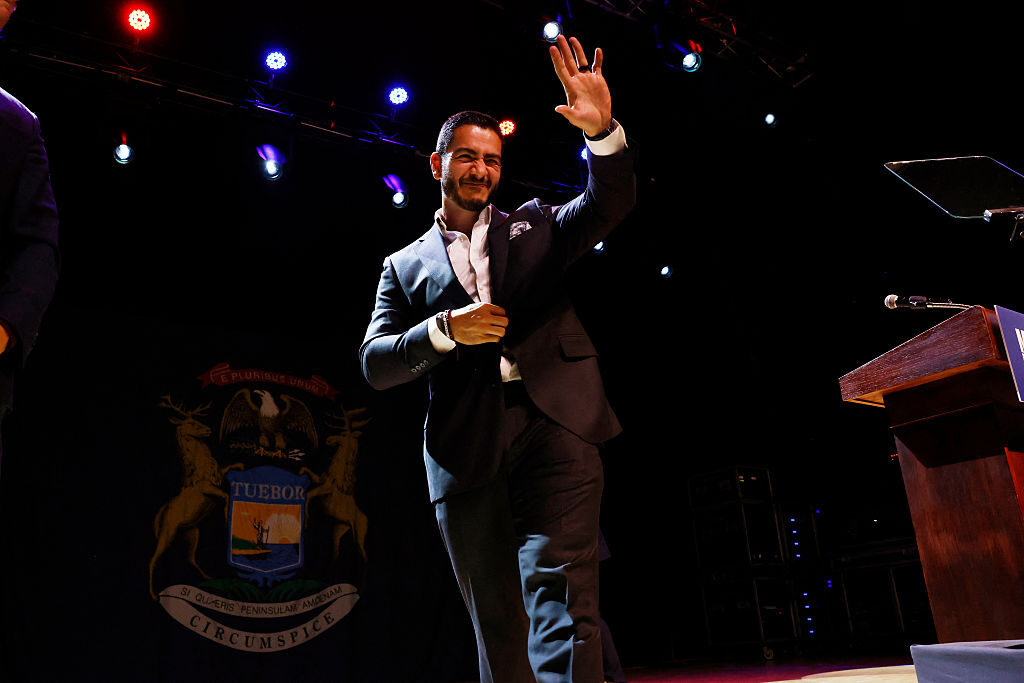
Could Mike Rogers have asked for a better outcome in the Michigan Democratic Senate primary? Doubtful. A photo finish campaign with one of the most extreme Democratic candidates squeaking out the narrowest of wins over an opponent supported by most of the party’s establishment.
State and national Democratic leadership will, no doubt, gather together for a unity photo-op to allay fears of post-primary divisions and turn their efforts to beating Rogers, a centrist Republican who came razor close to beating now-sitting Sen. Elissa Slotkin in 2024.
But defeating Rogers this time around, with a controversial candidate like Abdul El-Sayed, is likely to be a tougher climb, with El-Sayed underperforming polling numbers leading up to the election.
The Real Clear Politics polling average gave El-Sayed a 10.2 percent lead on Election Day. It wasn’t until 10 a.m. the following morning, with about 99 percent of the votes counted, that the race was finally called by the media. El-Sayed had won but with an extremely narrow and surprising 48.5 to 47.5 percent lead over Haley Stevens.
Interestingly, Mallory McMorrow, despite withdrawing from the race a month before, garnered 4 percent of the vote, which was large enough to be a decisive element in the race. In terms of actual votes, El-Sayed was leading by roughly 15,000 out of over 1.5 million votes cast; Morrow won more than 61,000 votes.
This was certainly not the comfortable victory that the surveys predicted. Now, the prognosticators have to assess the odds for the fall with little data on a head-to-head matchup between Rogers and El-Sayed. In the two surveys taken in July on the RCP site, one had Rogers and El-Sayed tied, and the other had Rogers up by 3.
This sets up one of the most critical Senate races for the fall. For Democrats to win a majority in the Senate, they have to win four Republican seats. If Rogers wins in November, and his odds have now improved literally overnight, Democrats would have to run the table by winning five Republican Senate seats, a tall order. Excluding Maine, which Kamala Harris won by 7 points, and North Carolina, which President Donald Trump only won by 3, the remaining four states in play were all won by Trump in 2024 with double digits — Ohio (11), Iowa (13), Alaska (13), and Texas (14). The last Democrat to win a Senate race in Texas was Lloyd Bentsen in 1988.
That doesn’t mean these Republican senators are a shoe-in, and the president’s popularity in key states has taken a beating. But defeating them all won’t be easy for Democrats even in a challenging environment for the GOP.
Without exit polls, finding answers to why El-Sayed’s margin was more nail-biter than big victory is difficult and will take some in-depth analysis of each candidate’s vote geographically and, if possible, ideologically. But for the Rogers’ campaign, there are some lessons that can be had from the 2024 Michigan Senate election exit polls.
First, in terms of political self-identification, according to the exit polls, independents made up the largest group of Michigan voters at 35 percent, with Republicans at 34 percent and Democrats at 31 percent. Both Trump and Rogers lost independents, by 4 points and 7 points, respectively. If Rogers had matched Trump’s performance with independents, he would be the senator today.
Reaching out to independents, who will likely determine this fall’s election, with a strong economic message must be the Rogers campaign’s top priority.
More positively, the Michigan electorate is far from the progressive and socialist ideology that seems to be taking over the Democratic Party. By ideology, the exit polls found that moderates were the largest group (41 percent) ahead of conservatives (35 percent), with liberals trailing at 25 percent.
Nationally, an August 2025 Gallup poll testing the issue of capitalism versus socialism is also good news for Rogers. When voters were asked whether they had a positive or negative view of socialism, 66 percent of Democrats viewed it positively, while only 38 percent of independents agreed. When it came to capitalism, 54 percent of voters had a positive view and 42 percent a negative view, a figure that should raise a flag for both parties.
If that ideological bent, however, still holds, Rogers’ pro-capitalism stance is a big plus against El-Sayed, who calls himself a capitalist but whose issue positions and well-known supporters, from Bernie Sanders to AOC to Hasan Piker, put him in the socialist camp.
The question hanging over the El-Sayed campaign is whether a socialist platform will “play in Pontiac,” to coin a phrase. Given his own personal controversies, will Abdul El-Sayed turn out to be more Graham Platner than palatable progressive?
Like Platner, El-Sayed is apparently comfortable campaigning with Piker, a virulent antisemitic, left-wing activist who among other things has said, “America deserved 9/11,” though he tried to walk back the comment after receiving heavy criticism. Piker also claims to be a socialist, but has said, “Communism is supposed to be the end stage. It’s like the final goal” and has praised Mao as “one of the great leaders of this world.”
The 2024 exit polls also showed that women comprised 55 percent of the Michigan electorate, with Slotkin winning women by 9 points, a larger margin than Harris (6). Slotkin was also able to create some separation from Biden’s unpopularity. Among the 11 percent of the electorate that somewhat disapproved of Biden’s performance, she won over half of those voters.
That means that tying her to Biden wasn’t enough to disqualify her, even among voters who somewhat disapproved of him. Given Trump’s negative poll numbers, Rogers has to be concerned with the president’s impact in Michigan, but the 2024 exit polls show that at least a portion of Michigan voters who had a negative view of the sitting president were open to a candidate of the same party.
The Michigan Senate race will be one of the most competitive Senate races this fall, one that will test the power of the progressive and socialist left — but it is more than that. Whether El-Sayed wins or loses, the outcome will seriously impact the Democratic presidential primary process that will unofficially kick off Nov. 4.
For Democrats now demanding post-primaries “vote blue no matter who,” be careful what you wish for.
David Winston is the president of The Winston Group and a longtime adviser to congressional Republicans. He previously served as the director of planning for Speaker Newt Gingrich. He advises Fortune 100 companies, foundations and nonprofit organizations on strategic planning and public policy issues, as well as serving as an election analyst for CBS News.