As Roy Cooper leads in polls, Democrats aren’t measuring the drapes yet
Both sides brace for fall Senate spending spree in North Carolina
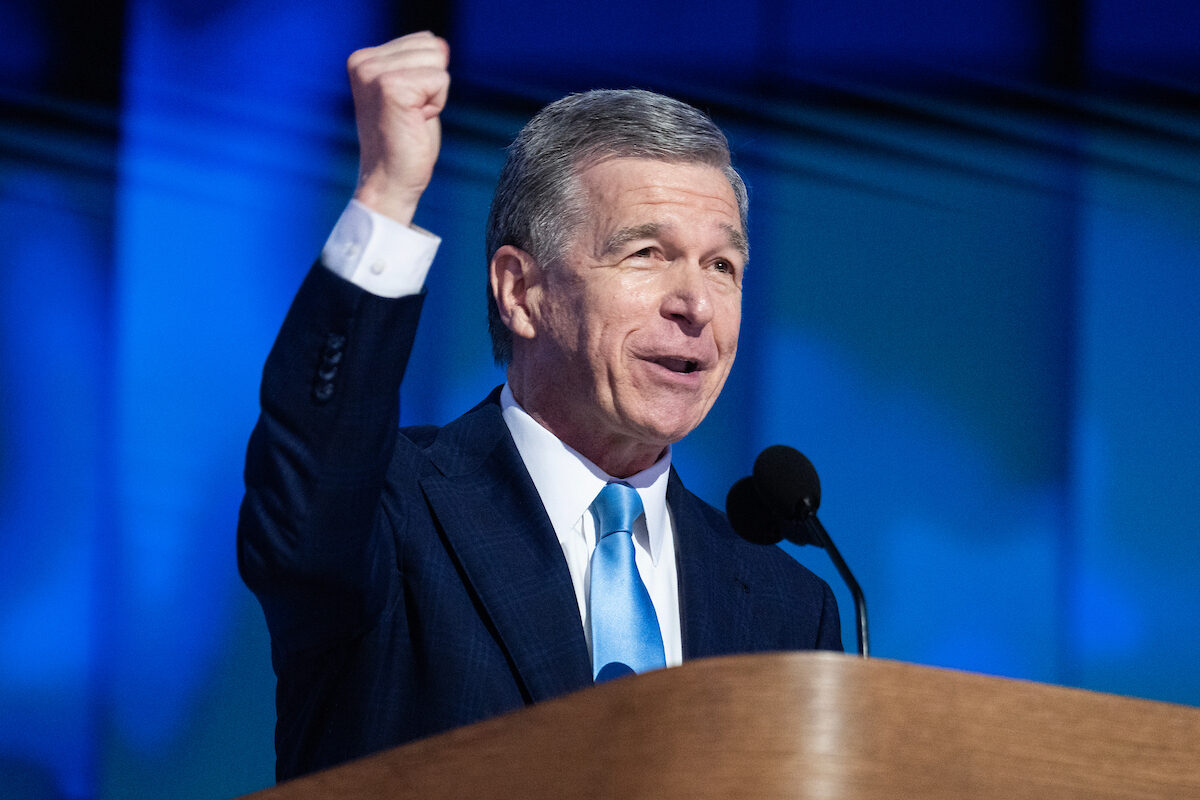
North Carolina Democrat Roy Cooper has broad name recognition as a former governor.
His Senate campaign is flush with cash.
And he enjoys a robust lead over Republican rival Michael Whatley in almost every public poll.
“This is the first time [Democrats] have had the wind at their backs in a long time,’’ said Christopher A. Cooper, a political science professor at Western Carolina University (and no relation to the Democratic nominee.) “It’s a bad year for Republicans, a good year for Democrats, and Donald Trump is underwater.”
But in a state that voted for Trump three times and hasn’t elected a Democrat to the Senate in nearly two decades, officials on both sides say they expect the race to succeed retiring Republican Sen. Thom Tillis to tighten considerably over the next three months.
The contest between Cooper and Whatley, the former chairman of the Republican National Committee, in a pivotal purple state could help determine control of the Senate, even as it has been largely overshadowed by high-stakes battles elsewhere on the map.
“If the money’s there for Whatley, he’s got a good chance to win it,’’ said Patrick Sebastian, a North Carolina-based Republican consultant and pollster not affiliated with the campaign. “If it’s not there, he’s not going to win it. I hate to be so simple, but it really is about the freaking money.”
Whatley, 57, recently launched his first general election digital ad, a clip introducing himself and reaffirming his support for the tax cuts signed by Trump last year.
Cooper’s first ad, which debuted in early June, was a nostalgia-tinged tribute to small-town life and a pledge to protect consumers and advocate on behalf of working people.
Cooper reeled in a hefty $8.1 million through his main campaign account in the second quarter of the year and entered July with nearly $21 million on hand. Whatley’s campaign committee reported raising $2.9 million between April and June and ended the quarter with $3.5 million banked.
Crunch time
Both campaigns are bracing for a burst of post-Labor Day spending to boost the GOP nominee. A recent Supreme Court decision cleared the way for political parties nationwide to spend unlimited amounts on behalf of candidates in federal elections. The Republican National Committee has a huge financial advantage over its Democratic counterpart, and Whatley, as its former leader, stands to benefit from some of that cash. Republicans are also hoping his close ties to Trump will loosen the purse strings of MAGA Inc., the president’s PAC.
At the end of June, Republicans had $58.6 million in ad reservations for the North Carolina Senate race, compared with $45.4 for Democrats, according to AdImpact.
As the spending ramps up, there are already signs of a shift. A July 10-11 Public Policy Polling survey found Cooper at 48 percent to 44 percent for Whatley. (The poll did not include Libertarian candidate Shannon Bray.)
In the meantime, both sides are honing their messaging. Whatley’s campaign has sought to portray Cooper as a “soft-on-crime” insider who is far too liberal for the state’s swing voters. And, the GOP candidate’s spokesman added, Cooper hasn’t been able to break the 50 percent polling threshold even after decades in public life — beginning in 1986, when he won a seat in the General Assembly, through four terms as state attorney general and two terms as governor.
“Career politician Roy Cooper started this campaign with the two perks of five decades of political office: universal name ID and a rolodex filled with left-wing donors,’’ DJ Griffin, spokesman for the Whatley campaign, said in a statement. “But now, even after spending millions on revisionist history TV ads, Cooper is still stuck where he started at 48 percent.”
And on Wednesday, the main super PAC for Senate Republicans unveiled a $17 million ad blitz to support Whatley. The digital, broadcast and streaming campaign by Senate Leadership Fund takes aim at Cooper’s long public service record and is tied together by the slogan “40 Years is Enough.”
Cooper’s campaign has focused on affordability, painting Whatley as a GOP power player who walks in lockstep with Trump and pointing to his work as a lobbyist for Duke Energy while the utility company was raising rates.
“From supporting the Iran war that has sent gas prices and his own stock portfolio skyrocketing, to making millions lobbying for utility companies including Duke that raised rates on families and leading the charge to double health care premiums, Michael Whatley’s policies have spiked costs for working families while he lined his own pockets,’’ Cooper campaign spokesperson Sam Chan said in a statement.
WinSenate, a group aligned with Democrats’ Senate Majority PAC, launched Friday a $2.25 million digital ad attacking Whatley’s appointment of a convicted sex offender to a party position when the candidate led the state GOP.
A top recruit
Cooper, 69, has burnished an image as a mainstream Southern Democrat with a history of compromising with Republicans and decades of experience in elective office.
His decision to seek the Senate seat was widely seen as a recruiting win for Democrats in their push to flip control of the chamber.
In a year when the party has favored populist outsiders running on promises of generational change and when democratic socialists have dominated the news cycle, Cooper represents a throwback to an earlier era, said political science professor Christopher Cooper.
“He’s not the most exciting person on the stump. He might even be one of the least exciting. … And I think that is to some degree a compliment,’’ the professor said, before pointing to more controversial recent candidates such as Mark Robinson and Graham Platner. “He reads like a politician from a different era, before we had conversations about [the] Nude Africa website in North Carolina, and before people in Maine had conversations about Reddit posts that are misogynistic to the Nth degree.”
Sebastian, the GOP consultant, said he doesn’t view Roy Cooper as “some rock star where there’s no chance of him ever losing.”
“In a lot of ways he does have a glass jaw, but no one’s ever had the money to really pack a punch hard enough to break it,’’ Sebastian said.
“If Cooper’s financial advantage ends up being massive, and the president’s approval rating is struggling here, then it’s going to be tough,” he added. “But we have a long way to go.”