Guns, voting and immigration on deck for Supreme Court
Justices face big fights and possible litigation over midterm elections in new term
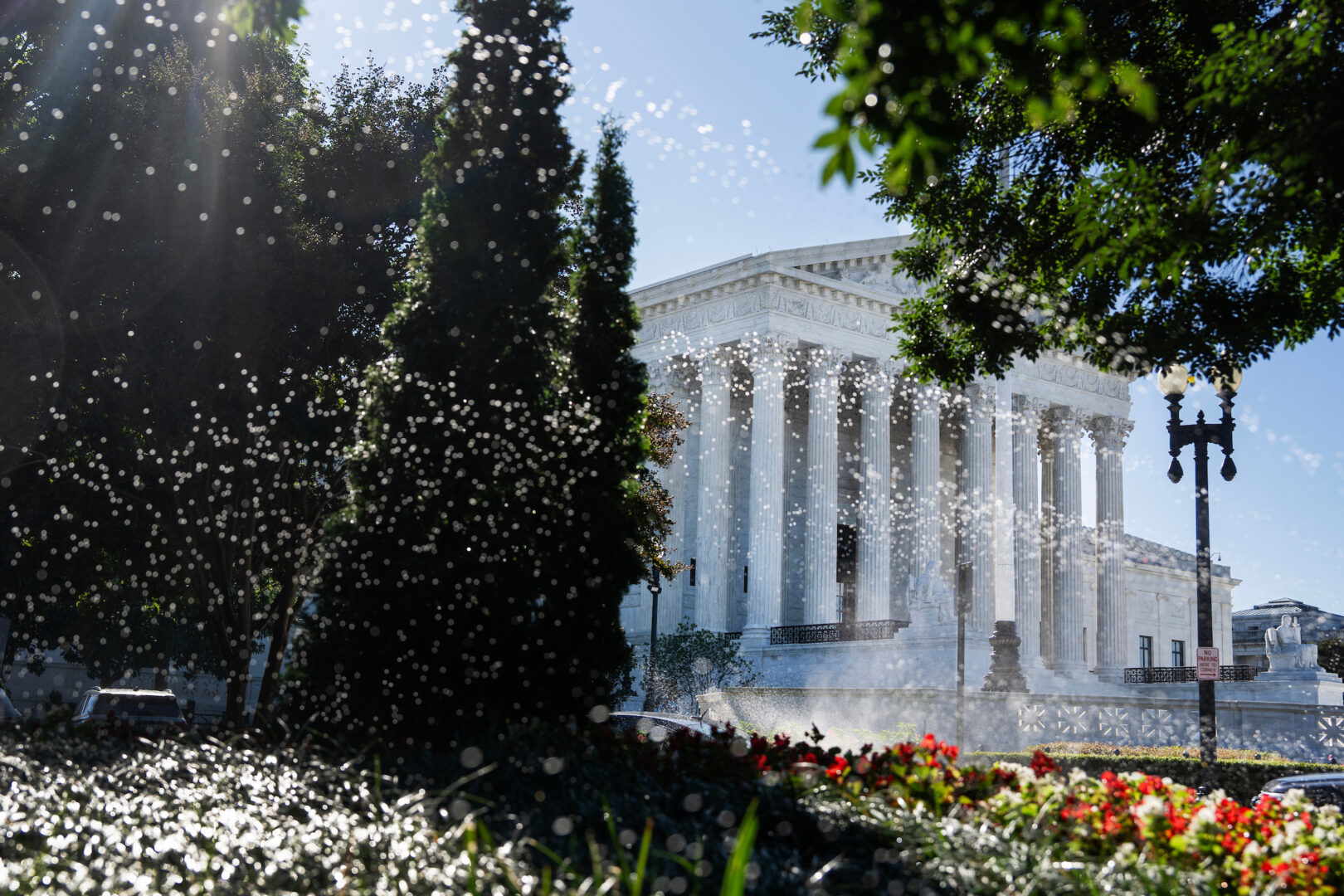
The Supreme Court begins its new term Monday facing cases on Americans’ civil rights, federalist struggles between states and the federal government, and the looming specter of more last-second litigation over the coming midterm elections.
The court, currently controlled by six conservative appointees, has stocked its docket with fights over climate change, voting rights, gun rights and the power of the government over immigrants. It follows a term where the court addressed even more explosive issues like LGBTQ rights, race in redistricting and President Donald Trump’s attempt to redefine birthright citizenship.
While it may look like fewer blockbuster cases this time around, experts like Brianne Gorod of the Constitutional Accountability Center say they are still on the way.
“Just because there’s an absence of cases involving Trump administration policies, that doesn’t mean they are not coming,” Gorod said.
A number of cases working their way through the courts could potentially come up this term, including on the Trump administration’s push to unilaterally cancel spending mandated by Congress, as well as disputes over his latest efforts to enact worldwide tariffs.
And all eyes will be on the justices’ expanding emergency docket, where an increasing number of major cases have landed. That’s where the justices decide issues faster than normal — frequently in a matter of days or weeks rather than months — but without full arguments from both sides.
Immigrants, guns and voting rights
In the past few decades, the justices have typically heard between 45 and 80 cases a term and routinely grant new ones for argument over the course of the year.
That came up this week when the justices agreed to hear two major challenges to Trump’s immigration policies. One, Department of Homeland Security v. D.V.D., et. al, covers the administration’s use of so-called “third-country removals” — sending an immigrant to a country other than their home country.
The second, Barbosa da Cunha v. Freden, covers the administration’s attempt to detain almost every immigrant without legal status indefinitely pending their removal proceedings. That policy has affected tens of thousands of immigrants and drawn hundreds of court rulings against the administration.
The justices are also set to hear a major gun rights dispute, over the constitutionality of local laws that ban “assault weapons” such as the AR-15, in Viramontes v. Cook County. Many experts expect the ban to face skepticism from the court, which has ruled in several cases recently to expand gun rights.
Joseph Blocher, a Duke University professor who specializes in firearms law, said the case is the first time the justices will address a ban on a particular kind of weapon. Congress previously passed a similar ban in a federal law that lapsed in 2004.
Blocher said the case could impact the power Congress and the states have to regulate high-caliber rifles, machine guns, high-capacity magazines, bump stocks and other firearms or accessories.
“All these other kinds of either weapons or weapons accessories that have big functional differences and potential serious implications for how those guns work for purposes of self-defense or for purposes of mass murder — that’s a hard thing for constitutional law to navigate. But that’s really what this case is about,” Blocher said.
Robert Cottrol, a law professor at George Washington University, said at a recent law school event that the case could also implicate Congress’ 90-year-old regime restricting machine guns known as the National Firearms Act.
“If these cases come out the way I think they’re going to take, how do they do that and not touch the 1934 National Firearms Act?” Cottrol said.
Cottrol said the decision in the case will be the first time the justices address limits on particular firearms since a 2022 decision that established a new framework for analyzing gun control laws that require they have roots in the “history and tradition” of the colonial era.
The justices have also agreed to hear a dispute over whether Arizona can require voters to provide more proof of citizenship than is required for federal elections in Republican National Committee v. Mi Familia Vota.
The case is set for arguments in December, after the midterm elections. In that dispute the justices will decide whether a state can effectively force registering voters to prove their citizenship and whether federal law prohibits states from canceling registrations of purported noncitizens close to an election.
Arizona law requires proof of citizenship to register to vote, and in 2022 the state passed an additional law requiring officials to periodically check registered voters’ citizenship. Civil rights groups and voters challenged the law, arguing that the state system violated a national voter registration law that also barred voting roll purges close to an election.
George Washington University Law professor Alan Morrison said at a recent event that the case would likely turn on the justices’ interpretation of what Congress meant in the National Voter Registration Act when it said states could use an “equivalent” form to the federal one and require “necessary” documentation.
“They took this case to decide whether states can do this or not. Congress could change that, either to expressly authorize states to do it, or expressly prohibit states from doing it. And the question in this case is, what do you do when Congress has been less than clear?”
In the shadows
Aside from the merits docket — where the justices have full briefing and oral arguments over cases before issuing decisions — experts said an increasing number of important cases have come through in the court’s emergency process, sometimes called the “shadow docket.”
Renée Lettow Lerner, a professor of law at George Washington University Law School, said the emergency docket has grown massively since she served as a Supreme Court clerk in 1995.
“It hasn’t always been like this,” Lerner said at an event at the university last month. “There were always emergency motions, but nothing like the scale that there is today.”
In prior years, some of the court’s most substantial cases came through the emergency docket, including the challenge to Trump’s effort to redefine birthright citizenship and the challenge to the law banning social media giant TikTok from the U.S.
Already this term the justices have added an emergency docket case to its full argument schedule, when they accepted the dispute over third-country removals for arguments in December.
William Baude, a University of Chicago law professor who served on a panel on Supreme Court reforms in the Biden administration, told reporters last month that the justices may have little say over weighing in during the election.
“The ideal time for the Supreme Court to be pulled into an election would be never,” Baude said. “But obviously, they can’t always avoid that, and so I think they’re going to somewhat be hostage to events.”
There have been numerous lawsuits already where the Supreme Court weighed in last minute, including in disputes over Missouri’s congressional map and on whether the Trump administration could overhaul mail voting for the midterms.