When campaign rivals become Senate colleagues
Mike Rogers and Sherrod Brown could join rare company if they win this fall
ANALYSIS — There might be some awkwardness for Michigan’s and Ohio’s Senate delegations next year.
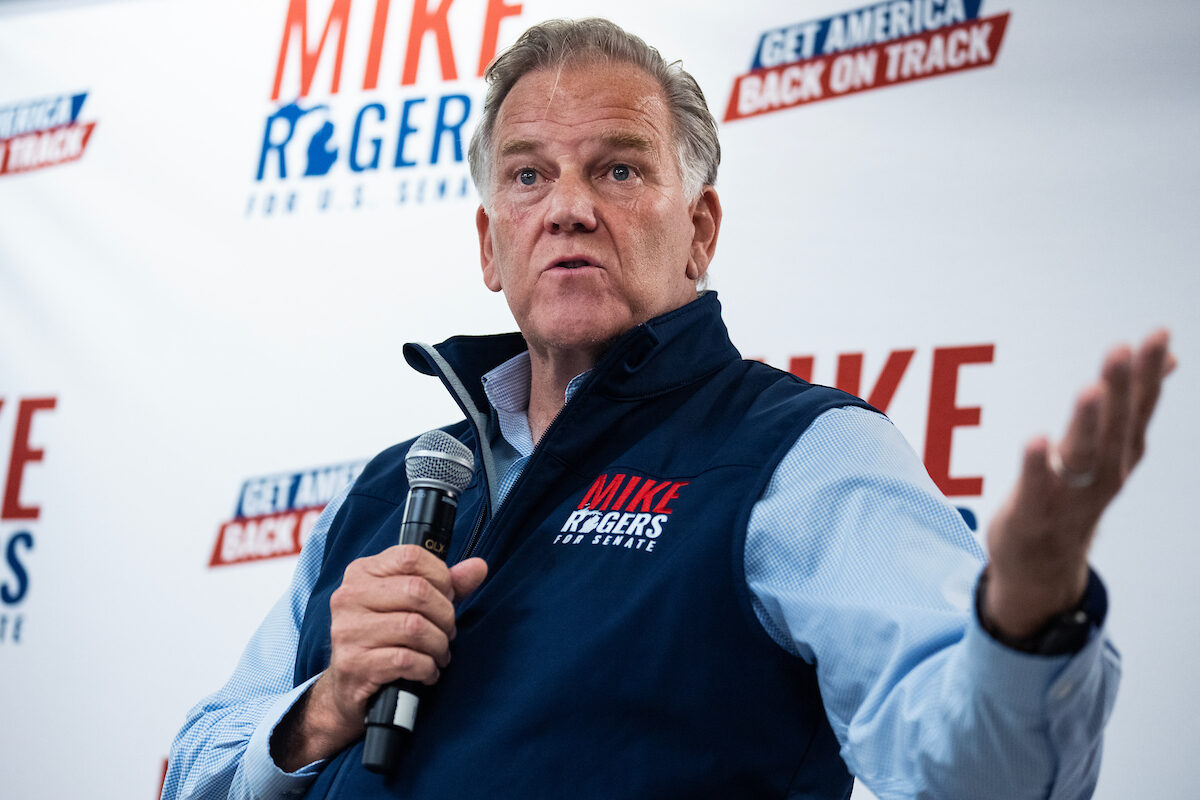
If Michigan Republican Mike Rogers and Ohio Democrat Sherrod Brown win in November, they’ll be serving alongside the senators who defeated them in 2024. But, surprisingly, such scenarios aren’t entirely unusual. We’ve had more than a dozen of them, and a pair of Oregonians showed that it doesn’t have to be contentious and can even benefit a state.
With an increase in partisanship, there’s been a decrease in the number of senators from the opposite party of their state’s leaning. In other words, fewer split delegations in the Senate.
In the current Senate, Democrat John Fetterman and Republican Dave McCormick represent Pennsylvania, Republican Ron Johnson and Democrat Tammy Baldwin represent Wisconsin and Republican Susan Collins and independent Angus King represent Maine. The other 47 states have two senators from the same party caucus.
But while King defeated Collins in Maine’s 1994 race for governor, none of the three odd couples have ever faced off for Senate. That could change next year.
Last cycle, Rogers lost a close race to Democratic Rep. Elissa Slotkin by less than half a point. This time around, he faces a more difficult political environment but a potentially more favorable opponent in former local public health official Abdul El-Sayed.
Brown lost reelection to Republican Bernie Moreno by 4 points in 2024, but he’s now running for Ohio’s other seat against appointed Republican Jon Husted. Brown gets a more favorable political environment this year but still has to overcome the partisanship of the state.
Both seats are at the center of the fight for the Senate majority, with Democrats needing a net gain of four seats to win control. Inside Elections currently rates the Michigan race as a Toss-up and Ohio as Tilt Republican.
A bipartisan opportunity
Brown’s comeback bid as a once-defeated senator is rare.
GOP Sen. Slade Gorton of Washington lost reelection to Democrat Brock Adams by 2 points during President Ronald Reagan’s second midterm in 1986. But Gorton came back to win the state’s other Senate seat by a similar margin two years later.
In other cases, losing was a stepping stone.
After GOP Sen. Bob Packwood resigned in 1995, Democratic Rep. Ron Wyden won a January 1996 special election for his open seat, defeating Republican state Senate President Gordon H. Smith by just over 18,000 votes out of more than 1.1 million cast.
At 6 a.m. the next day, Republican Mark Hatfield, Oregon’s other senator, called Smith to tell him he would be retiring and wanted him to run for his seat. Smith ended up winning the November election by 4 points, going from foes to colleagues with Wyden in less than a year.
“Even during the course of it, I could tell I could get along with Ron,” Smith recalled in a recent interview. “After I won the Hatfield seat, Ron and I reached out to each other. We agreed to have a truce and meet over breakfast and, before orange juice was poured, we’d become friends.”
After millions of dollars in attack ads, the mental transition must be difficult.
“Frankly, both of us felt embarrassed or apologetic or anxious to get beyond those,” said Smith, who emphasized that a bipartisan delegation presented an opportunity.
Before each Congress, Smith and Wyden would travel the state co-hosting bipartisan town halls. And they learned to adapt to political circumstances over the 12 years that they served together, a period that spanned Republican and Democratic Senate majorities and Republican and Democratic presidents.
“He’d work on his side of the aisle, and I’d work on mine,” said Smith. The former senator and his wife, Sharon, are now directors of church hosting for the Church of Jesus Christ of Latter-day Saints.
Other odd pairs
Smith and Wyden certainly haven’t been the only duo to shift from opponents to colleagues.
Brown and Moreno wouldn’t even be the first Senate pair from Ohio. In 1992, Republican Lt. Gov. Mike DeWine lost to Democratic Sen. John Glenn by 9 points, only to come back to win the state’s other Senate seat by 14 points two years later.
In Arizona, Democrat Kyrsten Sinema defeated Republican Martha McSally by 2 points in 2018, but both took office the following year after McSally was appointed to the state’s other seat. McSally lost a bid for a full term to Democrat Mark Kelly in 2020.
Current Senate Majority Leader John Thune of South Dakota lost to Democratic Sen. Tim Johnson in 2002. But two years later, he unseated Senate Democratic leader Tom Daschle, making him colleagues with his previous opponent.
In 1974, Republican Indianapolis Mayor Richard G. Lugar lost to Democratic Sen. Birch Bayh in Indiana, but they ended up serving together after Lugar defeated the state’s other Democratic senator, R. Vance Hartke, two years later.
Republican Chuck Hagel won the 1996 Senate election in Nebraska over Democratic Gov. Ben Nelson. But Nelson joined him in Washington after winning the state’s other Senate seat in 2000.
New Mexico Republican Gov. Edwin Mechem unsuccessfully challenged Democratic Sen. Clinton Anderson in 1954. But Mechem later came to Capitol Hill by appointing himself to the state’s other seat in 1962. (His tenure was short-lived, with Mechem losing the election for a full term two years later.)
The same decade, Conservative Party nominee James Buckley lost to GOP Sen. Jacob Javits in New York in 1968. But Buckley came back the following cycle to win the state’s other Senate seat in a very close three-way race.
In 1972, Republican former Rhode Island Gov. John Chafee failed to unseat Democratic Sen. Claiborne Pell. But, four years later, Chafee won the Ocean State’s other Senate seat and would be reelected three times.
About a quarter century later, Nevada Republican John Ensign lost an extremely close race to Democratic Sen. Harry Reid in 1998 (the final margin was 428 votes out of more than 435,000 cast) but won the state’s other Senate seat by 15 points two years later.
“Reid, under the theory of holding your friends close and your enemies closer, knew Ensign would win in 2000 and did not lift a finger to help his foe,” said legendary Nevada political analyst Jon Ralston, “He may even have helped Ensign behind the scenes.”
Even though their initial race was particularly nasty, Ensign and Reid cultivated a different relationship on the Hill. “The two not only developed a productive working partnership but actually developed a real friendship,” added Ralson, author of the Reid biography, “The Game Changer,” which came out earlier this year. “When Ensign left in disgrace, the usually acerbic and brutal Reid was all but silent.”
Sometimes the foe-to-friend dynamic happens on the same side of the aisle.
Current Senate Majority Whip John Barrasso lost narrowly to Michael B. Enzi in the 1996 Republican Senate primary in Wyoming. But he was appointed to the Cowboy State’s other Senate seat almost a decade later and served with Enzi.
Arlen Specter lost to Rep. John Heinz by 3 points in the 1976 Republican Senate primary in Pennsylvania, but he won the state’s other Senate seat in 1980. Also in 1976, Phil Gramm finished second to Sen. Lloyd Bentsen in the Democratic primary in Texas, but he went on to be elected to the Senate, as a Republican, in 1984 and served with Bentsen.
Testy times
It remains to be seen whether Rogers and Brown will prevail in November and what a relationship with their opponents-turned-colleagues in the next Congress would look like, particularly after an important fight at the center of the Senate battleground.
“The transformation of [Rogers] from a Bush Republican to a Trump sycophant. He certainly wasn’t claiming election fraud when he called me to concede in November 2024,” Slotkin posted Sunday on social media.
These potential relationships would also be tested at each state’s next Senate election (in 2028, when Brown would be up for a full term in Ohio; and in 2030, when Slotkin would be up for reelection in Michigan).
Along with their partnership on the Hill, Wyden and Smith had a nonaggression pact when it came to the campaign trail. When Wyden endorsed Democratic state House Speaker Jeff Merkley via video in 2008, he didn’t even mention Smith by name. (Smith lost by 3 points.)
If Rogers and Brown win, they might be wise to listen to someone who has been through the same experience.
“Campaigns are done in black-and-white terms. Governing is done in gray, and we both recognized that,” Smith said. “Not every vote you take has to be a partisan fight.”