How is ‘Mean Girls’ like gerrymandering? Ask these former Hill staffers
‘It really is like an elite ruling clique,’ author says
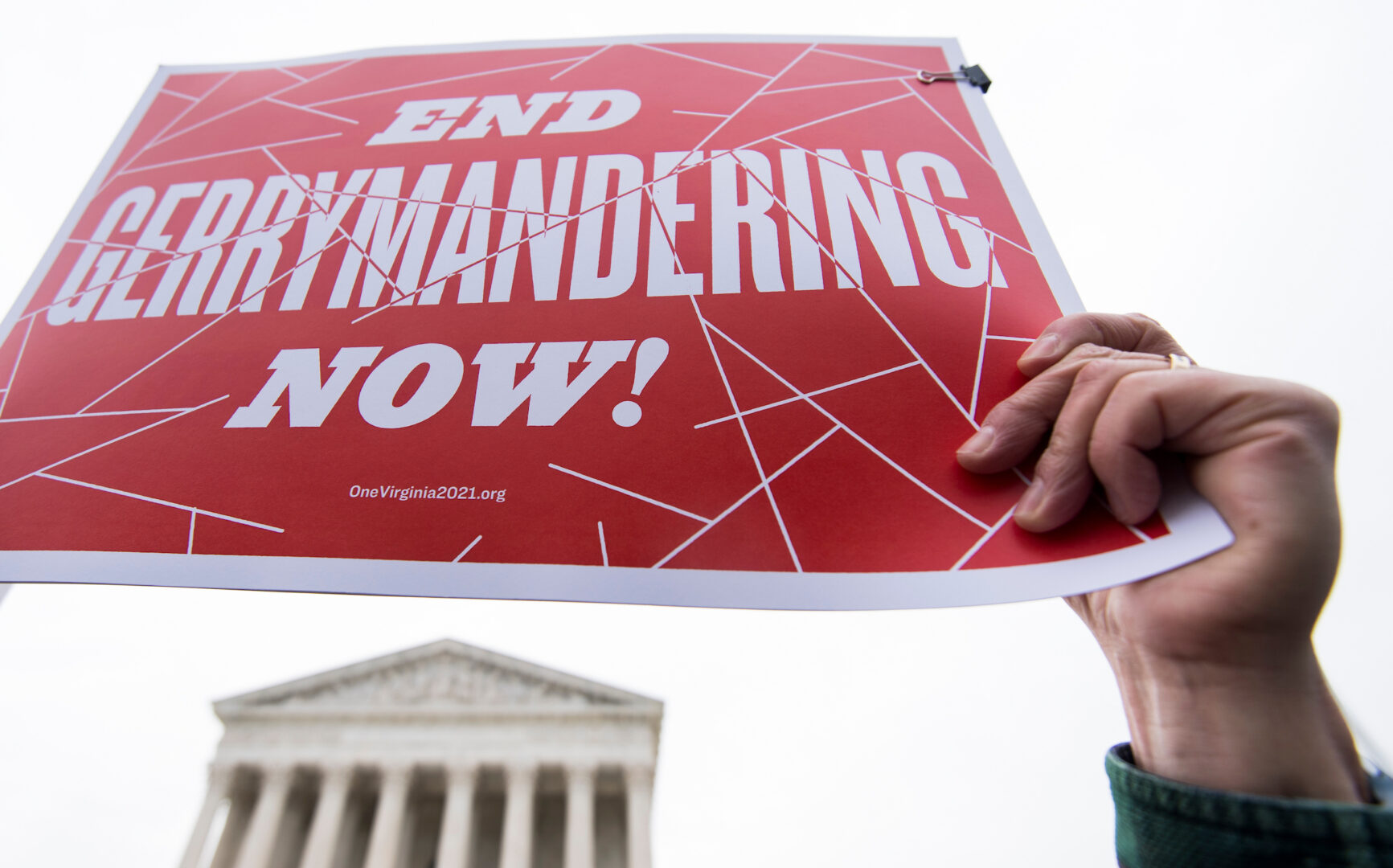
On the surface, it wouldn’t seem like an early-aughts teen comedy has much in common with the drawing of congressional maps.
Don’t tell that to Rory Riley Topping and Josh Rultenberg, who spend a good chunk of their new book referencing “Mean Girls.” The authors of “Draw the Line in Ohio” are on a mission to break down gerrymandering for a wider audience, one “get in, loser” at a time.
“People who care about politics, they can nerd out,” Topping said, but most people’s “eyes glaze over” when you talk about redistricting. The way she sees it, Regina George — and other pop culture touchstones — can help.
“I am a Bravo super-fan. So yes, I am happy to include references to things like ‘Vanderpump Rules’ any chance I can get,” she added.
Rultenberg said he wasn’t worried about diluting or cheapening a topic he sees as serious, even when the stakes are high. “If we can get people in the front door by talking about Stefon on ‘Saturday Night Live,’ all of a sudden they’re smiling before they realize that they’re probably going to be crying about what’s happening in this country,” he said.
Gerrymandering is a key driver of political corruption, the book argues, beyond its more obvious role in shaping which party controls Congress.
The co-authors share something else — they’re both former congressional staffers. Topping worked for Republicans as staff director for a House Veterans’ Affairs subcommittee in the early 2010s, while Rultenberg briefly served as communications director for Ohio Democratic Rep. Emilia Sykes until this summer.
What was it like to collaborate across the aisle on such a politically charged topic? It wasn’t a stretch, they said, since each currently identifies as an independent.
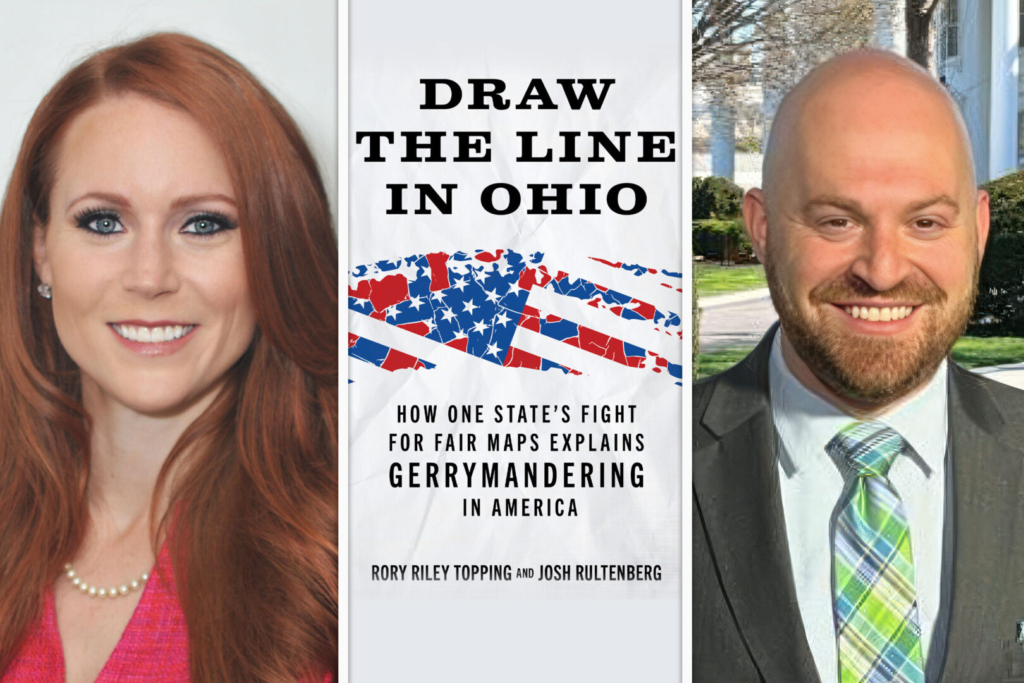
Rory Riley Topping and Josh Rultenberg worked together on “Draw the Line in Ohio,” which published this month. (Headshots courtesy of the authors. Book cover courtesy of Prometheus Books.)
Some of their cultural references rewind all the way back to ’90s network TV. (Get ready for some “Saved By the Bell” and “Family Matters.”) But one prevails over the others: “Mean Girls.”
“Continuing the ‘Mean Girls’ analogy, we’d say Republicans ‘spent about 80 percent of their time talking about Eric Holder. And the other 20 percent of the time, they were praying for someone else to bring him up so they could talk about him more,’” the authors write.
“On Wednesdays we wear pink, but on what day do we draw fair maps?” the book muses.
For Topping, the 2004 movie is a personal favorite. And in her view, it perfectly captures the self-sustaining cycle of one-upmanship that drives gerrymandering in Ohio and other states.
“It really is like an elite ruling clique making ridiculous demands on other people, and other people acquiescing to those demands because, as we say in the book, they’ve calculated that it’s better to be on the inside hating life than to be on the outside,” she said.
Now a legal analyst, Topping said she found parallels between working on the Hill and writing about redistricting.
“When you are a staffer on the Hill, you learn very quickly that the way Congress works, what you see on the inside is very different than what you see on the outside — and redistricting is no different,” she said.
For his part, Rultenberg said he started working for Sykes after the manuscript was finished, but his future boss was heavily featured due to her past role as the Ohio House minority leader, placing her on the Ohio Redistricting Commission. He had already covered her for years as a journalist.
“You try to report on what happens inside the room, and then all of a sudden, when you get the opportunity to be inside the room, obviously that mystery, that veil is taken away,” he said. “So you can see how Congress works from the inside.”
As the pair write in the book: “Democracy is largely shaped by culture at the state and federal levels. People come to Washington hoping it resembles ‘The West Wing’ and fearing it’s ‘House of Cards.’ In reality, it’s ‘Veep’: messy, chaotic, and held together by overworked staffers and the hope that no one notices how fragile it all is.”
“Draw the Line in Ohio” (Prometheus Books) published Sept. 15. The authors are set to appear in D.C. on Wednesday at Politics and Prose at the Wharf.