The most vulnerable senators of 2026, about a month out from Election Day
Three Republican incumbents make their debuts as races tighten
The once unlikely prospect of Democrats scoring a net gain of four seats to win the Senate majority now looks more plausible less than five weeks out from the midterm elections.
Still, that would require the party to win in red states that haven’t elected a Democrat to the Senate in years. But strong recruits, coupled with a favorable political environment, have moved some new races onto the Senate battleground in recent weeks.
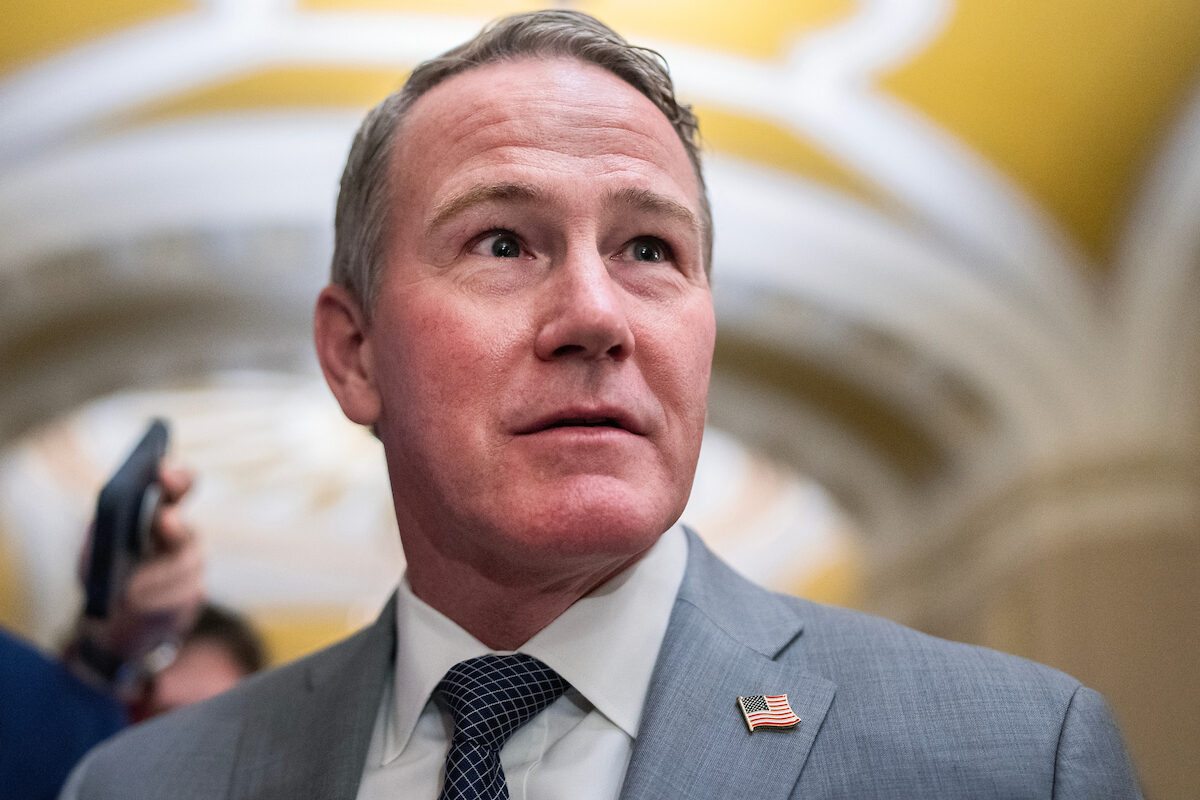
New to the top of CQ Roll Call’s list of the most vulnerable senators is Ohio Republican Jon Husted, who’s running for the remaining term of Sen.-turned-Vice President JD Vance. He faces a challenge from former Sen. Sherrod Brown, who lost reelection just two years ago and retains high name ID and fundraising prowess.
Maine Sen. Susan Collins, no stranger to tough races, remains at No. 2 as a Republican seeking reelection in a blue-leaning state. Her race was jolted mid-summer as Democrats scrambled to pick a new nominee.
But Georgia Democrat Jon Ossoff moves further down the list to No. 5. While the Peach State remains purple, he has proved to be a powerhouse fundraiser and his Republican opponent has been dogged by controversies.
Three senators whose greatest risk to reelection was in the primary — Republicans Bill Cassidy of Louisiana and John Cornyn of Texas and Democrat Edward J. Markey of Massachusetts — fall off the latest list. Cassidy and Cornyn both lost their primaries, while Markey defeated Rep. Seth Moulton and is now heavily favored in November in his deep-blue state.
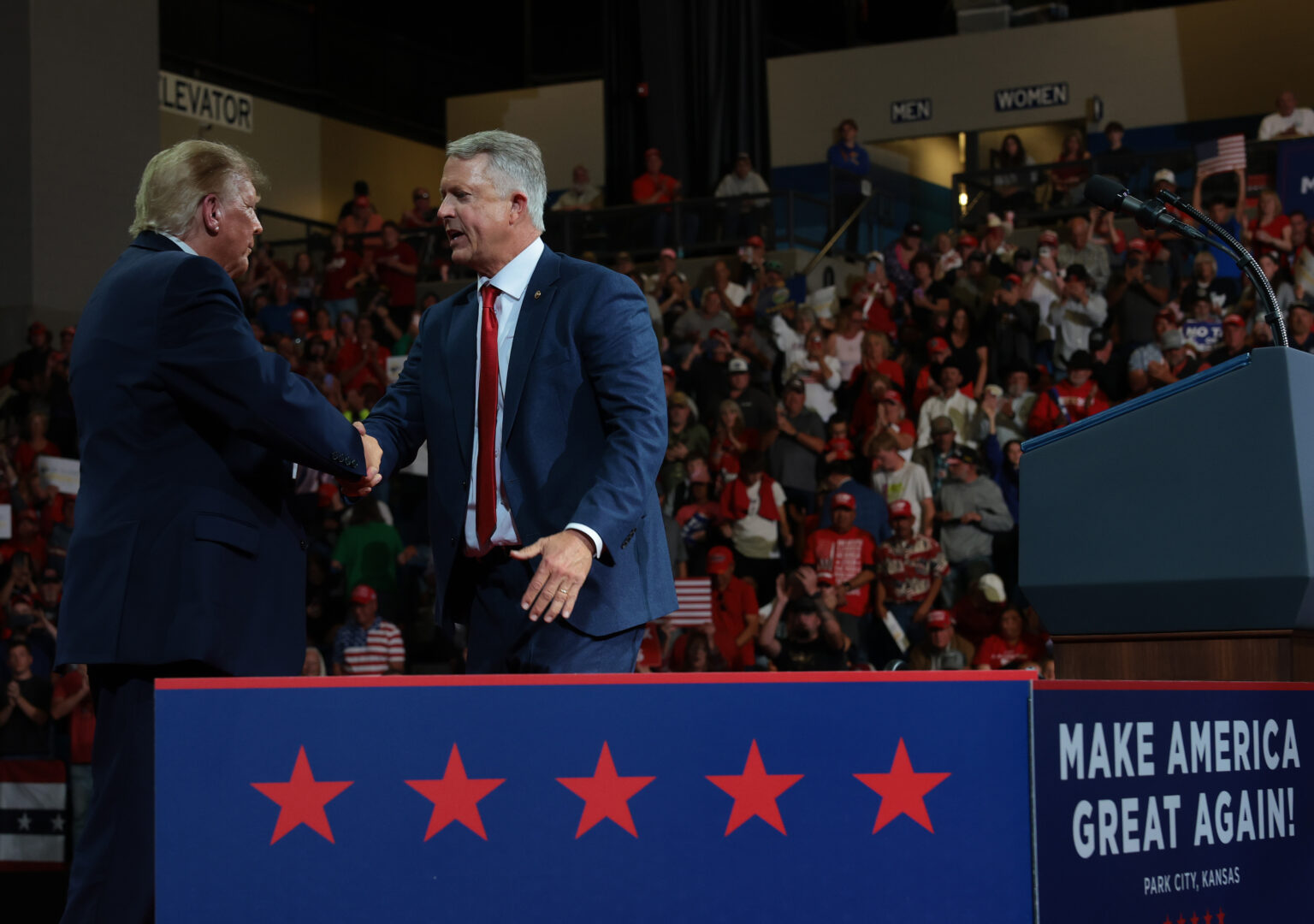
Taking their place are three Republican senators whose races have become more competitive. Debuting at No. 4 is Kansas Sen. Roger Marshall, who’s running for a second term against Democrat Adam Hamilton.
Also joining the list are Nebraska’s Pete Ricketts and South Carolina’s Darline Graham, who was appointed to the Senate this summer after the death of her brother, Sen. Lindsey Graham. Ricketts’ race against independent Dan Osborn is worth watching after Osborn made a late charge against GOP Sen. Deb Fischer two years ago. But the challenger faces new hurdles this time around. And Graham, with a key endorsement from President Donald Trump, remains favored to win in a Republican-leaning state, but she’s had to ramp up a campaign in a short time frame.
To compile these rankings, CQ Roll Call’s campaign team spoke with party insiders and election prognosticators and analyzed polls, candidates’ past performance, campaign finances and outside spending.
Several states with open Senate seats, which we did not include on this list of vulnerable incumbents, will also be key to determining control of the chamber. Among them is North Carolina, where polls show Democrat Roy Cooper in the driver’s seat against Republican Michael Whatley.
In Iowa, where Sen. Joni Enrst is retiring, GOP Rep. Ashley Hinson is in a tight race with Democratic state Rep. Josh Turek. And without Cornyn on the ballot in Texas, Democrats are cautiously hopeful about state Rep. James Talarico’s chances against scandal-tarred state Attorney General Ken Paxton, although spending by Republican outside groups has surged in recent weeks.
Republicans are also eyeing pickup opportunities in open seats. In Michigan, former Rep. Mike Rogers, who lost a close race in 2024, faces Abdul El-Sayed, and in New Hampshire, GOP former Sen. John E. Sununu is seeking a comeback against Democratic Rep. Chris Pappas.
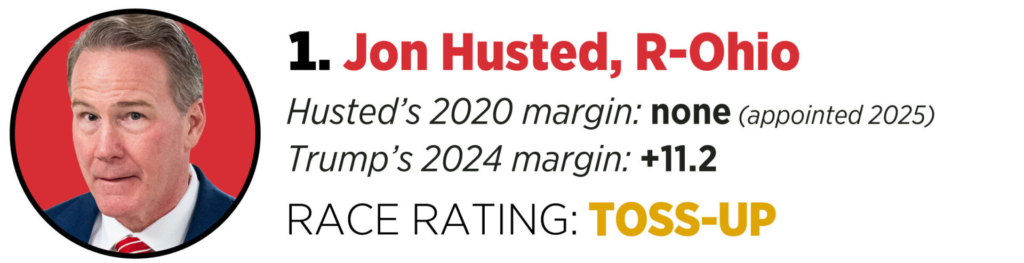
Appointed last year to fill the rest of Vice President JD Vance’s Senate term, Husted is being squeezed on multiple fronts. His stance on data centers has become a key campaign issue, and there are strong signs of a political realignment in reliably red Ohio. Husted’s Democratic rival, former Sen. Sherrod Brown, is seeking a comeback after losing to Republican Bernie Moreno in 2024. A Marist poll released Tuesday found Brown with an 8-point lead over Husted. The race is among the nation’s most expensive — Brown raised nearly $39 million through June 30, while Husted brought in more than $14 million. But outside money could play an outsize role in the race: Cryptocurrency interests spent big to defeat Brown two years ago, and the industry’s leading super PAC told The New York Times it intends to unleash $30 million in attacks targeting the Democrat in the run-up to November.
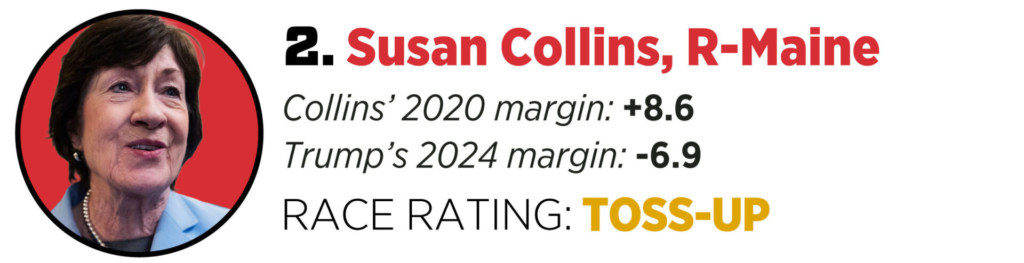
A frequent Democratic target, Collins is seeking a sixth term in what has perhaps been the most dramatic Senate race of the year. Since our previous rankings, Democratic nominee Graham Platner dropped out in the face of a rape allegation, which he denied. Former state Senate President Troy Jackson, who ran unsuccessfully for governor, then won a party convention to replace Platner on the ballot and had to rapidly assemble a campaign to face Collins. Third-quarter fundraising reports due in mid-October will be instructive on how Jackson’s campaign has ramped up. Republicans express optimism about Collins, who has won in tough years for her party before, but given Maine’s Democratic lean, the senator remains near the top of this list.
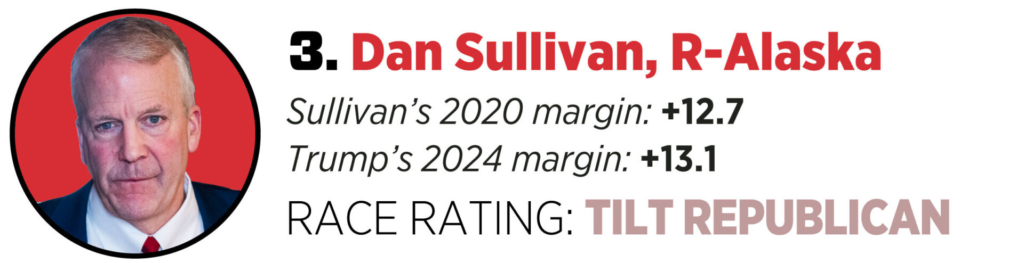
A high-profile Democratic challenger, a rival with the same name and Alaska’s ranked choice voting system all contribute to Sullivan’s vulnerability. There are four candidates on the November ballot: Sullivan, the GOP incumbent who will be listed as Dan S. Sullivan; Democratic former Rep. Mary Peltola; retired teacher Dan J. Sullivan, listed with no party affiliation; and Republican Gerald Heikes, a perennial hopeful. Sen. Sullivan is also contending with Democratic criticism that Republican policies are driving up costs, a potentially potent issue in a state where gas and food prices typically exceed the national average. Peltola, a moderate, has campaigned on affordability and “fixing the rigged system.” The race was rocked last week by a New York Times report on allegations that she used slurs and raged at staff members. Her campaign denied any pattern of hostile behavior.
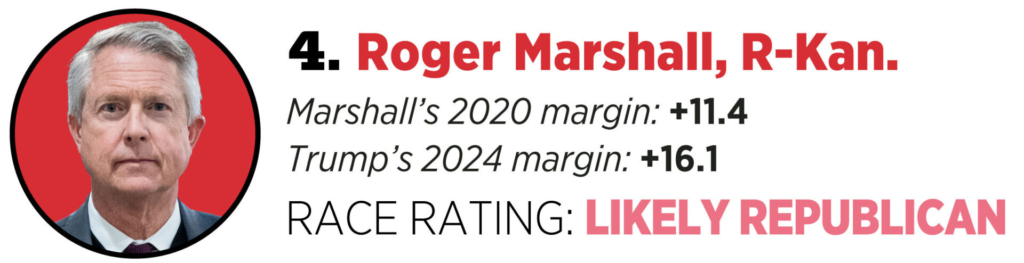
The presence on this list of a Republican from Kansas — which last elected a Democrat to the Senate in 1932 — signifies just how arduous the midterm environment has become for the GOP. Marshall faces Democrat Adam Hamilton, the pastor of the nation’s largest United Methodist congregation. Marshall, a physician, came under fire after The New York Times reported that his medical practice sued hundreds of patients for nonpayment of debts, which quickly became the subject of a Hamilton attack ad (drawing legal action from the senator’s team.) Meanwhile, The Kansas Reflector questioned Marshall’s residency, publishing details of his ties to Sarasota, Fla. A Trump ally, Marshall has recently tried to distance himself from the administration’s immigration enforcement policies, and Republicans have cast Hamilton as a “woke megachurch CEO.” Hamilton touts several GOP supporters, including former Gov. Bill Graves and Marshall’s primary opponent, Arch “Pond” Naramore.
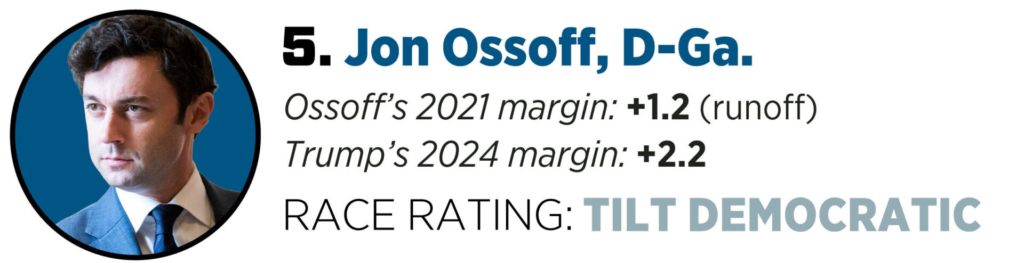
Ossoff started the cycle as the Senate’s most endangered Democratic incumbent — and he remains the only Democrat on our list. But his seismic fundraising numbers — his campaign reported raising more than $91 million through June 30 — and skill at creating viral clips calibrated to antagonize Trump have fueled growing confidence among his supporters. Ossoff has led Republican nominee Mike Collins in almost every public poll, and some Republicans have expressed concern that the race is slipping away. Collins, a second-term congressman, has Trump’s support, but he’s also been dogged by controversies, including a House Ethics investigation and reports that his son-in-law shared antisemitic and white nationalist social media posts. Still, Georgia is a purple state, and Republicans hold out hope that a strong showing by their billionaire gubernatorial nominee, Rick Jackson, will lift Collins.
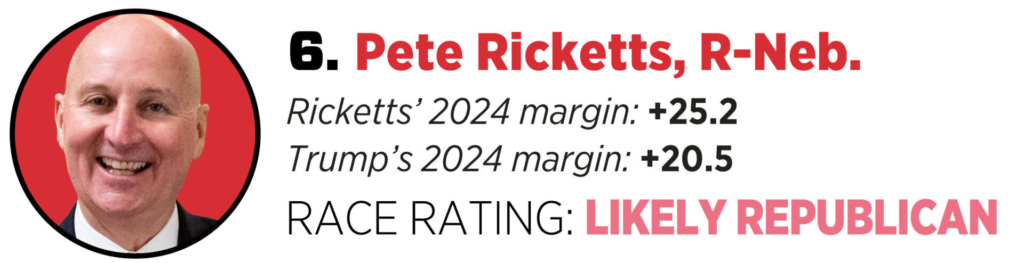
Two years ago, Dan Osborn, an independent union leader from Omaha with no elective experience, came within 7 points of unseating Republican Deb Fischer. Osborn is aiming to better that result this year in his challenge to Ricketts, a former two-term governor with enormous personal wealth and a powerful reach in Nebraska politics. Osborn again has the backing of state Democrats, with the party’s Senate nominee dropping out in August. But unlike 2024, there will be three other candidates on the ballot: Chuck Conboy of the America First Party; Robin Richards of the Nebraska Working People Party; and Mike Marvin of the Legal Marijuana NOW party, who has dropped out and endorsed Osborn though his name remains on the ballot. Earlier this month, Osborn apologized for profanity-laced remarks he made about rural Trump voters after the Republican National Committee posted leaked audio.

Following Sen. Lindsey Graham’s unexpected death in July, his sister, Darline Graham, was appointed to fill the rest of his term, and then, at Trump’s urging, announced she would seek a full six-year term. In the special election to replace her brother on the South Carolina ballot, Graham, armed by the president’s support, defeated several prominent Republican lawmakers, including Reps. Ralph Norman and Russell Fry. She next faces pediatrician Annie Andrews, who unsuccessfully ran for the House in 2022 and is hoping to become the first Democrat elected to statewide office in South Carolina in two decades. Graham is an untested candidate who’s had some early stumbles: In a debate before the primary, she acknowledged that she was “not that informed on national security” matters. But Trump is heavily invested in the race, and South Carolina’s strong Republican advantage complicates Andrews’ task.