State climate suits face skeptical Supreme Court
Justices could decide the fate of lawsuits seeking damages from oil and gas producers
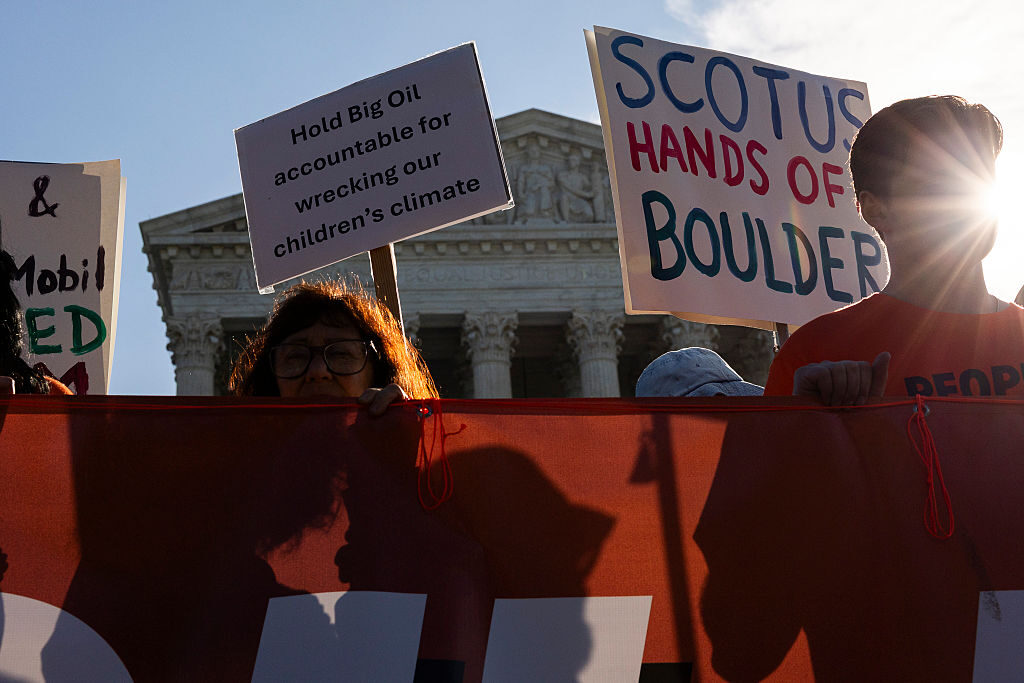
A majority of the Supreme Court appeared skeptical Monday of an effort by Boulder, Colo., to hold major oil producers accountable in state courts for the harms caused by climate change.
Across almost two hours of oral arguments, the justices raised concerns about upsetting the balance between states and the federal government and Congress’ power to regulate pollution issues. The case, the first of the justices’ new term, may effectively decide whether several dozen lawsuits from cities and counties seeking damages under state law can move forward nationwide.
Several times during oral arguments, Justice Brett M. Kavanaugh and other members of the court’s conservative bloc pointed out that the Supreme Court had previously said that air and water pollution are federal issues — not subject to state courts.
Kavanaugh said those cases “make crystal clear that interstate air and water pollution are federal issues.”
The case argued Monday before the justices started when Boulder County sued Suncor and ExxonMobil in state court to recover damages caused by wildfires that the county argues were worse due to climate change. The county argued the companies had for years downplayed the risks of climate change despite what their own research showed.
After losing an effort to fend off the suit in a lower state court, Suncor and ExxonMobil asked the justices to step in, arguing that federal law barred the state suit. The suit has not yet gone to trial or had a final ruling from the state Supreme Court.
An attorney for the oil companies, Kannon K. Shanmugam, argued that the dozens of state cases the companies have faced are an effort to dictate federal energy and environmental policy through court-imposed financial liability.
The cases “reflect an all too regrettable trend of trying to resolve political issues in court rather than in the political branches where they belong,” Shanmugam said.
Sarah M. Harris, principal deputy solicitor general arguing on behalf of the Trump administration on the same side as the oil giants, argued that the Clean Air Act and the Constitution give Congress the primary role in regulating greenhouse gas emissions — and letting the suit go forward would effectively allow Colorado state courts to upset that balance.
Harris said that just because Boulder found a way to plead the case that was not explicitly covered by federal law, “states don’t get to then fill a vacuum of federal area with state law.”
In response, Justice Neil M. Gorsuch pointed to EPA decisions this year seeking to disclaim federal authority to regulate greenhouse gas emissions under the Clean Air Act. Gorsuch wondered whether in the wake of the EPA decisions, “nobody can sue at all.”
Harris argued that Congress has already decided to address the issue in renewable fuel standards in legislation addressing ethanol use in vehicles.
The EPA decisions to renounce greenhouse gas emissions regulation are currently being challenged in federal courts.
More to come?
At the same time, Boulder attorney Kevin K. Russell faced numerous questions about whether the county’s claims had any kind of limits. Chief Justice John G. Roberts Jr. pointed out that a ruling in Boulder’s favor would potentially allow many more lawsuits.
“Presumably if you prevail, the next day, a municipality in every single state will file a lawsuit that will probably copy your pleadings,” Roberts said.
Exactly how the justices handle the case could have reverberations beyond Boulder’s specific suit — as Shanmugam emphasized, the case could affect dozens that have already been filed in state courts across the country. Shanmugam argued for the justices to find on two grounds, including that the Constitution itself, as well as the Clean Air Act, barred the state suits.
Several justices expressed skepticism about the companies’ efforts to quash the suits. On the broader constitutional claims, Roberts also pointed out the justices have traditionally allowed suits when a plaintiff is hurt by a defendant’s actions in another state, such as “if you throw a rock over the border and hit them.”
Justice Elena Kagan also analogized the lawsuit to previous ones over the harms caused by tobacco and opioids, and pushed Shanmugam on why those claims could proceed.
“If this is chapter three, were chapters one and two also preempted?”
Shanmugam said the tobacco and opioid cases were more specific about the harm caused and did not involve air and water pollution.
“This is a very different book, not a chapter in the same book,” Shanmugam said.
Justice Samuel A. Alito Jr., announced last week that he was recusing himself from the case, but did not give a reason. Alito also recused in a prior incarnation of the case in 2023, where the justices ultimately declined to hear the case, allowing the state court action to move forward.
The case has worked its way through the courts for years, and served as background for political struggles over investigations into major oil companies in Congress by Democrats. Republicans have dismissed the probes as political stunts, but they could return should either chamber change hands next year.
The justices will likely issue a decision in the case before the end of the term next June.
The case is Suncor Energy v. Boulder County.