‘Scrappy’ conference chair helped shape GOP midterm message
McClain has encouraged talking up bipartisan housing, financial deregulatory measures
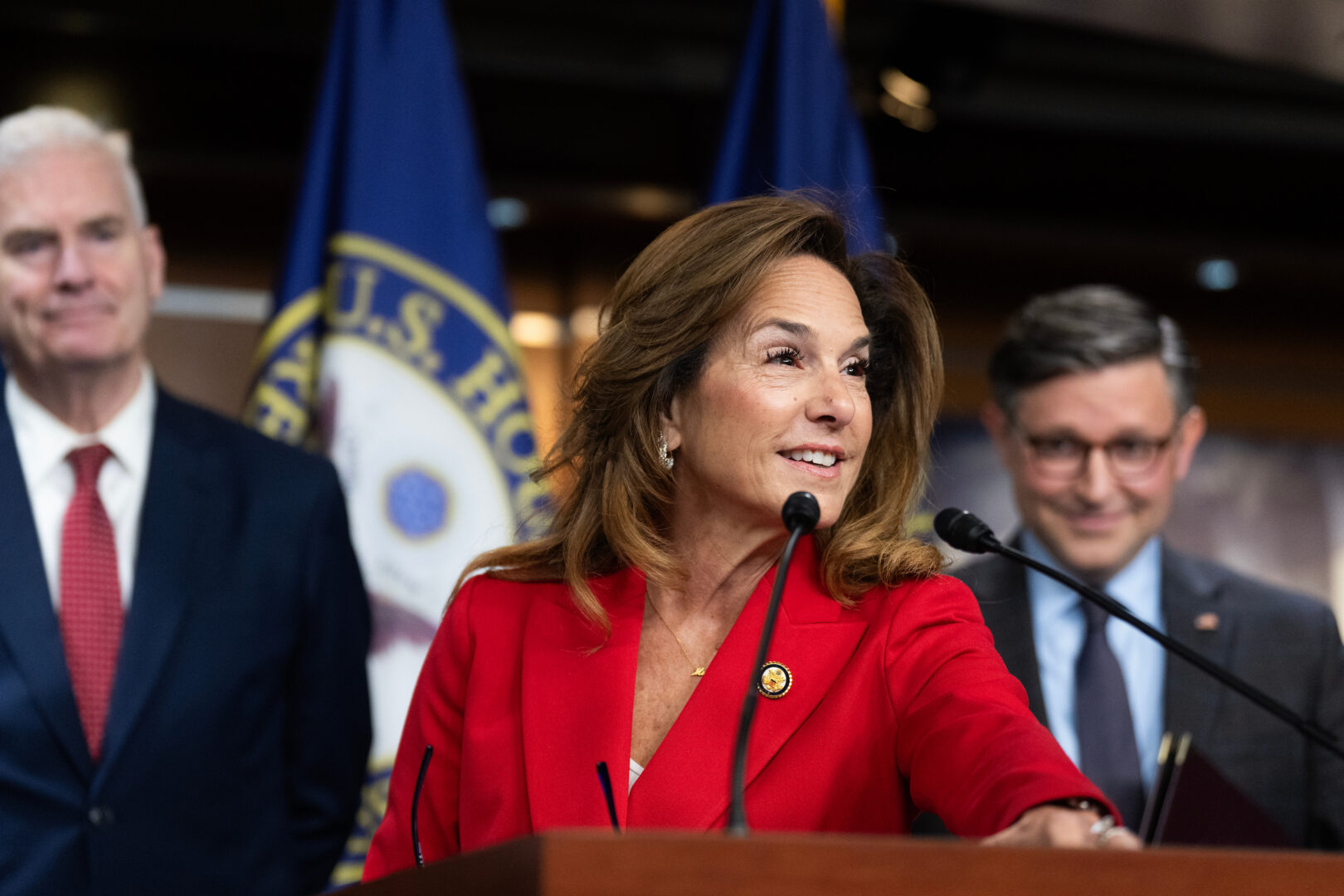
Few House lawmakers have risen through party leadership ranks as fast as GOP Conference Chair Lisa McClain. Now comes the toughest political challenge she’s faced in her short time in office: helping maintain Republicans’ tenuous grasp on the majority.
The third-term Michigan Republican, who took just four years to secure the No. 4 slot in the conference, isn’t in electoral danger personally. McClain surpassed President Donald Trump’s 32-point victory two years ago in the 9th Congressional District — Michigan’s southeastern “thumb” — and is considered a shoo-in for reelection.
But McClain’s doing her part for the party — raising money, campaigning for colleagues and promoting what she calls a “common sense” GOP message versus “communist crazy” on the other side.
“Americans want a secure border, safe communities, more money in their pockets, and parents to have a say in their children’s lives. Those aren’t complicated ideological positions,” said McClain, a mother of four. “And when you put that record side-by-side with the alternative, the contrast is pretty clear.”
An unabashed MAGA Republican and culture warrior, the 60-year-old McClain also has the kind of real-world experience that makes her a credible voice on economic policy within the party; she didn’t come from money but helped build a multibillion-dollar financial management firm. Nor is she a career politician, having spent three decades in the private sector before running for Congress in 2020.
A 2021 profile published by Independent Women, a nonprofit, called McClain a “scrappy Italian mama” — her maiden name is Iovannisci — who starred at high school basketball “despite her diminutive stature” and wasn’t afraid to take on then-Speaker Nancy Pelosi, D-Calif., in her first year.
McClain’s colleagues appointed her to the Financial Services Committee shortly after winning the conference chair slot in late 2024. That panel’s been a focus of her legislative efforts this Congress, and she’s encouraged members to talk up bipartisan housing and financial deregulatory measures along with more traditional partisan campaign fare — though the latter has received more airtime.
“The bipartisan results we achieve around here don’t get as much attention as warranted, but that’s part of the political dynamics of the country,” a GOP aide familiar with the party’s messaging efforts said.
Since her ascension in the ranks, McClain has joined the upper tier of House fundraisers, counting financial industry groups like the Mortgage Bankers Association, American Bankers Association and National Association of Realtors among her top donors, according to OpenSecrets.org.
She’s also leveraged her Michigan connections to secure hefty home-state contributions, including from executives of RDV Corp., which manages the DeVos family fortune; Ciena Healthcare, which provides skilled nursing and rehabilitation care services; and Rocket Companies, home of Rocket Mortgage.
Titans of finance from outside the state have also made large donations to McClain’s fundraising committees, including executives at New York-based Jane Street Capital, Silicon Valley venture capital firm Andreesen Horowitz, and Winklevoss Capital Management.
Andreesen Horowitz executives and the Winklevoss brothers are big donors to Fairshake, the major crypto-focused PAC that recently named McClain to a list of 32 pro-crypto House lawmakers it would contribute to, despite her safe seat.
Bipartisan successes
On the campaign trail, her party’s efforts on pro-crypto legislation haven’t played too much of a role. McClain and colleagues have mostly promoted partisan policies like the 2025 GOP reconciliation package, which delivered tax cuts for millions of households but also slashed safety net benefits like Medicaid and food stamps.
McClain has also tried to tout bipartisan successes, like the comprehensive housing package that became law in July.
A recess packet McClain sent members home with this summer said the law “delivers stability to the housing market,” citing internal polling showing “stability” is the “key word on housing that resonates across income, ideological and generational lines.”
McClain co-authored two bills that made it into the final package. One, which she wrote with a top GOP midterm target, Democrat Marie Gluesenkamp Perez of Washington, is intended to encourage local governments to cut red tape associated with homebuilding.
Their bill would adjust Community Development Block Grant allocations based on localities’ track records in home construction. If they are building more homes than the median growth rate, they get bonus payments; if below the median, they get their allocations docked.
Another McClain bill in the housing package, co-authored with Rep. Stephen F. Lynch, D-Mass., would direct the secretary of Housing and Urban Development to write rules making it easier for modular home manufacturers to get construction loans. Modular homes are assembled on location from sections built in factories — less expensive than building from scratch on site.
The two bills “help communities build more homes and remove financing barriers that stand between families and a home they can afford,” McClain said.
McClain is also promoting the “capital formation” package the House passed with bipartisan support last December that’s awaiting action in the Senate. The measure is aimed at making it easier for businesses to tap capital markets for financing, including provisions expanding retail investors’ access to more sophisticated financial products and loosening restrictions on startups that want to go public.
One provision would expand the pool of “accredited investors” — typically high net-worth individuals and financial institutions — granted access to private placements, or investments in companies before they go public.
That would allow more people to tap into pre-initial public offering rounds, like those who bought private stock in Elon Musk’s artificial intelligence company xAI, later folded into SpaceX before it went public this summer.
McClain’s husband — who works for Hantz Group, the $10 billion asset manager his wife helped build — is one of those early investors, purchasing between $100,000 and $250,000 in xAI last December, according to financial disclosures.
The capital formation bill would open the door “to real investment, real growth, and real wealth-building for Main Street,” McClain said.
No more ‘pig butchering’
Other Financial Services-approved bills House Republicans have pushed through the chamber with bipartisan support demonstrate policies that “put money back in Americans’ pockets,” McClain’s staff said.
One is legislation to allow mutual funds and exchange-traded funds to postpone share sales if they believe a transaction request is the result of financial exploitation of a senior or vulnerable adult.
Another would allow state and local law enforcement to tap federal grant programs for aid in combatting general financial fraud, elder fraud and “pig butchering,” which involves a perpetrator developing a relationship with a target to increase the amount of money that can be scammed.
McClain also is highlighting bipartisan work on bills aimed at curbing government waste, such as a measure that passed 424-0 that would expand whistleblower protections to older HUD contracts that aren’t currently subject to such oversight.
Another, which cleared the Senate last month, would codify the administration’s move to stop minting pennies, which have long cost more to produce than their actual value.
McClain, the lead House sponsor, insisted on passing her version rather than an identical Senate-passed bill. A source familiar said she was passionate enough about the work her chamber had done on the penny bill to put their own stamp on the final product.
‘Singles and doubles’
It isn’t clear any of these measures will make a difference on the campaign trail.
The housing and capital formation bills “are meaningful but hard to message,” said James Maloney, a longtime financial services industry consultant who co-founded Tiger Hill Partners.
“Voters want a clear and decisive economic roadmap to improve their lives,” Maloney said.
Ian Katz, a managing partner at Capital Alpha Partners, a political risk advisory firm, said the arcane details of such bills limit their effectiveness as campaign talking points.
“I’m skeptical that very specific, technical pieces of legislation resonate with most voters,” Katz said.
Most of the housing law’s provisions got down into the policy weeds, addressing affordability in incremental ways, said Isaac Boltansky, head of public policy at Pennymac, a top mortgage originator.
“You still score runs getting singles and doubles,” Boltansky said. “Anything that doesn’t have an immediate payoff can be tough to sell at a moment in time on the campaign trail, but that doesn’t mean it’s without political and policy utility.”
The housing bill has come up in at least one battleground race — but potentially working against the GOP incumbent.
Janelle Stelson, the Democrat running against Rep. Scott Perry in Pennsylvania’s 10th District, has aired an ad criticizing him for voting against the housing bill, an attack she reiterated during a debate Wednesday night.
She pointed out that Perry was the only member of the Pennsylvania delegation to vote against the measure, which she argued would bring down housing costs.
Perry said he backed the House’s version but voted against the final bill because the Senate “added housing money for illegals” and would introduce federal zoning rules overriding local decisions — which he said could lead to unwelcome data center construction.
Politifact has debunked claims that the law would subsidize homes for undocumented immigrants. While the goal is to increase the general housing supply, which could benefit all renters and homebuyers, nothing in the law changes existing immigration statutes or prohibitions on federal aid to undocumented immigrants.
On zoning, the law directs HUD to write voluntary guidelines for state and local zoning rules, but there’s no federal mandate, according to the National Association of Home Builders.
Inside Elections with Nathan L. Gonzales rates the Pennsylvania 10th District race a Toss-up.
Jacob Fulton and Peter Cohn contributed to this report.