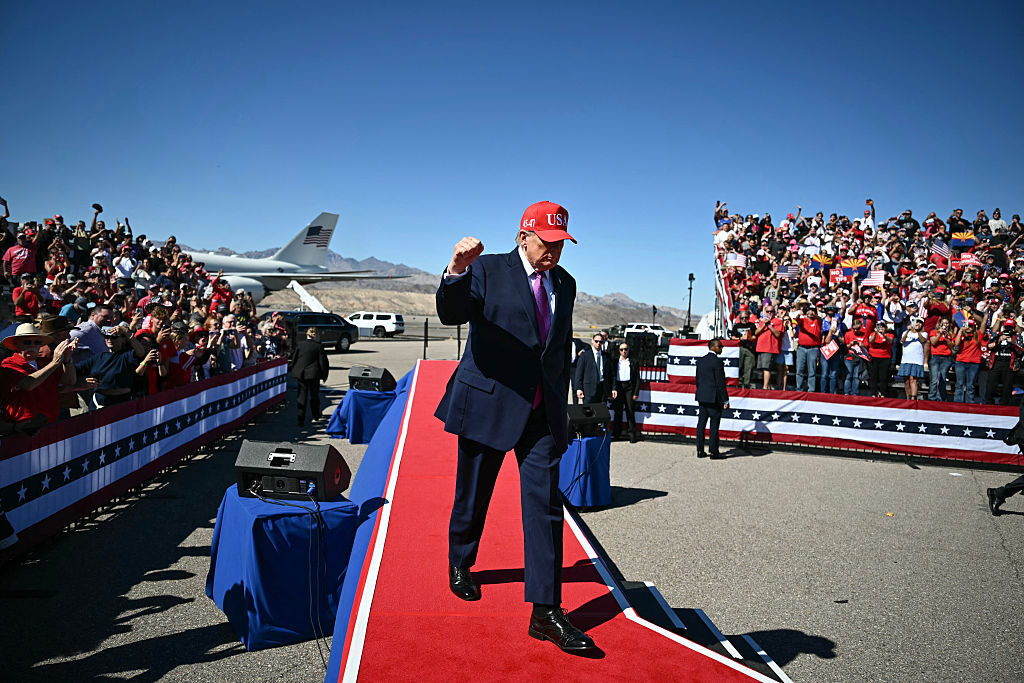
5 concerning things Trump has said about the 2026 elections
When the president speaks, we should take him seriously

After seeing Donald Trump in action for more than a decade, I take him seriously and literally.
A year ago, I wrote about how we shouldn’t take for granted what the president might do when it comes to the 2028 election. Twelve months later, that column still holds up. But Trump has also said a number of concerning things about this year’s midterm elections that should be taken seriously.
Some folks will accuse me of having “Trump Derangement Syndrome,” but, once again, there’s a pattern among Trump supporters. When he says something off the wall or controversial, his backers chastise critics by saying, “Don’t be so sensitive. Of course, Trump isn’t going to do that.” But then when he does it, they say, “Well, of course he did it. He said he was going to do it. Why are you surprised? Get over it.”
That’s why his comments about the midterms are noteworthy, particularly when taken as a whole. Trump has established a pattern of using declarations of war, emergency and terrorism to justify executive action. And remember, it’s not a question of whether he’s legally allowed to do something, it’s whether he’ll attempt to do it anyway and dare someone or something to stop him.
Right now, the president is operating like he’s accountable to no one. He even said as much in a recent New York Times interview when asked about limits to his power: “Yeah, there is one thing. My own morality. My own mind. It’s the only thing that can stop me.”
So no one should be surprised if Trump follows up on any or all of the actions he’s talked about.
Cancel culture
During an Aug. 18 Oval Office meeting, Ukrainian President Volodymyr Zelenskyy talked about the necessary conditions to restart elections in his country. Trump appeared more than a little intrigued about his answer and interjected to make a point.
“So you say, during the war, you can’t have elections,” said Trump. “So let me just say, three-and-half years from now. So you mean if we happen to be in a war with somebody, no more elections. I wonder what the fake news would say to that.”
But what are the chances of the United States being “in a war” sooner? The answer: pretty high.
Last year, the White House justified sweeping wartime authority by invoking the Alien Enemies Act of 1798 after declaring that the United States was being invaded by Tren de Aragua, a Venezuelan gang. Even though the administration was careful to label the capture of Venezuelan President Nicolás Maduro and the takeover of the country’s affairs as a law enforcement action, it’s not hard to see Trump claim that the U.S. is officially at war in South America. It’s also not a hard stretch for the country to be at war with Greenland, Denmark or several other countries based on the actions of the president, even if the conflicts aren’t full-fledged ground assaults.
Would the president have the authority to cancel the elections if the country was at war? Of course not. And we’ve had elections during numerous armed conflicts, including the Civil War. But that doesn’t mean there isn’t a risk.
Trump has neither the legal authority nor the practical ability to cancel elections, as explained by VoteBeat. But the greater danger would be a set of elections that are chaotic, unfairly challenged or deliberately cast as illegitimate after the fact.
Just not have them
More recently, some five months after his remarks to Zelenskyy, Trump appeared to question the need to hold the elections at all.
“It’s some deep psychological thing, but when you win the presidency, you don’t win the midterms,” Trump told Reuters on Jan. 14. He then boasted that he had accomplished so much that “when you think of it, we shouldn’t even have an election.”
White House press secretary Karoline Leavitt said Trump was “simply joking” and “speaking facetiously,” but unless the president says that, I’m skeptical.
That was just days after Trump said something similar in an address to House Republicans in Washington.
“Now, I won’t say ‘cancel the election’ – they should cancel the election – because the fake news would say, ‘He wants the elections canceled. He’s a dictator,’” Trump said, “They always call me a dictator.”
My advice is to pay attention to what Trump says, particularly when he repeats it.
Seize the machines
In a recent interview, Trump reflected on the opportunity to use government resources to seize voting machines in the wake of the 2020 election.
“Well, I should have,” he told The New York Times. Asked whether using the military to impound voting machines had been a viable option, the president questioned whether the National Guard could have gotten it done.
“You know, they’re good warriors. I’m not sure that they’re sophisticated enough in the ways of crooked Democrats, and the way they cheat, to figure that out,” he said.
That scenario never played out last time, but the concept is still clearly on the president’s mind at a time when he’s been more aggressive in deploying federal troops around the country for other reasons.
It’s important to remember that this was more than a fleeting thought five years ago. Politico reported on a draft of a Trump executive order that included seizing voting machines, appointing a special counsel to investigate the results and giving the Defense secretary 60 days to write an assessment of the 2020 election. More specifically, the order would have empowered the Defense secretary to “seize, collect, retain and analyze all machines, equipment, electronically stored information, and material records required for retention under” a U.S. law that relates to preservation of election records.
Again, that never happened but it’s not a stretch for a president trying to exert that power in the midterms, even if there’s no legal authority. It wouldn’t have to be all voting machines, but seizing even a small number could cause confusion and chaos and potentially affect which party controls Congress, given Republicans’ narrow majorities.
The watchmen
The Trump administration is once again likely to send or encourage people to monitor polling places. In 2025, the Department of Justice sent poll monitors to sites in California and New Jersey. Back in 2020, the Trump family took it one step further.
“We need every able-bodied man, woman to join Army for Trump’s election security operation at defendyourballot.com,” Donald Trump Jr. said in an online video, as reported by NPR. “We need you to help us watch them. Not just on Election Day, but also during early voting and at the counting boards. President Trump is going to win. Don’t let them steal it.”
Even though he won’t be on the ballot this fall, there’s no reason to believe this won’t be repeated. The White House knows the stakes are high as Democratic majorities in Congress would impede Trump’s agenda and lead to oversight and investigations.
To be clear, poll watchers, monitors and observers can be legal and even healthy, as explained by VoteBeat. But the Trump administration has lost the benefit of the doubt.
It’s not hard to see the president sending federal agents or the military to strategic polling places, particularly in Democratic areas. Even if those personnel assigned in the name of safety remain behind precinct boundaries, their presence could have a chilling effect on turnout. Trump’s supporters will simply say that law-abiding citizens shouldn’t be concerned. But that’s not compelling when it’s clear that some citizens have been arrested and even killed by federal agents. It would be intimidation in the name of integrity.
Voter rolls
Trump is also interested in who gets to vote in the midterm elections. In the wake of Alex Pretti’s shooting in Minneapolis, Attorney General Pamela Bondi wrote a letter to Democratic-Farmer-Labor Gov. Tim Walz suggesting that providing access to the state’s voter rolls could lead to a withdrawal of federal agents.
More specifically, the administration wanted the “Civil Rights Division of the Department of Justice to access voter rolls to confirm that Minnesota’s voter registration practices comply with the federal law as authorized by the Civil Rights Act of 1960,” Bondi said in her letter. “Fulfilling this common sense request will better guarantee free and fair elections and boost confidence in the rule of law.”
Overall, the Justice Department has demanded that states and Washington, D.C., hand over election-related records and data, such as full copies of statewide voter registration lists and ballots from previous elections, as well as access to voting equipment, according to the left-leaning Brennan Center. At least 11 states, all led by Republicans, have either provided or said they will provide full statewide voter registration lists, including driver’s license and Social Security numbers, according to the Brennan Center’s tracker.
While these efforts could be a part of Trump’s immigration enforcement, it’s not hard to see it misused in the elections to prohibit or impede legal citizens from voting or to prevent legal ballots from being counted.
Once again, chaos and confusion in a small number of areas can cast doubt on the entire process and system. What seems to be lost among some Republicans is that faith in the electoral system benefits both parties because actions that delegitimize the process hurt everyone, including when Republicans win.