Senate agrees to take up budget resolution for immigration funds
Republicans hope to bypass Democratic opposition to funding ICE, Border Patrol
The Senate voted Tuesday to take up a budget resolution that is designed to provide enough funding for immigration enforcement agencies through the remainder of President Donald Trump’s term.
On a strictly party-line vote of 52-46, the Senate agreed to proceed to a GOP-written budget resolution that marks the first step in a cumbersome reconciliation process that Republicans hope to use to bypass Democratic opposition to funding Immigration and Customs Enforcement, or ICE, and Border Patrol without new guardrails on federal immigration agents.
The draft fiscal 2026 budget resolution calls on the Senate Homeland Security and Governmental Affairs Committee and the Senate Judiciary Committee to write reconciliation legislation by May 15 that would provide up to $70 billion, which is expected to sustain the immigration agencies for 3.5 years.
It also calls on the House Homeland Security Committee and the House Judiciary Committee to do the same.
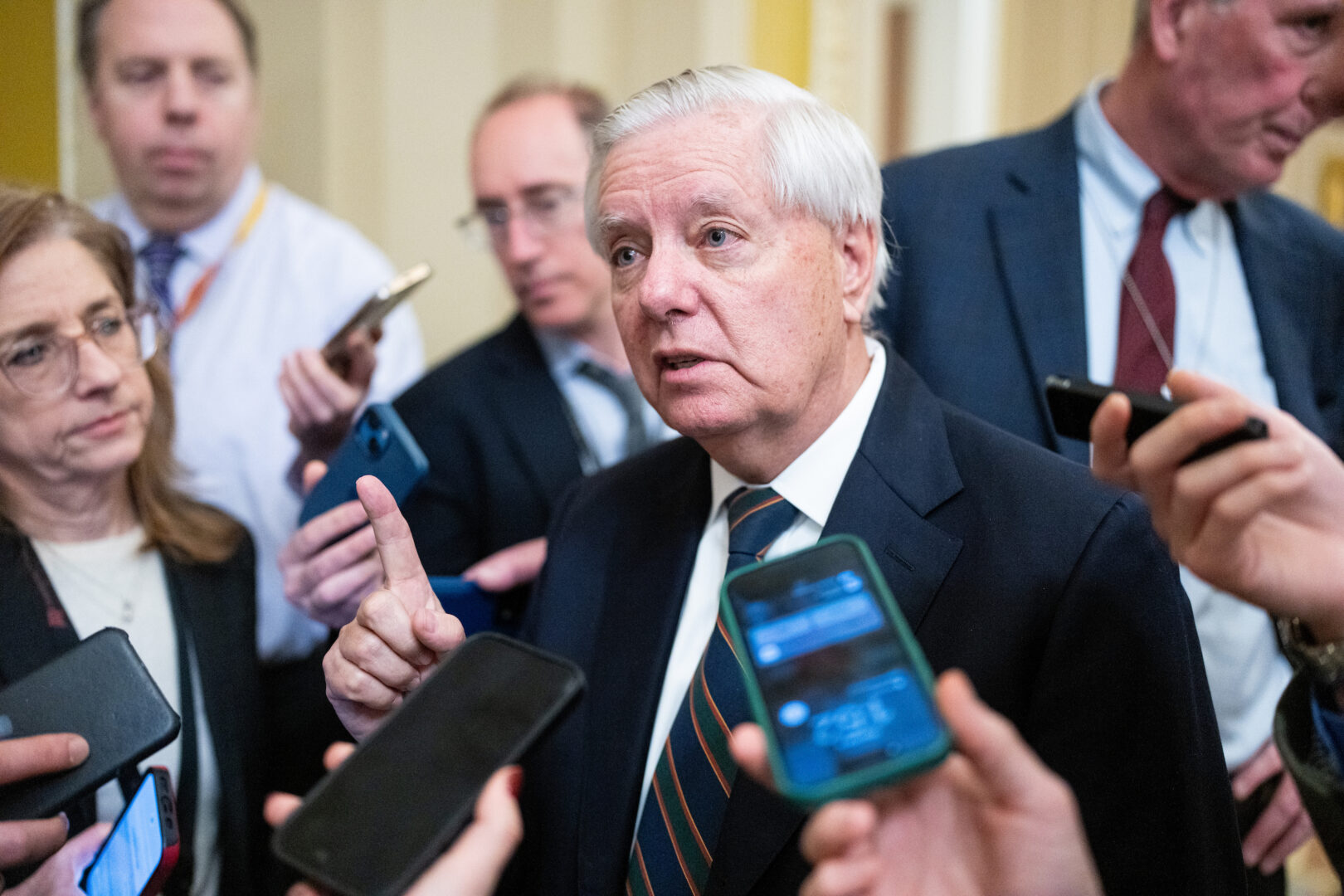
“Republicans are doing something that must be done quickly, and that our Democrat colleagues are trying to prevent us from doing,” said Senate Budget Chairman Lindsey Graham, a South Carolina Republican, in a statement. “With this budget resolution, we are moving forward — not backward — on rational immigration policies that secure our border.”
The resolution would technically allow each of the Senate’s two authorizing committees to increase the deficit by up to $70 billion, theoretically allowing for up to $140 billion in total new spending.
But Graham spokeswoman Taylor Reidy said on X that the matching instructions for the two committees are designed to “provide for maximum flexibility” because of overlapping committee jurisdictions on immigration policy. The GOP’s total spending target would remain at about $70 billion, she said.
Progress on a reconciliation bill could clear a path for fully funding the Department of Homeland Security and ending a record-breaking partial shutdown. Senate GOP leaders want to keep the bill confined to immigration funding to improve the chances for speedy passage.
But the budget resolution will be subject to unlimited amendment votes, known as a “vote-a-rama,” on the Senate floor, a process that could end up expanding the scope of a reconciliation package. The vote-a-rama could begin as early as Wednesday night, depending on whether senators want to use up all 50 hours of allowed debate time, but Graham said he was expecting it to begin Thursday.
After huddling Tuesday morning in Graham’s office, Senate Budget Republicans voiced support for prioritizing a narrow package focused on immigration enforcement funding, while some were hopeful of passing an additional reconciliation package later in the year that could include a wide range of items, from boosts in defense spending to potential health care spending cuts.
“I do agree with the general strategy of moving ahead quickly on funding ICE and Border Patrol, and that’s what I’m going to support,” said Finance Chairman Michael D. Crapo, R-Idaho.
Democrats ready to fight
Democrats said they’re preparing amendments that could include restrictions on ICE but mainly focus on affordability issues.
“We’re going to focus almost exclusively on the cost of living,” said Sen. Brian Schatz, D-Hawaii. “And we’re going to make the point that they have this extraordinary tool, and they’re using it to pre-fund ICE with no reforms, rather than to reduce the cost of gasoline and electricity and groceries and health insurance.”
Some have already voiced excitement about holding Republicans’ feet to the fire over potential proposals for restrictions on immigration agents, such as prohibiting the wearing of masks during raids and obtaining judicial warrants to enter private property. Republicans have resisted those restrictions, saying they would hamstring ICE operations and expose agents to doxing and intimidation.
“Instead of doing literally anything to lower costs, Republicans are spending their time working hard to cut another massive blank check for ICE and Border Patrol— without any reforms, or even basic guardrails,” said Senate Appropriations ranking member Patty Murray, D-Wash., in a statement.
Trump has set a deadline of June 1 for Republicans to pass a reconciliation bill funding immigration agencies. But they will need nearly every GOP member to push it through both chambers over united Democratic opposition.
The Senate has already passed a bill funding the rest of the Department of Homeland Security, with the exception of immigration agencies. But House leaders have been unwilling to take up that bill until a reconciliation bill is passed to secure immigration funding.
“The sequencing is important,” Speaker Mike Johnson, R-La., said Tuesday. “We’ve got to make sure we don’t isolate … and make an orphan out of key agencies of the department. And there’s some concern on our side that if you do the bulk of the department first, before that, that they could be left out.”
Some in the House GOP’s right flank remain resistant to the two-pronged approach for funding the department. “I haven’t said what I will do or not do,” said Rep. Chip Roy, R-Texas, a member of the ultraconservative Freedom Caucus. “But I think marching to the beat … of the Democratic drum is insane. That we would isolate Border Patrol and ICE, I think is crazy.”
There’s additionally concern in the party that the package is too narrow and that Republicans are burning what some think is their last chance to move filibuster-proof legislation before the November midterm elections, when they risk losing their fragile majorities in both chambers.
While some Republicans want another chance to cut some spending as part of a reconciliation package this year, some fiscal hawks have argued that cuts are not necessary for an immigration-enforcement-only funding package, since it’s intended to replace annual appropriations that would not have been offset.
Senate Republicans also said they think a smaller package would be easier to pass in both chambers.
Sen. Rick Scott, R-Fla., a member of the Budget Committee, said Tuesday that he’s also looking at pushing for potential deficit reduction measures in the reconciliation bill.
“I’m looking for pay-fors,” he said.
But when asked if he was confident any pay-fors would be attached to the package, Scott said: “I haven’t had a lot of success since I’ve been up here.”
“I’m an optimist, but I have to be realistic,” he said.
Valerie Yurk contributed to this report.