Immigration budget bill suffers setback as House leaves town
Efforts to thwart a Justice Department "anti-weaponization" fund tied the Senate in knots
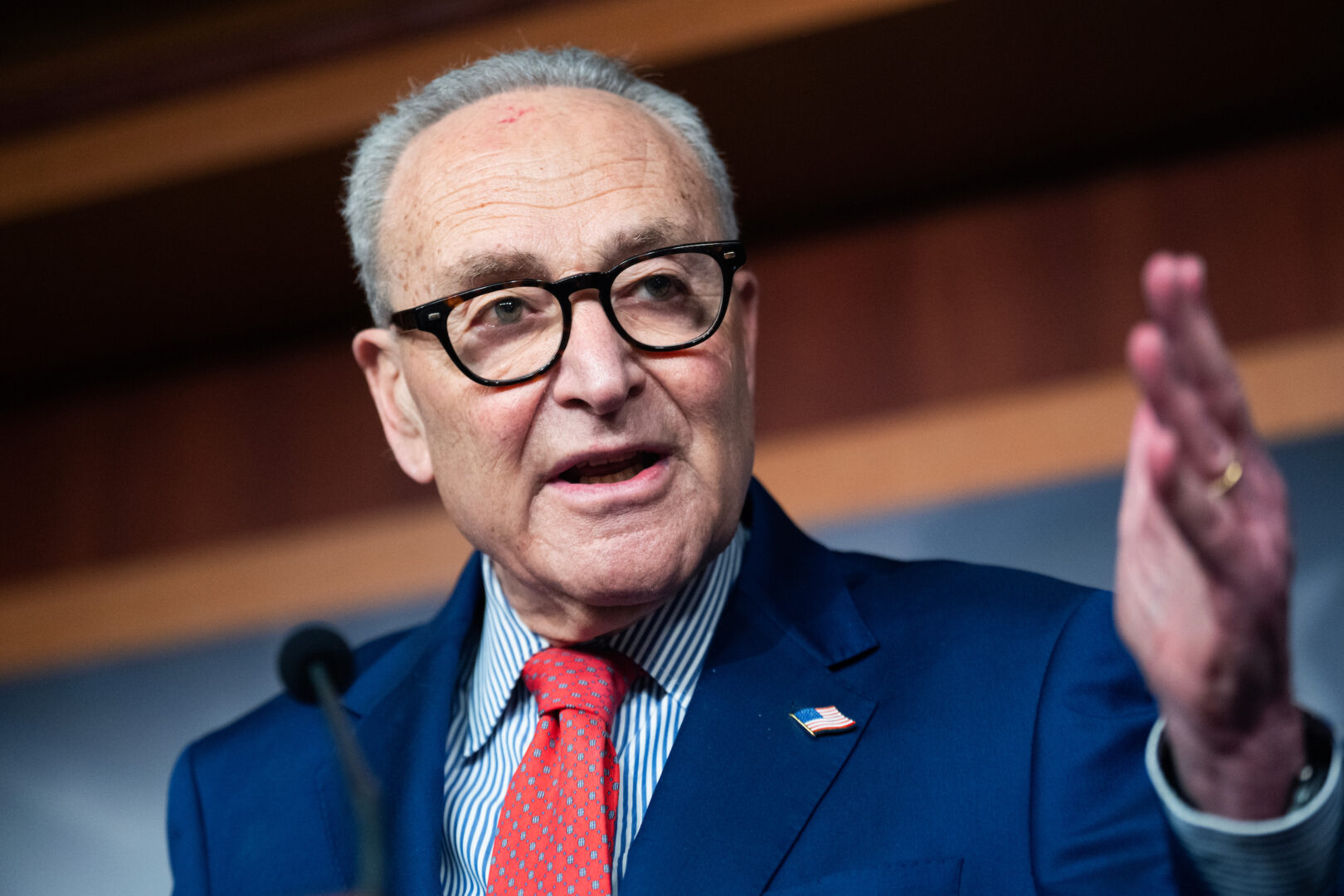
A GOP reconciliation bill for immigration enforcement appeared to be skating on thin ice Thursday night as the House suddenly left town for the week and lawmakers continued to wrangle over a Justice Department “anti-weaponization” fund.
Senate opponents of the nearly $1.8 billion fund — derided by critics as a “slush fund” for President Donald Trump’s loyalists who broke the law — were eager to adopt an amendment to the bill from Sen. Bill Cassidy, R-La., that would prohibit payments from the fund. They were working with the Senate parliamentarian to see if the amendment could be adopted with a simple-majority vote instead of a 60-vote threshold to make it easier to win approval.
Cassidy told reporters that if an amendment on the fund isn’t adopted, “it’s a possibility” that the bill (S 2) could die on the Senate floor. He filed a new version of his amendment Thursday night that would restrict payouts from the fund only to those who died or suffered from the Jan. 6, 2021, attack on the Capitol. And it would appropriate $100 million to the fund for that effort.
But Senate Majority Leader John Thune, R-S.D., said he was concerned that if a Justice Department fund amendment were included in the bill, it would be “problematic in the House and, probably, then ultimately getting it signed by the president.”
As if to underscore that concern, House leaders abruptly decided to leave town for the week, abandoning earlier plans to take up the reconciliation bill as soon as Thursday night, whenever the Senate can pass it.
But senators continued to plow ahead and were trying to reach a bipartisan agreement on amendment votes that could allow them to complete work on the measure late Thursday night.
‘Republican-led solution’
The bill survived its first key test earlier as the Senate kicked off its amendment “vote-a-rama.”
On a 49-50 vote, the Senate rejected a procedural motion by Minority Leader Charles E. Schumer, D-N.Y., to send the bill (S 2) back to the Judiciary Committee, a move that would have effectively killed it. Schumer was seeking to use that maneuver to push for a prohibition against the Justice Department fund.
While some Republicans want to prohibit or restrict the fund through legislation, they proved unwilling to derail the entire bill. Still, three Republicans facing reelection this year —Susan Collins of Maine, Jon Husted of Ohio and Dan Sullivan of Alaska — supported Schumer’s motion.
Cassidy, who lost his reelection bid in the primaries in large part thanks to Trump’s opposition, held back his vote on the Schumer motion for most of the roughly three hours the tally was held open before voting against it.
“I want this to be a Republican-led solution,” said retiring Sen. Thom Tillis, R-N.C., a leading GOP critic of the fund, before opposing Schumer’s motion. “I’m not going to move on a Democrat motion.”
But Tillis then offered his own amendment to block the fund by diverting the money to fraud enforcement efforts.
That effort, too, was rejected by a lopsided vote of 15-84. Democrats said the Tillis amendment wouldn’t actually prohibit the fund and would likely create a slush fund by another name, under the guise of fraud enforcement.
GOP leaders maneuvered to make adoption of such amendments more difficult when they stripped $1.46 billion in Justice Department funding from the bill. That move meant an amendment on the Justice Department fund would no longer be considered germane to the bill and would require 60 votes to overcome a procedural objection, instead of a simple majority.
With that threshold in place, the Senate disposed of several other amendments from both parties.
One amendment, from Sen. Jeff Merkley, D-Ore., would have blocked any funding for the White House East Wing modernization project, which features a 90,000-square-foot ballroom, without congressional authorization. A procedural motion defeated that amendment on a 53-46 vote, falling seven votes shy of the 60 required.
Another, from Sen. Mark Warner, D-Va., took aim at Trump’s selection of Federal Housing Finance Agency Director Bill Pulte to serve as acting director of national intelligence. The amendment would have banned Senate-confirmed leaders of federal agencies and departments from serving as the DNI at the same time. It fell on a 49-49 vote.
And an amendment from Sen. Lindsey Graham, R-S.C., would have inserted the language from the so-called SAVE America Act (S 1383), which would require proof of citizenship to register to vote and photo identification at the polls, among other things.
While Trump has pushed to abolish the Senate filibuster to pass that election measure with a simple majority instead of 60 votes, Republicans couldn’t even muster a simple majority for it Thursday night. It fell on a vote of 48-50, with Collins, Tillis, Sen. Lisa Murkowski, R-Alaska, and Sen. Mitch McConnell, R-Ky., siding with Democrats against the proposal.
More amendments on the way
Republicans filed a range of amendments, though those concerning the Justice Department fund were paramount.
A second Cassidy amendment would nullify a settlement agreement announced when Trump withdrew his $10 billion lawsuit against the IRS over his leaked tax returns. That agreement forbids tax audits of the president. And a third amendment would prohibit such settlements in the future.
Other GOP amendments filed include:
- Another amendment from Cassidy that would walk back the Trump administration’s newly announced green card policy requiring many applicants to return to their home countries to await a decision.
- An additional Cassidy amendment that would raise the retirement age for Immigration and Customs Enforcement officers with less than 25 years of service to offset the costs of the reconciliation bill.
- An amendment sought by Murkowski that would permanently exempt seasonal fish processors from the numerical cap on H-2B non-immigrant visas.
- Another Murkowski amendment that seeks to provide “a fee exemption for applications for naturalization filed by certain nationals who have resided in outlying possession of the United States.”
- A second amendment by Tillis that would set up a new nonimmigrant visa for “mobile entertainment workers” like circus performers.
- A third Murkowski amendment that seeks exemptions for public school employees from nonprocessing-related fees for H-1B visas.
Democrats, meanwhile, planned to put Republicans on the record on a number of other controversial topics through their proposed amendments, though those amendments were likely to be unsuccessful.
“Democrats will force Republicans to vote on Trump’s MAGA slush fund, his lifetime tax exemption, his billion-dollar taxpayer-funded ballroom,” Schumer said on the Senate floor ahead of the vote-a-rama. “Amendment after amendment, vote after vote, Republicans are going to have to answer to the American people on tariffs, on skyrocketing costs, on the disastrous war with Iran, on the violence Trump’s masked agents have unleashed on our streets.”
The filibuster-proof bill is designed to fund immigration enforcement agencies through the rest of Trump’s term. Democrats have opposed that funding without imposing new restrictions on federal immigration agents to curb abuses.
While Trump had set a June 1 deadline for passing the bill, GOP leaders were hoping to pass it as early as this week through both chambers, until the House abruptly left town.
Valerie Yurk contributed to this report.