Trump’s primary involvement sparks vote-a-rama drama
Seven GOP senators become unpredictable during marathon voting session
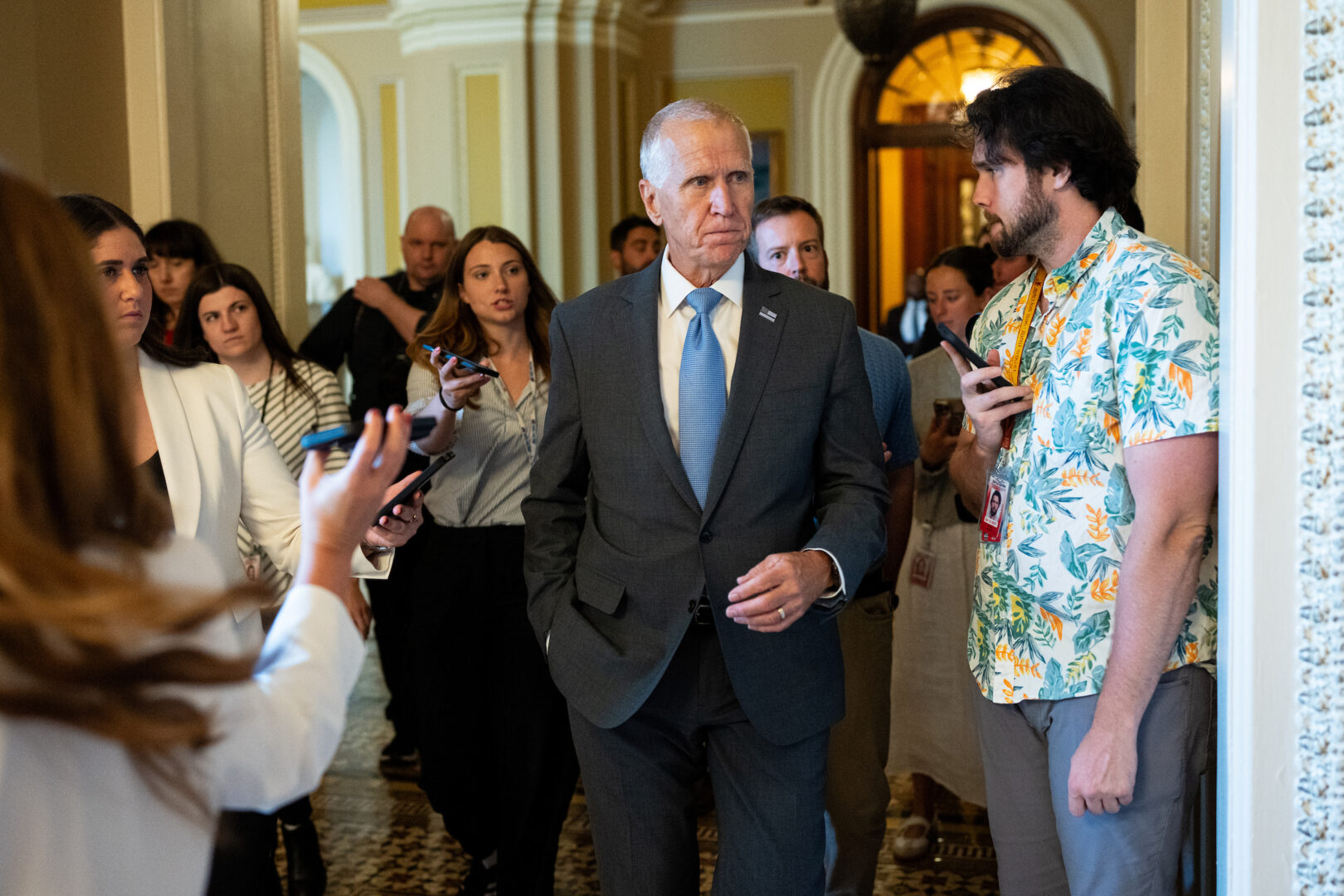
Some call them the “YOLO caucus,” the slang term for the phrase “You only live once.”
Others say this is how some members of this growing group of Senate Republicans have always legislated.
Either way, Thursday’s high drama vote-a-rama highlighted the complicated equation of the Senate Republicans’ slim majority and the anxiety over the upcoming midterm elections, with President Donald Trump’s heavy thumb on the political scale serving as an additional pressure point.
A group of seven Republican senators — either casualties of Trump’s involvement in the 2026 elections or a few facing tough reelection fights —emerged early during Thursday’s marathon vote series on the GOP’s reconciliation bill for immigration enforcement as a possible thorn in Senate Majority Leader John Thune’s side.
“Timing is everything,” Thune told reporters this week when asked about the growing rift between both ends of Pennsylvania Avenue. “And we’re trying to get some stuff done up here, things that the White House wants done, [and they] get more complicated with the weekly announcements.”
The main point of contention the group has with the reconciliation bill involves a separate land mine announcement the White House and Senate Republicans have navigated for weeks: the Justice Department’s $1.8 billion “anti-weaponization” fund, which angered many in the conference.
Though the DOJ has since walked back the fund — acting Attorney General Todd Blanche told lawmakers Tuesday it is being scrapped — the impact of that announcement lingers.
The group includes Republican Sens. Thom Tillis of North Carolina, a moderate Republican who is retiring at the end of this term; Bill Cassidy of Louisiana and John Cornyn of Texas, who Trump successfully primaried out of their seats; Lisa Murkowski of Alaska, a longtime Trump critic; and Susan Collins of Maine, Jon Husted of Ohio and Dan Sullivan of Alaska, who all face increasingly competitive races this November.
Tillis, who announced his retirement last year to be able to “speak truth” to Trump and the White House, unsuccessfully pushed an amendment Thursday to block the $1.8 billion fund by diverting that money to fraud enforcement efforts. That was rejected 15-84, with Democrats saying the Tillis amendment wouldn’t actually prohibit the fund and would likely create a slush fund by another name under the guise of fraud enforcement.
Cassidy, Collins, Cornyn, Husted, Murkowski and Sullivan backed his amendment.
“I don’t want to be disruptive to the leader, but we’ve got to have a treatment for this fund before we get off this bill. I mean, I certainly won’t support getting off of it until we do,” Tillis told reporters ahead of the vote-a-rama.
Similarly, Murkowski told reporters she wasn’t “making any promises” when asked if she’d support the final bill if the $1.8 billion fund hadn’t been addressed.
Vote-a-rama drama
The drama started before the first vote of the vote-a-rama, when a motion to recommit the legislation from Minority Leader Charles E. Schumer, D-N.Y., stalled on the Senate floor for nearly three hours while Cassidy, Husted and Sullivan held off on voting.
During that stretch, Cassidy engaged in several animated conversations with Thune and Senate Majority Whip John Barrasso of Wyoming on the floor and could be seen chatting with the Senate’s parliamentarian, Elizabeth MacDonough.
He eventually voted “nay” in line with Republicans, which allowed Husted, Collins and Sullivan to vote with Democrats, without halting the reconciliation bill before the vote-a-rama officially even began. The Schumer motion was defeated 49-50.
Cassidy, a gastroenterologist, became the first incumbent senator to lose a regularly scheduled primary election since 2012 after Trump endorsed Rep. Julia Letlow in the race.
Cassidy voted to convict Trump during his 2021 impeachment trial and wasn’t able regain the president’s good graces even after he gave the key committee vote in confirming Robert F. Kennedy Jr. for secretary of Health and Human Services last year.
Similarly, Cornyn faced Trump’s political wrath and lost this cycle to Texas Attorney General Ken Paxton after Trump issued an eleventh-hour endorsement of Paxton last month.
Sen. Shelley Moore Capito, R-W.Va., the Republican Policy Committee chair, said, “The Cassidy and Cornyn anti-endorsements of their opponents really deflated a lot of people.”
“There are certain instances where you have to put the political lens on, and I think they just do that less,” she said, referring to senators leaving next year. “Are they persuadable? Yes, I would say all of the ones that I’ve seen are, have always been, and continue to be team players, and want the team to do well, and know that preserving the majority, in their hearts, they know that that’s the right thing for the country.
“I don’t think they want to be a force of destruction,” she added.
As of Thursday evening, it was unclear what Cassidy’s next move was, but it was clear there was still a group of GOP senators uncomfortable with passing the reconciliation bill without addressing the fund.
Cassidy was working with the Senate parliamentarian into the evening Thursday regarding an amendment and its vote threshold, per Thune and Tillis.
Tillis said he didn’t know how large that group may be, but “I, for one, think that it’s a political liability that we should take off the table.”
“I’m going to be guided by the position of the members that are in [cycle],” he said. “When you see my vote, it’s going to be because I believe it’s in the best interest [of the members who are in cycle].”
Husted, who faces Democratic former Sen. Sherrod Brown of Ohio in the November election, broke with Trump on two votes related to the weaponization fund and ballroom funding authorization. A poll from Fox News on Wednesday found 53 percent of respondents backed Brown to Husted’s 45 percent.
Collins, Senate Democrats’ top target in the November elections, is in a close race with Graham Platner, the likely Democratic nominee for Maine’s Senate seat. Platner’s campaign circulated a memo Wednesday showing a survey taken early this week found him with a 4-point lead over Collins and said his campaign had “seen some of the strongest fundraising of the entire campaign” in recent days. Still, the Maine Democrat faces controversies, including reports that he sent sexually explicit texts to other women while married.
And Sullivan, in perhaps the reddest of what are considered to be swing seats, faces former Rep. Mary Peltola, a moderate who lost her at-large House seat by less than 3 percentage points in 2024, even as Trump carried the state by 13 points.
A majority of this group of Republicans defected from several of the amendments early on during the vote-a-rama.
The group continued to show their independent streak on other amendments, including a Democratic-led one to bar those in other Senate-confirmed positions from serving as Director of National Intelligence — targeted toward Trump’s temporary pick for DNI, Bill Pulte — and a Trump-pushed amendment to attach his election overhaul bill to the reconciliation legislation.
That amendment, filed by Budget Chairman Lindsey Graham, R-S.C., fell short of the needed 60 votes.
Several of the group, including Tillis, Collins and Murkowski, voted with Democrats, as well as former Republican Leader Sen. Mitch McConnell of Kentucky.
Daniela Altimari, Mary Ellen McIntire, Jacob Fulton and Aris Folley contributed to this report.