DeSantis unveils new map aiming to help Florida GOP flip 4 House seats
Sunshine State is latest to join mid-decade redistricting push

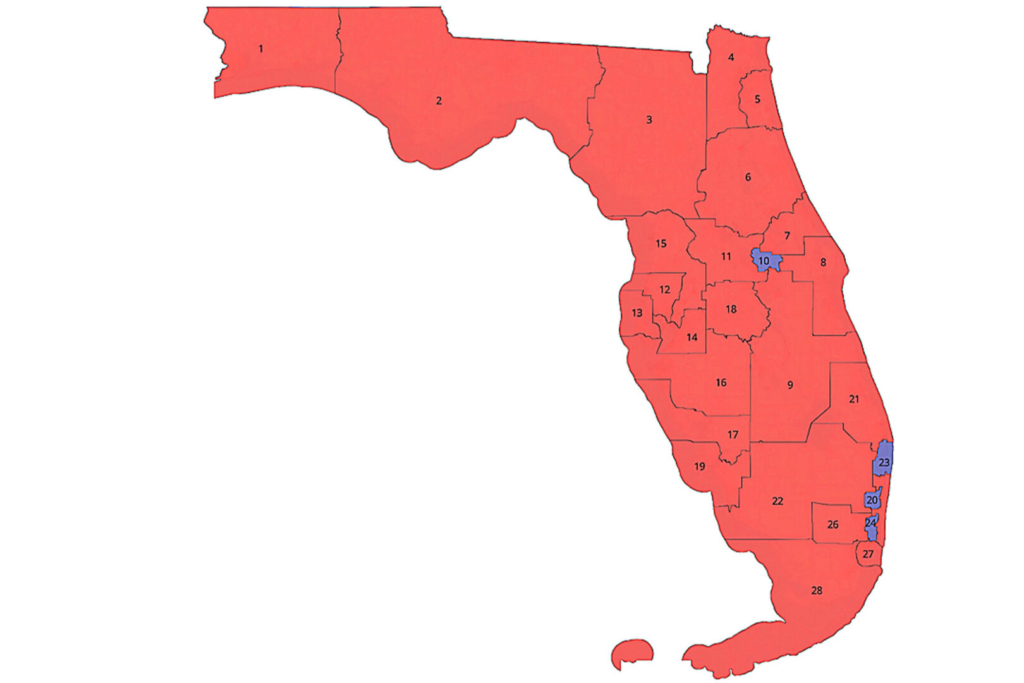
Florida Gov. Ron DeSantis unveiled a new House map for the state Legislature to consider in a special session this week that would appear to give Republicans four pickup opportunities if enacted.
The map, which was first reported by Fox News Digital, is expected to come up for a vote in both the state House and Senate later this week. Florida is looking to join other states that have drawn new congressional maps ahead of this year’s midterm elections, including Virginia, where voters narrowly approved a Democrat-drawn map in a referendum last week.
“Florida got shortchanged in the 2020 Census, and we’ve been fighting for fair representation ever since,” DeSantis told the outlet. “Our population has since grown dramatically, and we have moved from a Democrat majority to a 1.5 million Republican advantage.”
The Republican governor, who’s in his second term, also said that “drawing maps based on race … is unconstitutional and should be prohibited.”
A new map in Florida, though, would almost certainly be subject to legal challenges, especially given the so-called Fair District Amendments of the state constitution, which say the congressional map shouldn’t be drawn with partisan intent.
Republicans currently hold 20 of Florida’s 28 House districts, while the map shared with CQ Roll Call by DeSantis’ office shows Republicans would be favored in 24 seats. It wasn’t immediately clear what the partisan breakdown of the proposed districts would be.
“It’s clear Republicans haven’t learned a thing, choosing to move forward with a corrupt partisan power grab that violates Florida’s strict prohibition of partisan gerrymanders,” Julie Merz, the executive director of the Democratic Congressional Campaign Committee, said in a statement. “Republicans are doing this because they know they have lost the support of the American people, and with it, the midterms.”
Some Florida Republicans have warned against trying to redraw the state’s congressional map too aggressively. They say doing so could imperil Republican incumbents who could face more difficult paths to reelection, especially in a midterm year that could favor Democrats. Florida Democrats have already overperformed expectations in a handful of special elections this cycle.
Redistricting has reshaped the House midterm battleground for 2026 after President Donald Trump pushed Republican-led states to redraw their congressional lines to help the party maintain its razor-thin House majority. States that have heeded Trump’s call include Texas, Missouri and North Carolina, where new lines collectively give Republicans seven pickup opportunities.
Meanwhile, Democrat-run states have sought to counter those efforts through ballot measures, with voters in California and Virginia approving new congressional maps that, combined, could help Democrats flip nine seats.
The Supreme Court of Virginia on Monday heard oral arguments in a case challenging the legislative process that set up the redistricting ballot measure, after lower court rulings had invalidated the referendum process. The new map approved in Virginia last week would favor Democrats in 10 of the commonwealth’s 11 House districts.
Other states that have adopted new maps ahead of this year’s elections include Utah, where a new court–ordered map gives Democrats a chance to flip one seat, and Ohio, where constitutionally required new lines give Republicans a chance to flip two seats.
The U.S. Supreme Court is also expected to rule in the coming months on a challenge to the Voting Rights Act. Striking down Section 2 of the civil rights law could prompt additional redistricting efforts in some Southern states, although it’s not clear whether those states would have enough time to act ahead of the November elections.