GOP senators push for challenge to House maps in Democratic states
Schmitt, other GOP senators call for ‘aggressive’ fight against Democratic maps
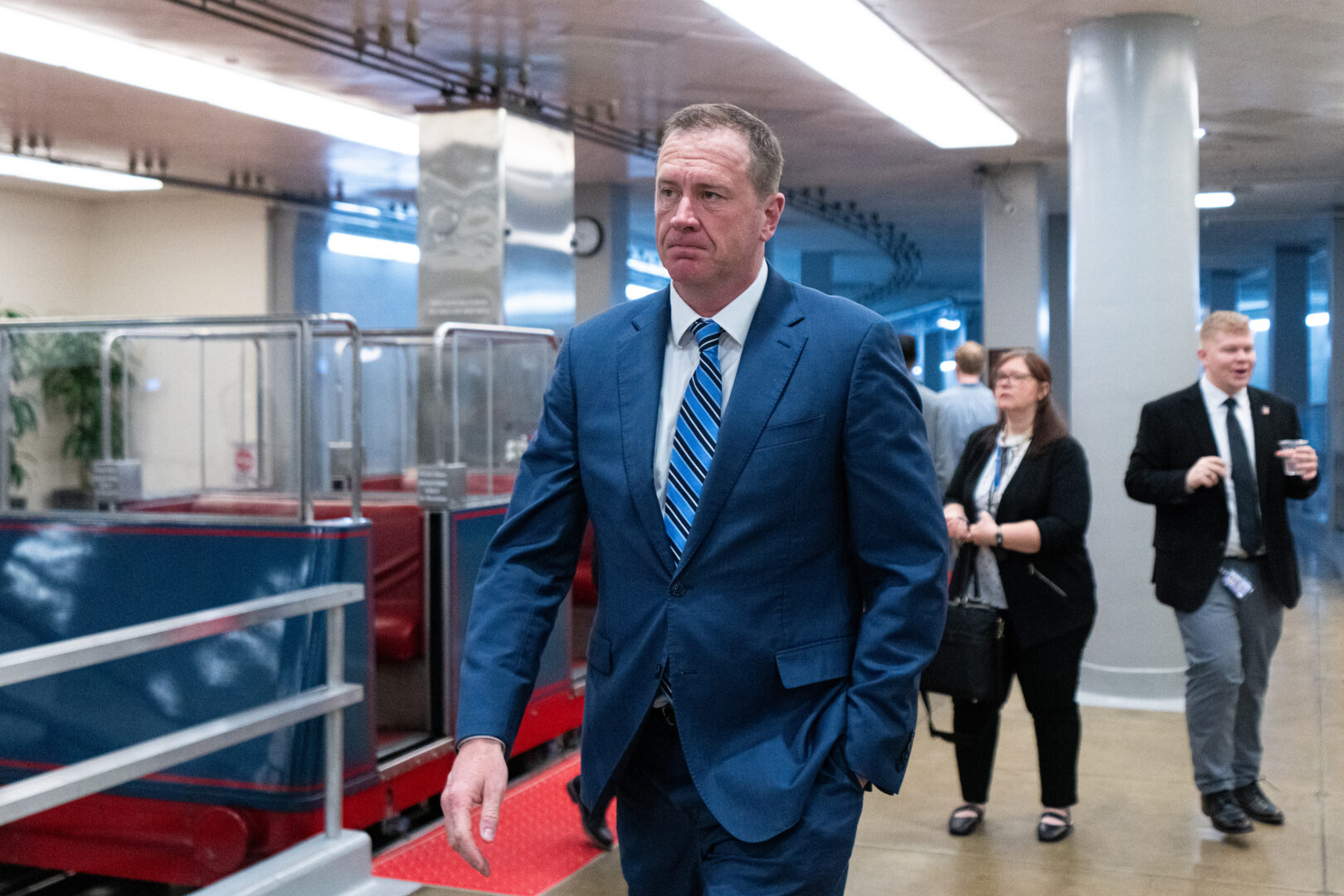
Senate Republicans used a hearing Tuesday to push the Trump administration to file lawsuits challenging congressional maps in California, Illinois and other Democrat-controlled states in the wake of a Supreme Court decision rolling back the Voting Rights Act.
The hearing comes weeks after the Supreme Court’s six-justice conservative majority in Louisiana v. Callais overturned a Louisiana congressional map with a second Black opportunity district drawn to satisfy the Voting Rights Act.
The decision supercharged a nationwide redistricting arms race. Experts and members of Congress have said the decision changes long-standing redistricting standards and makes discrimination in redistricting harder to prove.
At the opening of the hearing of the Senate Judiciary Committee Subcommittee on the Constitution, subcommittee Chair Eric Schmitt, R-Mo., urged the Justice Department and any possible private litigants to challenge maps in states such as California and Illinois, arguing that efforts to have the maps maximize minority representation violate the Constitution.
“These maps do not become constitutional because they’re already in use; they do not survive because politicians call them voting rights maps, and they will not disappear on their own,” Schmitt said.
Schmitt and other members of the panel argued that the states were explicit about considering race in drawing minority opportunity maps in the states. Schmitt said the DOJ should try to intervene before this fall.
“I hope they are very aggressive about this,” Schmitt said.
Schmitt and several Republican senators on the panel argued the court’s decision means that states cannot take race into account when drawing districts — equating it to affirmative action in college admissions, which the Supreme Court said violated the Constitution in a 2023 decision.
Tuesday’s hearing, which featured attorneys on both sides of the Louisiana case as witnesses, also touched on broader issues of race in redistricting, partisanship and discrimination. Both majority witnesses said that maps in several Democratic states may violate the Constitution following the Louisiana decision.
Will Chamberlain, senior counsel with the Article III Project, argued states like California have an obligation to redistrict this year in the wake of the Louisiana decision, even if it means delaying primaries and other election dates.
“Unless it’s simply impossible to implement constitutional maps and conduct elections, state governments should do everything under their power not to discriminate on the basis of race,” Chamberlain said.
Mike Davis, president of the Article III Project and former chief counsel for the Senate Judiciary panel, has been a proponent of Republicans pursuing maximum partisan advantage in new maps following the Louisiana decision.
The other majority witness, attorney Edward Greim, who successfully argued the Louisiana case, said that “federal courts may have a limited role to play” in elections this year as the electoral process has already started in many states.
On the opposite side of the dais, Sen. Peter Welch, D-Vt., said the Supreme Court‘s Louisiana decision accelerated the “race to the bottom” in partisan redistricting and undermined Congress’ efforts to address racial discrimination.
“Our democracy depends ultimately on protecting and preserving the right of individual citizens to pick their politicians, not intensifying the control that politicians have about who the voters are that they will permit to be involved in the election,” Welch said.
Sen. Mazie K. Hirono, D-Hawaii, argued the Supreme Court made it almost impossible to prove racial discrimination in drawing maps unless legislators explicitly say they are drawing the lines to discriminate against minority voters.
“Are you crazy? You think they are going to be that overt about it? Of course not,” Hirono said.
The minority witness, Todd Cox, associate director and counsel for the NAACP Legal Defense Fund, argued that the Supreme Court twisted the intent of Congress’ VRA amendments in 1982 with the Louisiana decision to make it harder to prove racial discrimination.
Experts noted that portions of the Louisiana decision were aimed at making it harder for Congress to respond to race-based vote dilution in redistricting.
Several Republican states, including Louisiana, Tennessee, Alabama and South Carolina have started redistricting since the decision, targeting majority-minority House seats held by Democrats.
Further, since then the justices quietly overturned a separate ruling requiring Alabama to draw a congressional map with a second opportunity district under the Voting Rights Act. That decision, issued without oral arguments, allowed the state to move forward with a map the lower court found to be racially discriminatory after a trial last year.
A three-judge court is scheduled to hold a hearing Friday on the future of Alabama’s new map.