Senators urge quick action to halt college sports decay
Rare bipartisan agreement on 'the last best hope we have to save college sports'
Senators and college officials on Wednesday urged swift action on a bipartisan measure that aims to overhaul a college athletics system they say hemorrhages money and hinders student-athletes — even as two powerful conferences said they would seek changes.
During a much-anticipated Senate Commerce Committee hearing, both the bill’s authors — Chair Ted Cruz, R-Texas, and ranking member Maria Cantwell, D-Wash. — spoke in dire terms about the trajectory of college athletics. Cantwell warned against “an arms race of money” and Cruz said “college athletics is being torn apart.”
The three-hour hearing featured no major criticisms of the bill and appeared aimed at drumming up support for it ahead of a committee markup and possible floor action.
Cruz noted that a related but much different House bill was yanked from consideration twice over the last six months, calling the Senate measure “the only bipartisan bill” in town and “the last, best hope we have to save college sports.”
However, Sen. Bernie Moreno, R-Ohio, signaled that he likely would seek changes for more-targeted antitrust language for the NCAA and a prohibition on men playing in women’s sports.
And Sen. Ben Ray Luján, D-N.M., said he would like to work on language that would restrict the movement of coaches from program to program, because “the market for coaches is a bit of a mess as well.”
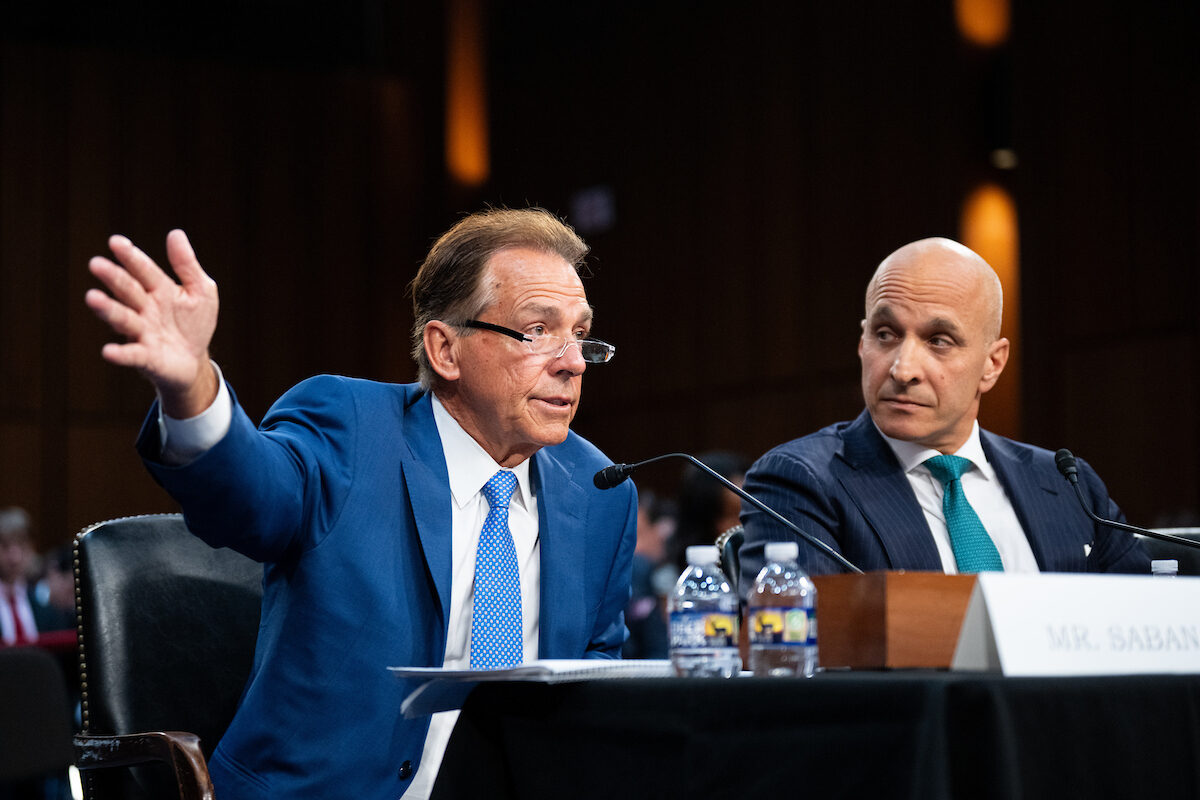
Nick Saban, a legendary head coach who won seven national championships, endorsed the Senate bill said college sports — and especially football — has devolved into a “pay-for-play” system. Such a model, unless modified by Congress, would be unsustainable and force many institutions of higher learning to shut down non-revenue-generating sports, Saban and other college officials warned the panel.
“We cannot have a pay-for-play system and then continue to cut this many women and Olympic athletes in various programs,” Saban said. “Just since 2023, over 100 programs and more than 1,000 athletic scholarships and rosters in women and Olympic sports have been eliminated — and it’s going to get worse.”
He also told the committee, “Congress does not need to micromanage college athletics.”
The so-called “NIL era,” in which student-athletes can legally profit from their name, image and likeness, has cost college athletic programs a collective $5 billion over the last year, Cantwell said. Part of those growing losses are quickly expanding costs of football — and, to a lesser extent, basketball — rosters.
In a rare scene on Capitol Hill in the age of strong partisanship, conservative senators like Marsha Blackburn, R-Tenn., appeared to agree with progressive panel members such as Cantwell and Andy Kim, D-N.J.
Sen. Eric Schmitt, R-Mo., who played football and baseball at Truman State University and is an original cosponsor of the Senate measure, said his constituents have asked him why Congress is getting involved in this. His reply: “The truth is, Congress is the only entity on the planet that can provide the antitrust exemption status to empower a governing body to set the rules and to enforce the rules.”
What’s more, only federal legislation could create the Cruz-Cantwell measure’s proposed five-year eligibility window for student-athletes and limit players to two trips through the controversial transfer portal, he said.
“No one else can do it. It is up to us,” Schmitt said of lawmakers. “And if we don’t do it, I think if we’re having a hearing two years from now, shame on us. Because it’s going to look a lot different — and it won’t be better.”
Sen. Lisa Blunt Rochester, D-Del., said she wanted the committee to hear from more advocates for non-revenue-generating sports and women’s sports, as well as officials from smaller institutions and historically Black colleges and universities.
She also said some student-athletes, labor unions and civil rights organizations have expressed concerns about the measure to her. She did not elaborate on those worries. Blunt Rochester also expressed concerns that the bill could force players and their families to pay any legal fees needed to resolve disputes with institutions and conferences.
The most sweeping provisions of the Senate bill would establish nationwide rules for student-athletes to earn money from their name, image and likeness, known as NIL. It would hand the NCAA — or a to-be-established national governing entity — some limited antitrust power to enforce its rules and create a potential revenue-sharing system, while remaining neutral on the question of whether student-athletes could be considered university employees.
The measure also would prohibit the creation of a so-called superconference, such as a breakaway league composed of the existing members of the Southeastern and Big 10 conferences. But senators and witnesses warned that kind of realignment would exclusively benefit those conferences’ 34 members, popular independent Notre Dame and maybe a small handful of ACC and Big 12 members that are household names.
Cantwell said she had received a letter from officials from the Atlantic Coast and Big 12 conferences expressing their worry that “somebody’s going to come in and rearrange the deck chairs of those conferences, steal the ‘eyeball schools,’ and then basically leave everybody with everything else.”
Pete Bevacqua, Notre Dame athletics director, told the committee that without the Senate legislation, “you’re going to see certain schools invest, maybe almost singularly, in certain sports.”
“The inevitable outcome is there’s going to be a small handful of schools that will differentiate themselves from others and play football at a superleague level,” Bevacqua said. “I don’t think it’s good for college football to be a mini-NFL. That’s not the spirit of college football. That’s not what college football is about.”
‘Unresolved’
Pushback on the idea of the SEC and Big 10 breaking away came after those conferences on Tuesday night cast some doubt over the legislation ahead of a markup, which committee aides said could occur later this month.
In a joint statement released on X late Tuesday night, the so-called “Power Two” conferences said they oppose the Cruz-Cantwell measure “as drafted.” The conferences said they would support “a sustainable national framework for college sports — one with an effective transfer portal, clear eligibility standards, and protections and benefits for student-athletes.”
“The bill leaves critical issues unresolved. It does not meaningfully preempt the patchwork of state laws or provide the protections needed to make and enforce consistent rules, both essential to long-term stability in college athletics,” the SEC and Big 10 said. “It also shifts ongoing rulemaking to Congress, limiting the ability to adapt quickly as the landscape evolves. Rather than reducing litigation, the bill likely expands it without offering clear alternatives for dispute resolution.”
The SEC and Big 10 statement also pointed to how the Senate measure would establish a revenue-sharing pool if 102 of the 138 Football Bowl Subdivision institutions agree to participate, which would “result in fewer student-athletes receiving direct revenue share payments.”
A Democratic Commerce Committee aide said panel members and staff were not surprised by the initial pushback from the SEC and Big 10, saying they felt “optimistic” that the conferences said they intended to work with Cruz and Cantwell to alter the measure.
The committee has yet to set a date for a markup, with aides saying Wednesday they hoped to learn enough during the hearing to move toward a markup soon.
Gordon Gee, who has helmed several major universities and backs the Cruz-Cantwell measure, warned that college athletics has hit an “existential crisis,” urging Congress to take “bold action” to fix an “unsustainable system.”
“College football already has twice the viewership as the NBA, but half the media revenue,” Gee said. “Now, that just seems to me to be unsustainable — it’s something that we cannot really be able to even understand.”