College sports bill sparks unusual alliances
Sweeping measure scrambles typical partisan line of scrimmage
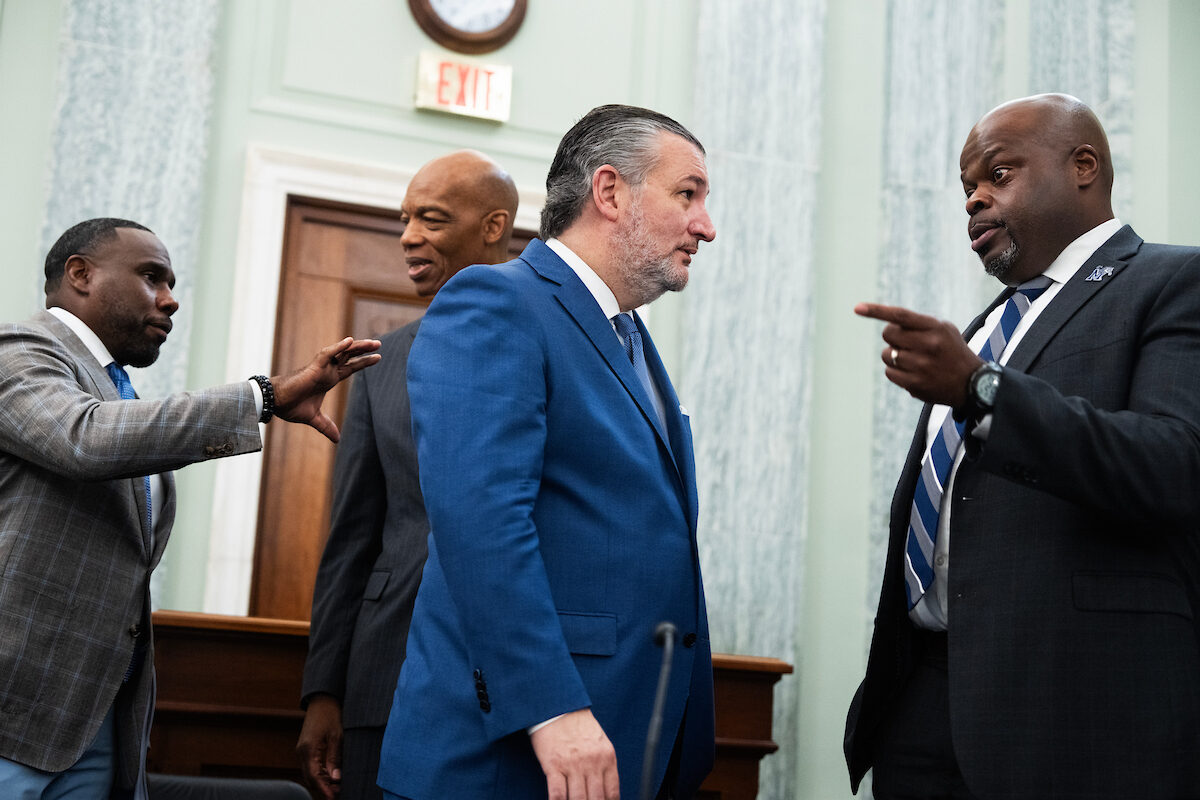
A push on Capitol Hill to craft legislation to rein in college sports amid skyrocketing costs and roster upheaval has created strange alliances across both the political and athletic spectrums, as was on display Wednesday at a roundtable hearing to rally support for the Senate’s version.
The head football coaches at the University of Memphis and Middle Tennessee State University are accustomed to being foes on the gridiron and recruiting trails. But on Wednesday, Derek Mason of MTSU and Charles Huff of Memphis were on the same team in support of sweeping changes to collegiate athletics.
Mason said “rules, regulations and order have to be restored” and compared college sports to the movie series depicting a post-apocalyptic battle royale featuring young combatants: “Right now, it feels like the ‘Hunger Games.’”
And Huff said legislation is necessary to tamp down on agents “preying on the naivete” of young student athletes as part of an “arms race.”
They were speaking with what would typically be an unlikely trio: Bill authors Ted Cruz, R-Texas, and Maria Cantwell, D-Wash., along with an original co-sponsor, Chris Coons, D-Del. Their bill got the backing of President Donald Trump.
Brian Socolow, co-chair of the sports practice at Loeb & Loeb law firm and who has represented professional and amateur athletes as well as teams and media companies, said during a Monday telephone interview that “sports is not your traditional political issue.”
“There’s different perspectives that, in some cases, are informed more by your region or your conference affiliation,” Socolow said. “That can really make a more significant difference than if you’re ‘far left’ or ‘far right,’ in terms of how we think about politics.”
The Senate bill, dubbed the Protect College Sports Act, has something for many members of Congress. There are Football Bowl Subdivision (FBS) institutions across the country, and 361 schools playing Division I men’s basketball. Those are college sports’ top money-makers — but the NIL era, with its massive payments to star players and lack of enforced rules, has become a drag on many athletics departments’ annual budgets.
Cruz told reporters following the roundtable that he would like to get the Senate version to the floor on what would amount to a legislative bullet train. Cantwell said she and Cruz would huddle soon to set a markup date.
Cruz said that on recent calls with major conference officials, they all have asked, “‘How quickly can you all do this, and can you do this before December, when the transfer portal opens?’”
“And I said, ‘Look, my hope is that we get this passed before the beginning of the school year.'”
But the bipartisan measure’s path to passage in both chambers has been muddied by objections from some conservatives and progressives in Congress, as well as by divisions among college sports conference leaders.
Jason Montgomery of the Husch Blackwell law firm, a former NCAA investigator with more than 20 years of legal and athletics regulatory experience, said “the strange bedfellows on this have been drummed up by political factors, more so than the substance of the underlying bill.”
“I think you have groups and folks in Congress who are opposed, right now, for different political reasons,” Montgomery said. “There are forces at play here before a midterm election that might be too powerful.”
Trump and House Majority Leader Steve Scalise of Louisiana often refer to one another as friends. The No. 2 House Republican is one of the most reliable votes in the chamber for the president.
But after Trump last week backed the Cruz-Cantwell bill, Scalise made clear he’s opposed, preferring a much different — but stalled — House version. Cruz, when asked Wednesday if he had spoken to Scalise about his bill, replied only, “Yes,”
Another Trump ally on the Hill, Alabama Sen. Tommy Tuberville, a former head football coach at Auburn and Texas Tech universities who is running for governor, has said he believes implementing the measure in totality would be hugely complicated for college administrators, coaches and athletics departments officials.
Tuberville, in a recent letter to college sports stakeholders, outlined his concerns, including restrictions on conference realignment and media rights that he called too tough.
The letter came after the powerful Southeastern Conference and Big 10 announced their opposition to the initial version. The Atlantic Coast, American Athletic, Big 12, Pac-12 and Conference USA have backed the bill.
Defensive holding
Progressive lawmakers such as Connecticut Sen. Chris Murphy and conservatives such as Ohio Sen. Bernie Moreno are aligned — for now, at least — in opposition to one of the legislation’s most controversial provisions on athletes as employees.
The Senate language would not address whether student-athletes should be considered employees of colleges and universities. The House bill would prohibit them from being considered employees.
Moreno addressed the Buckeye State’s sports-playing institutions of higher learning during a June 3 Commerce Committee hearing on the measure. “It doesn’t address the employment issue. We have 47 NCAA division teams between three divisions — 20,000 college athletes that I think would be left behind,” he said of Buckeye State institutions. “So, that gives me grave concern.”
And in a May 27 social media post, Murphy wrote the bill’s “primary effect seems to be to limit the compensation of athletes while protecting the huge salaries of all the adults — coaches, ADs, sports industry executives — who are getting rich off the performance of the players.”
In a sign of the needle Cruz and Cantwell must thread, Moreno and Murphy also disagree on another pressing matter: what to do about the NCAA’s anti-trust status.
Moreno said during the hearing he believes “the bill needs to be narrowed and more targeted as a targeted antitrust exemption.”
But Murphy wrote on social media that the Cruz-Cantwell measure “gives the NCAA an antitrust exemption that no other industry gets just so they can keep underpaying the athletes.”
The Congressional Black Caucus and NAACP led the charge last month in forcing House GOP leaders to shelve their college sports overhaul bill. CBC members and the organization’s leaders tied the bill to recent moves in red states to redraw congressional maps in ways that would eliminate majority-Black districts. They also contended the House bill would be tilted too far toward colleges and conferences, and away from players.
“If the SEC schools are for it, we are against it,” House Minority Leader Hakeem Jeffries said at a May 19 press conference outside the Capitol alongside CBC members and NAACP President Derrick Johnson. “These universities should feel compelled to speak up. Not because of their athletic programs; because it’s the right thing to do.”
Fast forward several weeks. The CBC and the powerful Birmingham-based conference both are opposed to the Senate measure — though for different reasons. The CBC on June 3 urged Cruz and Cantwell to “pause” their bill “until college athletics leaders meaningfully engage concerns about attacks on Black political representation.”
Committee aides and some involved in debate about the legislation agree on one thing: The prospects of getting it to Trump’s desk this year appear to be about 50-50.
“I’ve heard people say it’s a coin flip on passage of the Senate bill,” Montgomery said. “Me, personally? No. I don’t have much confidence in the current leadership of the NCAA or the conferences. They have a track record of screwing things up, and I think they’ll find a way to screw this up, too.”
“I tend to think anything that’s not done by August isn’t going to get done,” he added. “There’s plenty of other big things to worry about after the election.”