Rush to regulate AI divides Democrats in Congress
Bipartisan draft plan undercut by leading House Democrat
Recent proposals to regulate artificial intelligence show Democratic paths diverging between cooperation and compromise on the one hand and sweeping regulations on the other.
Growing public angst about the new technology and its impact on jobs, communities and the environment has fueled both ends of the spectrum and, even in the case of the most progressive ideas, attracted possible support from Republicans.
In co-sponsoring a draft bipartisan AI framework, Rep. Lori Trahan, D-Mass., pitched her position as one of balance.
“The threats AI poses to our national security, our safety, and our workforce are here and growing by the day,” Trahan said in a statement on the discussion draft release last week with sponsor Jay Obernolte, R-Calif. “This bipartisan framework is designed to meet the challenges posed by this rapidly advancing technology without smothering American innovation.”
[Related: Bipartisan AI draft proposes three-year preemption of state laws]
Trahan had drawn significant criticism for the bill’s proposed three-year preemption of state AI development laws even before the draft was released. Once it was out, the opposition grew louder — from within her own party.
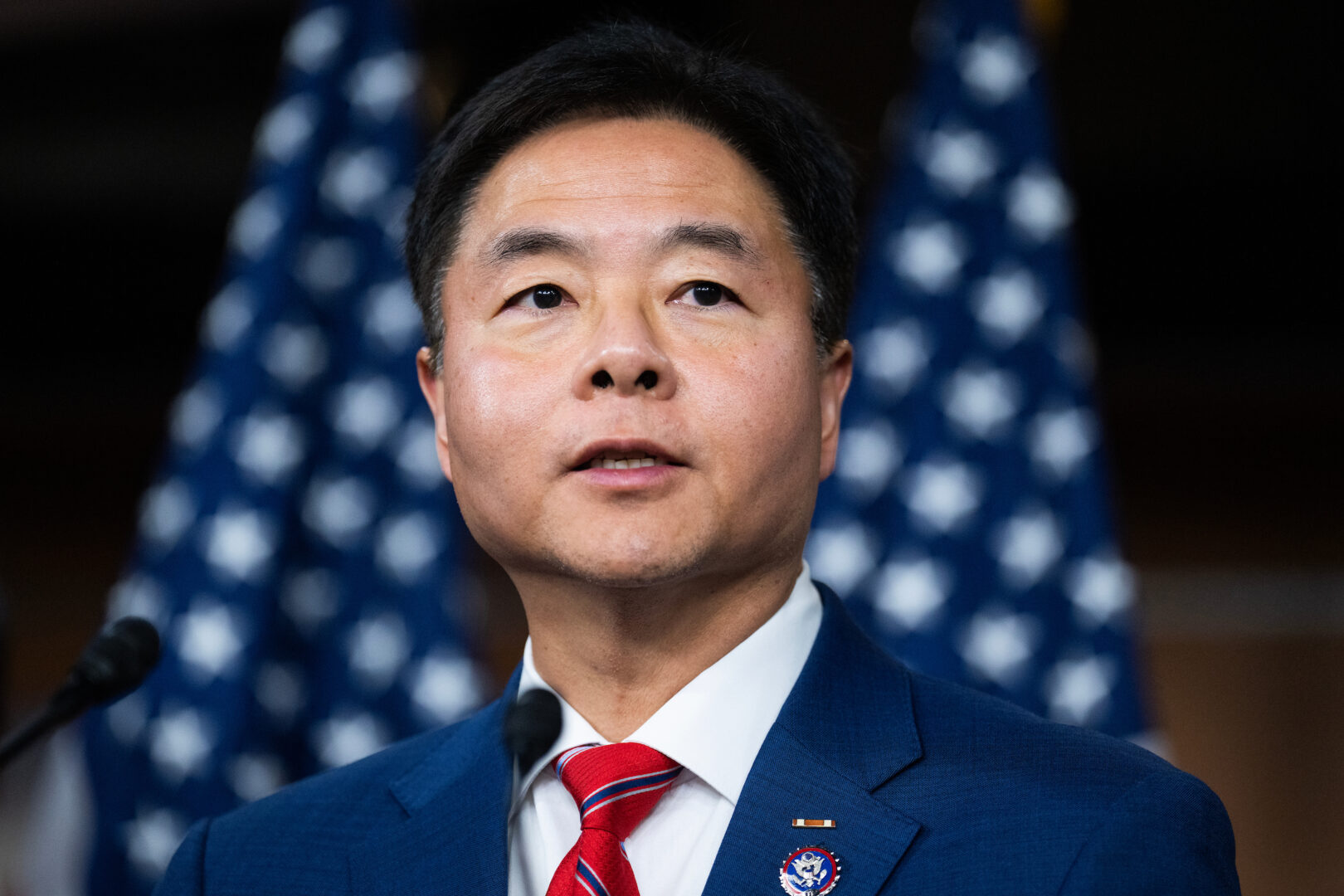
The Democratic House Commission on AI and the Innovation Economy put out a statement the day of the release saying the group, led by Reps. Ted Lieu, D-Calif., Valerie P. Foushee, D-N.C., and Josh Gottheimer, D-N.J., couldn’t support the bill because it “does not meet the enormity of the moment.”
“The House Commission on AI and the Innovation Economy has spent months working closely with our colleagues and key stakeholders from civil society organizations, industry, labor, academia, and others addressing AI issues,” the group said in a statement. “Many of those same organizations share our view that this document cannot serve as the basis for productive dialogue.”
The AFL-CIO, the ACLU and the AI safety-focused group Americans for Responsible Innovation all came out in opposition to the bill’s preemption of state laws.
Lieu, who is also Democratic Caucus vice chair, said Tuesday that the commission’s statement “only speaks for itself,” and not for party leadership or the larger Democratic caucus. He said he agrees with Trahan on the “urgency” of regulating AI, but not without real agreement.
“In Congress, you have to build a consensus. You actually have to get groups and members of Congress and organizations to support what you’re trying to do,” he said.
Lieu also said the commission is continuing to meet with stakeholders to develop their own AI plan. “By the end of the year, we’ll have a framework to propose to Leader Jeffries for when Democrats are in control next year,” he said, referring to House Minority Leader Hakeem Jeffries, D-N.Y.
Trahan and Obernolte’s proposal also didn’t garner full support from the Republican side of the aisle.
House Majority Leader Steve Scalise, R-La., said he plans to look to the House Energy and Commerce Committee and Chairman Brett Guthrie, R-Ky., for AI legislation, rather than Obernolte. He is supportive of preemption, though he didn’t specify a length of time or types of state AI laws that should be preempted.
“As a new growing form of technology, I’m against any form of preventing innovation in America, and so preemption at the federal level on bad local policies is something really important that we’re looking at,” Scalise told reporters on Tuesday.
Progressive stance
While Trahan has looked for compromise and found pushback from the right and left, Sen. Bernie Sanders, I-Vt., looks to swing for the fences and has found some commonality across the aisle.
Last week, Sanders announced plans to draft legislation that would create an AI sovereign wealth fund, which would have the federal government take a 50 percent stake in major AI firms.
Speaking at an event Monday at the National Press Club, Sanders said he hopes the legislation will be ready “in a week or two.”
Sanders argued that the public should have ownership in AI because it was developed using the knowledge of the public, through published works of art and writing and through social media posts and comments.
“Given the fact that it is the people … whose work is the foundation, whose labor is the foundation of AI, they should have some say in the future of AI.” Sanders said.
Sanders said that public representation within the AI industry could look like the president nominating individuals to serve on company boards, to be approved by the Senate.
In an op-ed published by The New York Times announcing the bill, Sanders said the fund would “give the public a direct role in determining the future of this technology.”
“The federal government would have the power, through its voting shares and an equal representation on each company’s board, to block decisions that hurt our citizens and to push for policies that help them,” Sanders wrote.
Sanders said Monday that as AI companies grow, the fund could be used to provide dividends to the American people and to fund social priorities like Medicare and education. He compared the fund to similar policies in Norway and Alaska. Alaska residents receive around $1,000 annually out of oil and mining revenue generated in the state.
The idea has a perhaps unlikely supporter in the White House.
On Friday, President Donald Trump told reporters he’s meeting with AI companies “in the very near future” to discuss the possibility of federal government stakes in the firms.
“There’s so much money and it’s so big that there are concepts where pieces could be given to the American public, where the American public essentially becomes a partner,” Trump said.
Sanders said Trump is responding to public discomfort with the role of certain wealthy tech funders “investing huge amounts of money simply to make themselves even richer.”
An April Politico poll found that 43 percent of respondents think AI’s risks outweigh its benefits, while only 33 percent think the benefits outweigh risks.
“I think as a politician, that’s where he’s coming from,” Sanders said. “Do I have great confidence that Trump will do the right thing? No, I don’t.”
Industry views
The public dividends portion of the idea also has at least some support from one of AI’s biggest players, OpenAI, whose CEO Sam Altman met with Sanders last week.
In April, the company released a plan for “Industrial Policy for the Intelligence Age,” which it said would address societal risks from AI, including disruption of the workforce.
The company suggested the creation of a “public wealth fund” that “provides every citizen — including those not invested in financial markets — with a stake in AI-driven economic growth. “
But importantly, there appears to be a distinction for some between finding ways for Americans to benefit economically from AI and the federal government taking a stake.
In a statement in response to Trump’s comments, Patrick Hedger, director of policy for technology industry group NetChoice, compared a government stake in private firms to state control in China.
“The free market is infinitely more agile and efficient than the federal government,” Hedger said. “Nationalizing America’s leading AI labs, even if only partially, would inject Washington bureaucracy into a hyper-competitive, fast-moving industry, stalling progress when we can least afford it.”
Sen. Josh Hawley, R-Mo., took a similar line speaking to reporters on Tuesday.
“Having big government own Big Tech seems to be putting together some of the worst people on earth,” Hawley said.
However, he left open the door to using taxes on AI companies to create Sanders’ proposed sovereign wealth fund.
“Making sure that these AI companies, in particular, that what they’re doing is actually benefiting ordinary working Americans, that’s a huge deal, and that is absolutely viable,” Hawley said.
The fund is not Sanders’ only big attempt to address Americans’ unease over the growth of AI.
In March, backed by fellow progressive Rep. Alexandria Ocasio-Cortez, D-N.Y., he introduced legislation that would pause the construction of AI data centers and upgrades until federal laws were enacted to regulate AI and its associated energy costs and environmental effects.
The proposed ban is in line with sentiment spreading not just in Democratic areas but Republican ones as well.
Localities in Missouri, North Carolina, Virginia and Rhode Island have either full data center bans or bans based on size and other specifications.
A March Gallup poll found that 71 percent of respondents either strongly or somewhat oppose the construction of an AI data center in their area. That opposition crosses parties, with 75 percent of Democrats opposed and 63 percent of Republicans.
Valerie Yurk contributed to this report.