Turning down the lights on US surveillance authorities at a time of peril
Letting Section 702 expire is a ‘lose-lose’ act of self-sabotage
This Friday at midnight, while the American military may very well be trading fire once again with Iran, the single most productive foreign intelligence collection authority in the U.S. government’s arsenal will expire.
Section 702 of the Foreign Intelligence Surveillance Act — the law that lets our government collect communications of foreign terrorists, spies and hostile governments overseas — will lapse unless Congress acts in the next 48 hours.
That Congress has allowed matters to reach this point, at this moment, is an act of self-sabotage that our enemies could scarcely have improved upon.
Consider the moment. Notwithstanding the notional ceasefire, our military (and those of our partners) remains in open hostilities with Iran and its terrorist proxies.
Russia’s war in Ukraine grinds on with civilian deaths rising, and Moscow’s intelligence services continue to target America and our allies.
China continues to threaten Taiwan and American interests across the Indo-Pacific. And al Qaeda and ISIS are reconstituted, expanding, and openly calling for attacks on Americans both at home and abroad.
Against these threats, Section 702 is literally invaluable. By the government’s own math, this single authority contributes to roughly 60 percent of the articles in the President’s Daily Brief. It has exposed plots against Americans at home, protected our forces and citizens abroad, and warned allies of dangers they could not see themselves.
There are those in Congress who seem unconcerned about their own pending failure to act, because, as they correctly note, collection will not stop all at once on Friday as existing court-approved certifications remain in effect for a time.
But this ignores the reality that those orders cannot guarantee the compliance of providers who receive them.
While some providers may continue fully to be sure, the reality is that others may decline to go up on new targets or stop producing altogether, meaning the Iranian terror cell identified next week (or already being collected on) may go uncovered.
And with the House going on a short vacation next week and no deal for any movement even when it returns, we could see a precipitous decline in coverage over what could be a very high-threat summer.
None of this is mere speculation; the authors of this op-ed have personal experience with such a lapse.
2008 expiration
In February 2008, Congress let the Protect America Act — Section 702’s predecessor — expire while lawmakers haggled over a replacement. Existing directives technically remained in force then too.
Yet we saw providers — suddenly unsure of their legal footing — reducing cooperation and balking at new taskings. Indeed, the gap wasn’t closed until the FISA Amendments Act passed months later.
While the government may seek to litigate with the providers — and may very well win — such litigation is measured in months, while discovered terrorist plots and wartime threats are measured in days, hours and minutes.
Intelligence delayed in wartime — and we are at war — is intelligence denied.
There is a second problem almost no one has mentioned, and it carries with it a bitter irony.
The expiring statute contains more than just Section 702. Other parts of the statute provide both authority and protections for Americans, guaranteeing them a court order for any surveillance conducted worldwide, a significant improvement over prior law.
Unlike the yearlong authorizations available under Section 702, these orders run 90 days and cannot be renewed after the lapse, and Section 702 — even were it available, which it won’t be — can’t fill the gap, because by law it may never target Americans.
The likely fallback is the pre-2008 regime, in which targeting Americans abroad required only the attorney general’s sign-off — no judge at all.
Hardly a triumph for privacy and civil liberties.
The perversity does not stop there, because other safeguards die with the statute as well. Virtually every oversight measure and protection for American’s privacy and civil liberties that have been won also go away. And because the government’s need for intelligence will never lapse, it is a virtual certainty that the government will revert to other authorities, chiefly overseas collection under Executive Order 12,333, meaning both less oversight, no FISA court, less transparency — and less capability too, for nothing can effectively replicate Section 702’s speed, reliability, specificity and insight.
A lapse — like the one we are walking into this week — delivers weaker protections for Americans and weaker intelligence for America — a lose-lose only Washington bureaucrats and politicians could engineer.
So why is Congress even flirting with this trainwreck? The issue, today, is not mainly over the program’s merits. The latest version of this impasse is substantially a political standoff over the president’s choice of an acting Director of National Intelligence.
Now that the president has announced the intention to nominate U.S. Attorney for the Southern District of New York Jay Clayton for the permanent job, this issue should be of limited resonance, if any.
Indeed, degrading the nation’s intelligence coverage in wartime as leverage in a personnel fight — even where there are fears about what that acting official might do — is simply indefensible.
Playing this game of chicken with our national security is just wrong.
The deeper dysfunction that got us here is that Congress built this hostage ransom mechanism itself by repeatedly adopting a sunset clause for this vital — and now nearly two decade old — authority.
Statutory sunsets are often sold as built-in accountability, when in reality they have simply become a tool for political brinksmanship. The real tool for accountability is the fact that Congress can amend Section 702 tomorrow, next month, or next year, like any other statute.
All a sunset guarantees is that the same battles are fought over and over again every few years while the nation’s most important collection program dangles over a cliff. And this is our third cliff in three years, and the second this year alone.
Finally, there can be little question that the substantive debate has been had.
Two years ago Congress enacted the most sweeping FISA reforms in decades, addressing the vast majority of legitimate concerns. The lone remaining demand — a warrant before the government may even look at information lawfully in its possession — would rebuild the pre-9/11 “wall” that left our intelligence community unable to connect the dots on two hijackers the CIA saw at a terrorist meeting in Malaysia and who were later living openly in San Diego.
That failure led to three thousand dead Americans in New York, Virginia and Pennsylvania. That is not civil liberties protection; it is willful blindness.
Congress should do two things: Extend Section 702 and the rest of the FISA Amendments Act in the next 48 hours — cleanly, before the erosion that threatens our national security begins. Then, end the cycle of nonsense: Reauthorize the program without a sunset.
America’s warfighters and intelligence professionals are doing their job on the frontlines protecting our people and interests around the globe.
It is long past time for Congress to do its own.
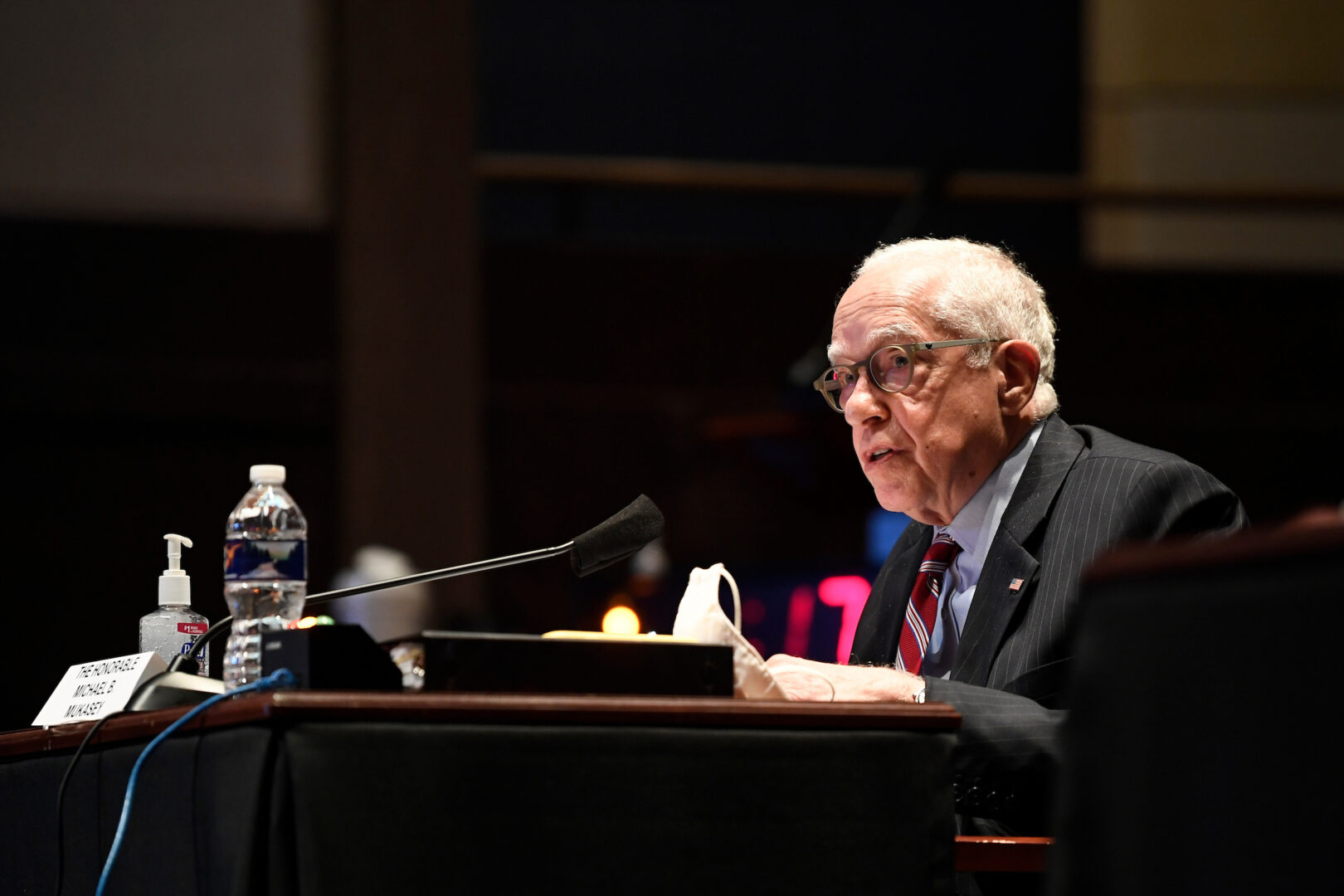
Michael B. Mukasey served as attorney general of the United States under President George W. Bush (2007–09) and as a U.S. district judge in the Southern District of New York (1988–2006), including as chief judge.
Jamil N. Jaffer is founder and executive director of the National Security Institute at George Mason University’s Antonin Scalia Law School and previously served in a variety of senior national security roles in the federal government, including as counsel to the assistant attorney general for national security at the Department of Justice when Mukasey was attorney general.