Rep. LaMonica McIver urges appeals court to toss charges
Attorney argues New Jersey Democrat was doing 'legislative act' of immigration facility oversight
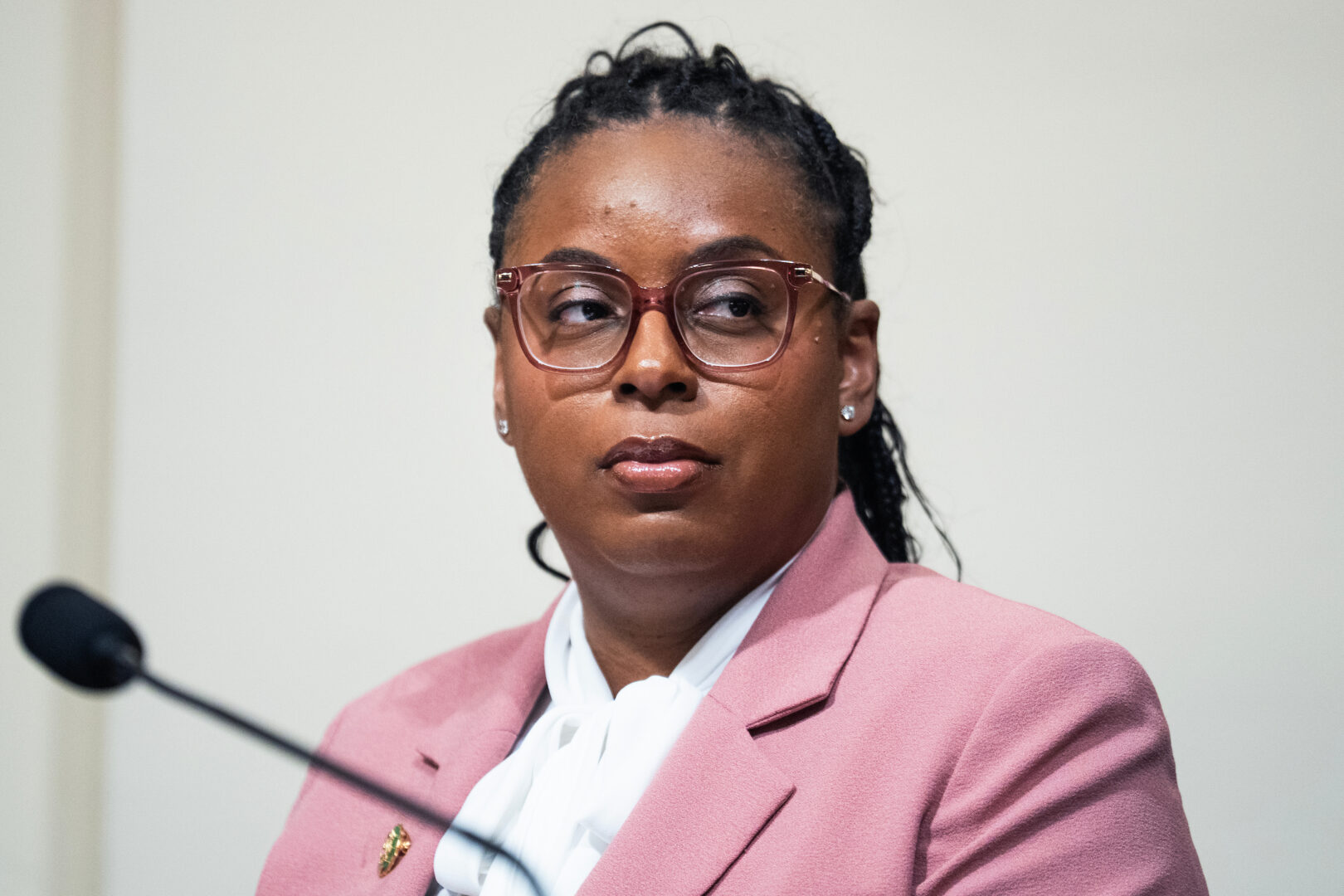
New Jersey Democratic Rep. LaMonica McIver urged a federal appeals court Wednesday to throw out the three-count indictment against her, arguing her arrest outside a federal immigration detention center last year interfered with her legislative duties.
In challenging the charges, McIver has argued that Trump administration officials have targeted her for her opposition to the administration, and that the case impedes on constitutional protections for acts relating to the “Speech or Debate” for members of Congress.
Paul Fishman, an attorney for McIver, told a three-judge panel of the U.S. Court of Appeals for the 3rd Circuit that the government can’t separate the purpose of the visit, which was oversight of the Immigration and Customs Enforcement facility, from the altercation between McIver and ICE officials.
“The entire visit was a manifestly legislative act,” Fishman said.
Much of the argument turns on the application of the clause in the Constitution, which says “for any Speech or Debate in either House, they shall not be questioned in any other Place.”
Fishman said that the country had made a “value judgment” that it was more important for legislators to have a degree of immunity than allow criminal or civil liability to impede their jobs.
He also pointed out that for hundreds of years, cases similar to the one against McIver have not been brought and the House and Senate have the ability to discipline their own members.
In September, the House considered and ultimately voted down a resolution to censure McIver and remove her from the House’s homeland security panel. The House Ethics Committee has a separate probe active into McIver.
Separately, Fishman urged the judges to take up McIver’s claims that she was prosecuted for her opposition to the Trump administration, a claim that is not normally appealable before trial.
“They are picking on someone who is a member of Congress who does not agree with their views, so that is the problem,” Fishman said.
Fishman also pointed out that the record showed that immigration officials said they were acting on orders from Deputy Attorney General Todd Blanche, who is currently serving as acting attorney general.
“These decisions, they’re not made in Newark,” Fishman said.
Judge Thomas Ambro pointed out that allowing a trial before hearing a vindictive prosecution claim may let the government get a “pound of flesh” of forcing a trial before those issues can be appealed.
Judge Stephanos Bibas pushed back on one of Fishman’s claims, that such prosecutions of lawmakers were rare. Bibas said it may just be that the DOJ has not brought those claims because “juries don’t like them,” and the department may lose.
In McIver’s case, “if the department wants to roll the dice, then that is its prerogative,” Bibas said.
Fishman argued ICE officials sought to obstruct congressional oversight in the first place, delaying the inspection and then later “luring” the members of Congress outside to arrest Newark Mayor Ras Baraka, who had accompanied them for the visit.
Officials charged McIver with two felonies and a misdemeanor related to “Assaulting, Resisting, and Impeding” federal officials outside the facility. Filings in the case said that she struck federal agents with her forearms and elbows during a scuffle around Baraka.
Mark Coyne, an attorney for the Justice Department, argued that McIver’s participation in the confrontation outside of Delaney Hall should not be considered a legislative act.
“Use of physical force is never, never covered by the speech or debate clause,” Coyne said.
In January, Judge Jamel K. Semper of the U.S. District Court for the District of New Jersey ruled that the case could proceed, finding that the prosecution could isolate the portion of the visit where McIver and others were outside Delaney Hall.