Supreme Court stops Trump firing of Fed board member
But justices back presidential power to fire FTC commissioners

The Supreme Court ruled against President Donald Trump’s effort to remove Federal Reserve Board member Lisa Cook on Monday, even as the justices expanded presidential power to remove members of the Federal Trade Commission and other independent agencies.
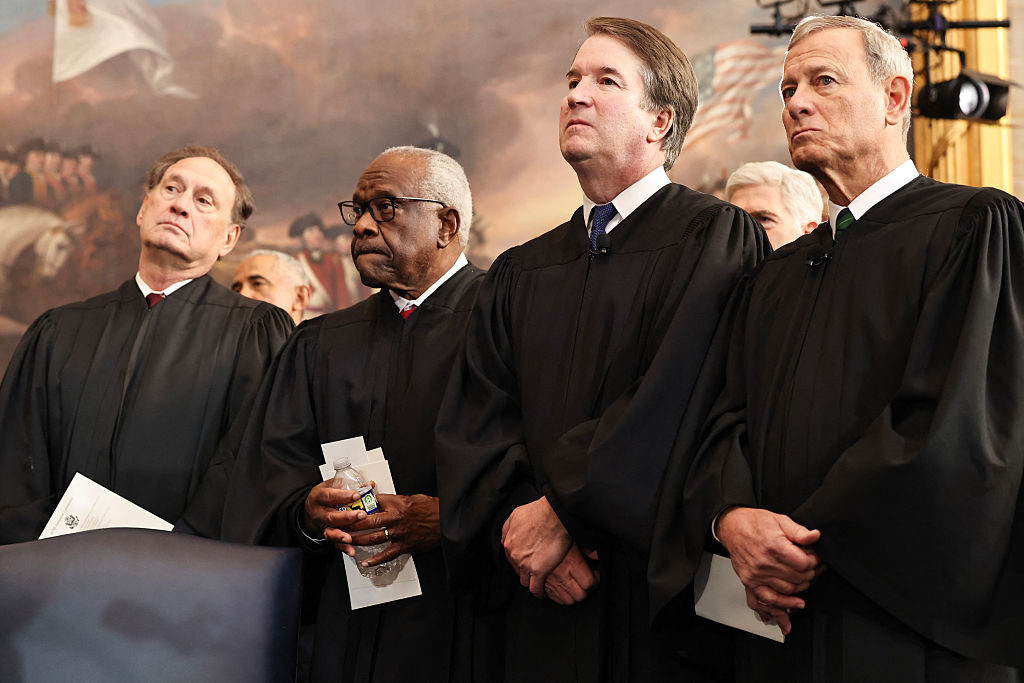
The two decisions written by Chief Justice John G. Roberts Jr — a 5-4 opinion in favor of Cook and a 6-3 opinion allowing Trump to fire FTC commissioner Rebecca Slaughter — reshape the bounds of presidential control over the executive branch of government.
The Cook decision backs laws Congress meant to protect members of the Federal Reserve from being fired without cause, but the Slaughter decision effectively cancels out those laws for members of independent boards such as the FTC, Federal Election Commission and Federal Communications Commission.
Together, the decisions back broad presidential power to remove almost any official in the executive branch at will but drew a line at the Federal Reserve Board of Governors.
Roberts wrote that Congress had limited the power of presidents to remove Federal Reserve board members “for good reason,” a long tradition of monetary policy independent of executive influence made it different from executive agencies.
“Not only the fact of independence but also the appearance of independence is key to the Federal Reserve’s design,” Roberts wrote.
Accepting the Trump administration’s contentions in the case “would allow the President to remove a member of the Federal Reserve at any time, for any reason, without any notice before, and without any judicial check after,” Roberts wrote. “That would turn for-cause protection into little more than at-will employment.”
Trump attempted to fire Cook in August, arguing that alleged mortgage records improprieties from before she took office disqualified her from the role. Cook then challenged the firing, and the courts reinstated her while the case worked its way through the process.
That included the Supreme Court, which last year ruled to allow her to serve in office while she fought the firing. On Monday, the court formally denied Trump’s emergency request to remove Cook while she fought her firing.
Roberts wrote that the court would not define how far Trump had to go to prove cause for Cook’s removal, he wrote that the Truth Social posts calling for her to resign were not enough. Roberts wrote that Trump would have to provide at least some notice of the alleged improprieties and an opportunity to respond, which would then be reviewable by a court.
“To be clear, the ultimate question of whether the President can remove Cook for cause will depend in part on the underlying facts,” Roberts wrote.
Justice Brett M. Kavanaugh, in a separate concurring opinion, emphasized that Monday’s decision had not ultimately determined whether Trump could fire Cook.
Justice Clarence Thomas dissented from the decision, arguing that any protection against Trump firing Cook was unconstitutional — a position the Trump administration did not argue.
Justice Samuel A. Alito Jr., joined by Justice Neil. M. Gorsuch, dissented from the decision, arguing that they should have allowed Trump to remove Cook while she fought the firing. Alito wrote that the large constitutional questions around the case should have been allowed to work their way through the lower courts.
“I would grant the application because, within the narrow confines of this case’s posture, the President has satisfied the traditional stay factors,” Alito wrote.
Justice Amy Coney Barrett also filed a dissenting opinion, criticizing the scope of the majority’s decision.
FTC decision
The Slaughter opinion overturned a decision by the U.S. Court of Appeals for the District of Columbia Circuit that reinstated Slaughter, as well as a more than 90-year-old precedent protecting the members of independent boards from arbitrary removal.
Roberts wrote that the structure of those agencies violated the founding principles of the country, which was meant to have a single executive official vested with executive power.
“We hold that such protection from removal is contrary to the separation of powers enshrined in the Constitution,” Roberts wrote.
Justice Sonia Sotomayor, in a dissent joined by Justices Elena Kagan and Ketanji Brown Jackson, argued that the majority had upset a century of balance between the political branches to allow for independent decisionmaking on complex issues.
Reading from a portion of her dissent from the bench, Sotomayor argued that Congress had acted for nearly a century on the assumption that it could create agencies with vast powers over pollution, nuclear energy, workplace safety and more with a modicum of independence.
“In these and many other areas, the wisdom of centuries has taught that some decisions should depend not only on who is in office – much less who is disfavored or owed a favor by those in office – but also on judgment, expertise and the public good,” Sotomayor wrote.
Sotomayor’s dissent argued that the majority effectively expanded the power of the president by giving him direct authority over agencies that Congress intended him to control indirectly.
“The result is a President who emerges with far greater power than ever before,” Sotomayor wrote. “It is a power, however, that neither the People, nor Congress nor the Constitution bestowed upon him.”
Trump fired Slaughter last March along with fellow FTC Commissioner Alvaro Bedoya. The pair challenged their firing in federal court, and Bedoya eventually dropped his case. Later, the D.C. Circuit eventually ruled in Slaughter’s favor and ordered that she be reinstated. The Supreme Court put that ruling on hold, over the objections of the court’s liberal justices.
The cases are Donald Trump v. Lisa Cook and Donald J. Trump, President of the United States, et al. v. Rebecca Kelly Slaughter, et al.