When Washington politicians can’t go home again
Republican and Democratic lawmakers struggle to make gubernatorial jumps this cycle
ANALYSIS — While Republicans and Democrats battle for control of Washington this year, Washington has become a scarlet letter for members of both parties vying to be their state’s next governor.
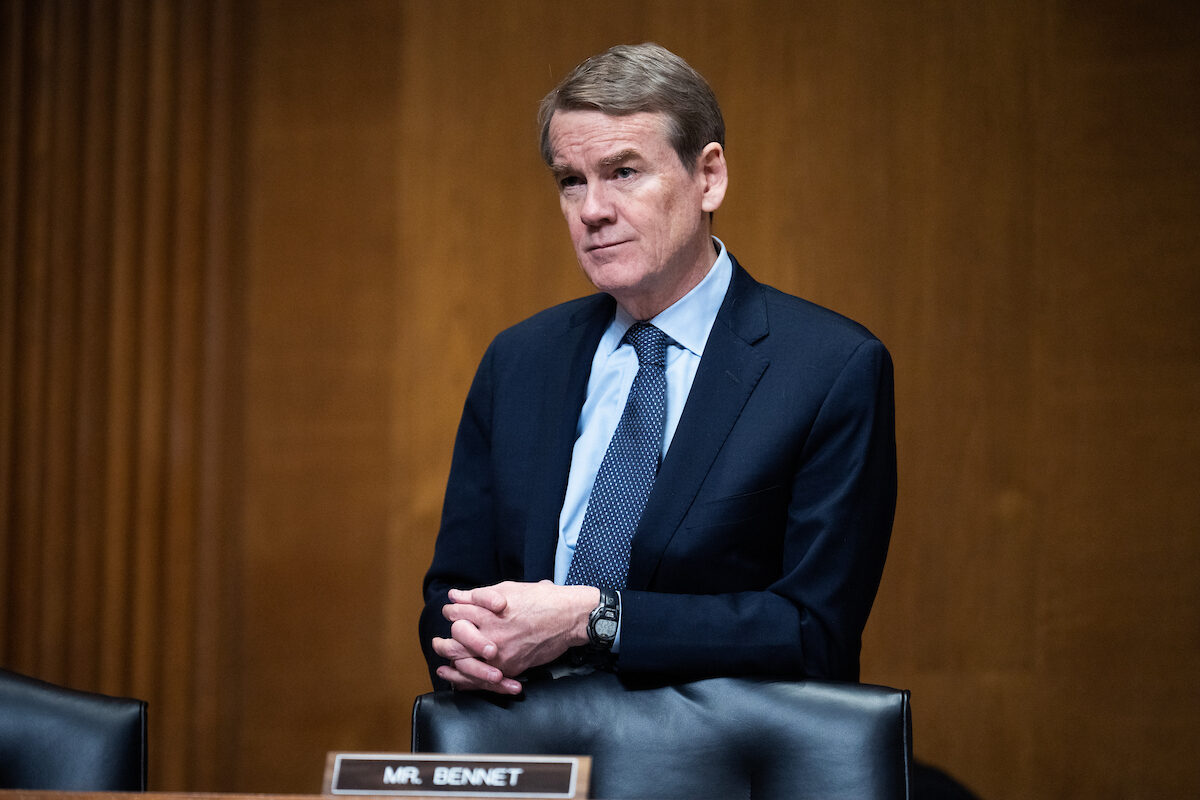
Colorado Sen. Michael Bennet was just the latest member of Congress to fail in a gubernatorial attempt when he lost the Democratic primary Tuesday to state Attorney General Phil Weiser, 55 percent to 45 percent.
This cycle’s bipartisan club of gubernatorial losers from D.C. already included Republican Reps. Dusty Johnson of South Dakota, Randy Feenstra of Iowa and Nancy Mace and Ralph Norman of South Carolina. While there were unique dynamics in each race, including varying levels of involvement by President Donald Trump, House members falling short in their bids for governor is an emerging trend.
That dynamic could be a warning sign for Michigan Rep. John James, who faces a wealthy political outsider and a former state attorney general in the Aug. 4 GOP gubernatorial primary. The congressman recently secured Trump’s endorsement, but, as Feenstra found out last month, that backing doesn’t always guarantee the Republican nod.
Of course, there are some places where a House member will be successful, such as Arizona, where Rep. Andy Biggs appears poised to secure the GOP nomination later this month. But that would come at the expense of fellow Republican Rep. David Schweikert, a primary opponent.
And at least one senator is poised to be elected governor this year, with Republican Tommy Tuberville clinching the GOP nomination in deep-red Alabama. And Sens. Marsha Blackburn of Tennessee and Amy Klobuchar of Minnesota are the favorites for the governorships of their respective states. (A Blackburn win would come after an expected discarding of Rep. John W. Rose in the primary.)
Advantage Democrats?
Overall, this year’s gubernatorial primaries merely serve as the opening acts for a series of competitive general elections around the country.
Similar to their margins on Capitol Hill, Republicans hold a narrow majority of governorships nationwide, with 26 for Republicans and 24 for Democrats. While that advantage doesn’t have much of a functional impact, governors are powerful figures, presiding over entire states and influencing policy, and could have a role in election implementation in 2028 and beyond.
While Republicans have opportunities to grow their gubernatorial ranks by taking over Kansas (where Democratic Gov. Laura Kelly can’t run for reelection), Arizona (a swing state where Democrat Katie Hobbs is seeking a second term), Wisconsin (a Democratic open seat in a perennial swing state) or Oregon (where Democratic Gov. Tina Kotek is uniquely vulnerable), it’s more likely that Democrats end up adding to their governors’ roster.
Under their best-case scenario, Democrats could approach their most recent high-water mark of 29 governorships, achieved after the 2008 elections, when President George W. Bush’s job approval rating was at 28 percent, according to Gallup. Trump’s standing isn’t that low, but it’s not great: 39 percent as of Wednesday, according to Nate Silver’s national average.
Democrats’ best opportunities to flip governors’ mansions this cycle include Georgia (where GOP Gov. Brian Kemp can’t run again) and Iowa (where GOP Gov. Kim Reynolds declined to run again). Inside Elections rates both races as Toss-ups.
In Nevada, GOP Gov. Joe Lombardo is vulnerable in a swing-state race that Inside Elections rates Tilt Republican. Democrats have opportunities in at least two red states, including Ohio (where Republican Gov. Mike DeWine is term-limited) and Alaska (where a crowded race gives Democrats a chance). Florida, New Hampshire and Texas could become competitive if the bottom drops out for Republicans this fall.
Reaching those new heights would also require Democrats to hold their own governorships in battleground states. Those include open seats in Maine, Minnesota and New Mexico, where Govs. Janet Mills, Tim Walz and Michelle Lujan Grisham are not running again, and New York, where Democratic Gov. Kathy Hochul looks to be on better footing than four years ago.
There’s an extra layer of uncertainty, though, in the gubernatorial landscape because of the large number of open seats beyond the aforementioned trio of Maine, Minnesota and New Mexico.
Eighteen of the 36 governors’ races in 2026 lack an incumbent running for reelection. And that number could tick up to 20 if Republican Larry Rhoden loses his July 28 runoff in South Dakota and Democrat Dan McKee loses his primary in Rhode Island on Sept. 9.
Both men ascended to their positions when their predecessors took Cabinet positions in Washington. McKee survived his 2022 gubernatorial primary, but with just 33 percent in a state that doesn’t have a runoff provision. Rhoden, who finished second in the June first round with just 25 percent, doesn’t have that luxury.
If governors somehow seem otherwise irrelevant to the conversation in Washington, it’s important to remember that at least a dozen sitting governors will be in the broader presidential conversation before too long.
Govs. Gavin Newsom (California), Gretchen Whitmer (Michigan), JB Pritzker (Illinois), Wes Moore (Maryland), Josh Shapiro (Pennsylvania), Abigail Spanberger (Virginia) and Mikie Sherrill (New Jersey) will all be in the mix at some level on the Democratic side, no matter what they might say publicly.
Kemp (Georgia), Sarah Huckabee Sanders (Arkansas), Ron DeSantis (Florida), Kelly Ayotte (New Hampshire) and Greg Abbott (Texas) will be part of the Republican discussion, with the caveat that we don’t know who Trump and Trump-first voters will be looking for in two years time.