Congress looks to stop horsing around on wild mustangs and burros
Lawmakers should take the reins and find a permanent fix, advocates say
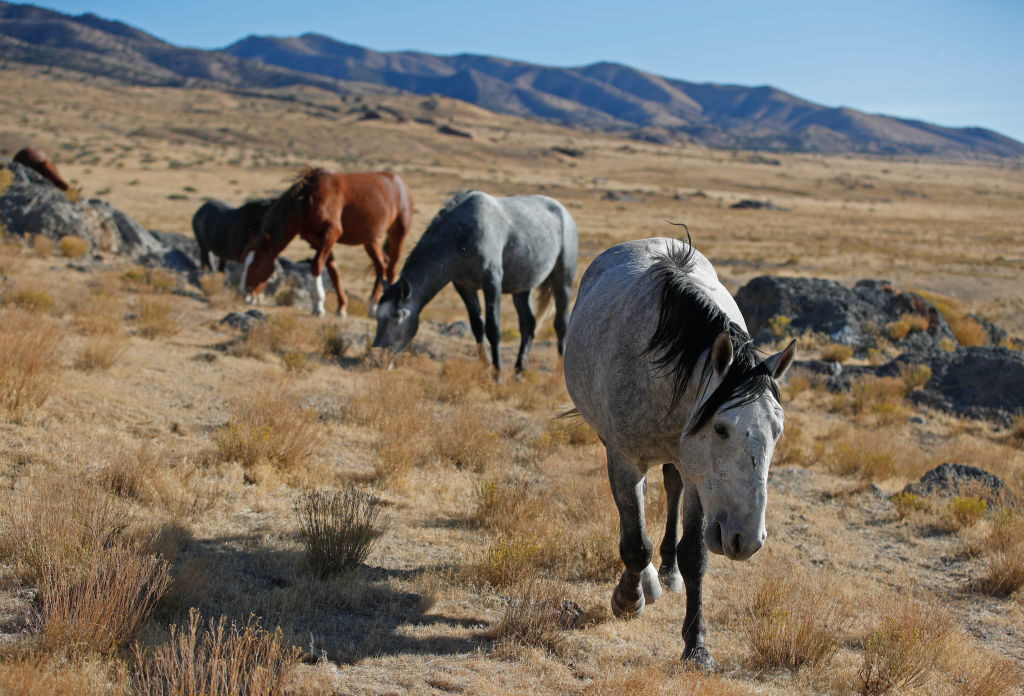
Wild horses roaming the untamed West have become a symbol of the American frontier. But through gaps in existing policy, many still find themselves in slaughter pipelines across both the southern and northern borders each year.
Advocates are calling on Congress to change that and codify protections for wild mustangs and burros into federal law, especially after recent reporting from The New York Times shined a spotlight on the animals.
Some lawmakers are saddling up to lead that charge.
Mustangs “represent that sense of freedom that we’ve always thought about in this country,” Democratic Rep. Dina Titus said in an interview. Her state of Nevada is home to the largest wild horse population in the country, and she leads the bipartisan Congressional Wild Horse Caucus, which encourages federal policies aimed at more humane treatment.
The issue is not new, she and advocates say.
Joanna Grossman, the equine program director at the Animal Welfare Institute, called it “a long-standing problem.”
The Bureau of Land Management has been rounding up horses from the wild for more than 50 years with the passage of the Wild Free-Roaming Horses and Burros Act in 1971. Soon, the system led to a buildup of horses in off-range holding facilities, and the BLM began placing more of them into private care through adoption programs to address overcrowding.
But according to Titus, “once the horse is adopted, there’s not much follow-through” from the BLM or the government. Many of those “horses were being adopted and then shipped off to slaughter,” she said.
The BLM has maintained it is focused on keeping the horses safe, but in a post last week, noted that “no system is perfect” and called on the public to report “credible information that a buyer may be violating the terms of sale or putting animals at risk” following public outcry after the Times report.
“It’s hard to say whether there’s a true increase or if people are simply being more vigilant,” Grossman said. “I think the height of the export trade was 2012, when about 166,000 American horses were being sent to Mexico and Canada to be butchered for their meat.”
She described the BLM as being focused on the “huge numbers of removals, [and] then it follows that the agency then is going to say, ‘OK, well, we’re going to do what we can to try to essentially sell or adopt as many of these horses as we possibly can.’”
The Times investigation found nearly 4,000 wild horses were sold overall last year by the BLM — nearly doubling the number in 2024 — and at least dozens of those could be indirectly traced to the slaughter-auction pipeline.
Nearly every year, Congress includes safeguards in spending bills to restrict the use of federal funds from sending healthy wild horses to slaughter. But once a horse leaves the BLM’s hands and passes through — possibly multiple — private owners, the government can lose sight of it.
And President Donald Trump’s budget request for fiscal 2027 omitted this long-standing appropriations rider language. His budget request for fiscal 2026 similarly was devoid of the protection, but lawmakers included it in the final spending law even so.
That is likely to happen again; the House Appropriations panel has already advanced its version of next year’s Department of Interior funding proposal with the typical language barring agencies that receive excess horses from destroying them “into a commercial product.”
But the status quo is no longer enough, according to some lawmakers. A bill sponsored by Rep. Vern Buchanan, R-Fla., would establish a permanent federal ban on slaughtering equines for human consumption and prohibit the sale, transport or export of horses destined for slaughter. Supporters say the legislation, known as the Save America’s Forgotten Equines Act, would close gaps in current policy.
Lawmakers are looking at potential vehicles to try to get the proposal passed this Congress but acknowledge they may be corralled in by political realities.
An amendment pushed by Titus and Rep. Jeff Van Drew, R-N.J., that would achieve many of the same goals was added to the House’s surface transportation reauthorization bill when it advanced out of the Transportation and Infrastructure Committee in May.
“Protecting American horses from slaughter reflects our values as a nation, and I’m proud that a modified version of my SAFE Act will finally end this inhumane practice permanently,” Buchanan, who co-chairs the Animal Protection Caucus, said in a statement at the time.
Lawmakers are eyeing the lame-duck session, after the November midterms, as a possible time to try to pass the highway bill, but Titus noted the Senate has multiple “different committees that look at this bill.” She also said the stopgap funding measure that cleared the House earlier this week extends current surface transportation program authorities into December and “I suspect depending on what happens in the election, it’s likely to just be rolled over to next term.”
She and advocates are calling for changes to address not only the slaughter pipeline, but also the manner in which these animals are rounded up here at home and treated in the wild as part of a “two-pronged” cruelty problem.
The government has been turning to helicopters to round up wild horses to thin herds in the West, a practice Titus and Grossman both described as inhumane.
“You see little colts, little foals that get chased down, their legs get broken. It’s just horrifying, inhumane,” Titus said. She pointed to a bill she introduced — which she’s nicknamed “Save a horse, hire a cowboy” — that would address a “monopoly” she says has formed on these contracts from just a few helicopter companies.
She’s also in favor of using reproductive methods rather than roundups, like porcine zona pellucida, or PZP, an immunocontraceptive vaccine.
“I think there’s this broad recognition, regardless of how one kind of feels about the presence of wild horses out West, that the BLM does need to do more on the fertility control front,” Grossman said.
Of its annual funds for managing wild horses, the agency has devoted only a small fraction to fertility control. That’s part of a historical trend: In fiscal 2025, BLM administered 921 fertility control treatments but placed over 8,000 horses into private care.
She and others are pushing the BLM to dedicate 10 percent of the Wild Horse and Burro Program budget to humane fertility control efforts.
“If you just keep rounding them up, rounding them up, rounding them up, it’s like that definition of insanity: doing the same thing, expecting it to turn out differently,” Titus said. “If you could manage the number on the range, then you wouldn’t have to take them into the pens.”