GOP consensus elusive on timing, scope of data centers bill
The week after Labor Day would be the likeliest target
As anger mounts over the impacts of data centers, Republicans are wrestling with legislation that would address concerns over increased electricity and water demand that many voters associate with higher utility bills. But it’s not yet clear if any solution can move in the now-shortened September work period before House members go home to campaign.
House Energy and Commerce Committee members have been pushing GOP leaders to bring to the floor a bill the committee approved 52-0 in July. The bill is led by Reps. Gabe Evans, R-Colo., and Kathy Castor, D-Fla., both of whom are in competitive elections this year.
That bill, dubbed the “Ratepayer Protection Act” by supporters, would codify portions of the “Ratepayer Protection Pledge” that President Donald Trump convinced over 300 utilities, electric cooperatives, artificial intelligence “hyperscalers” and more to sign.
It would require states to consider adopting federal standards ensuring that data centers and other large-load customers cover the costs of necessary grid upgrades, a move intended to prevent costs from being passed on to ratepayers.
On Thursday, the Energy and Commerce Environment Subcommittee held a hearing on a discussion draft of legislation that would prevent states from allowing public water systems to recover costs associated with data centers from any customer other than the data centers’ owner and operator.
While that water costs measure is still in the initial stages, top Republicans are deep in discussions about what kind of data centers bill to put on the floor, and when.
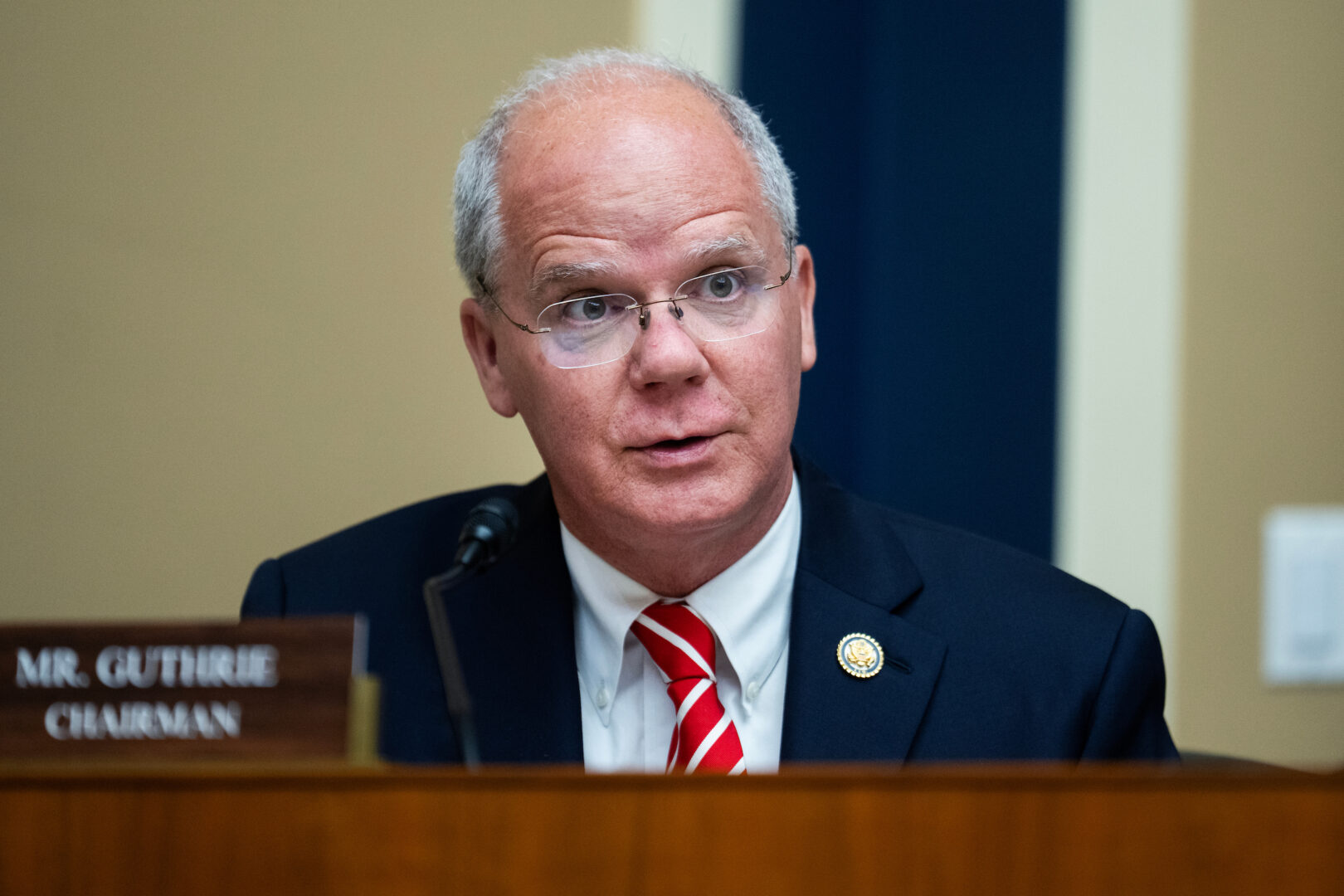
Full-committee Chairman Brett Guthrie, R-Ky., said on Wednesday that while no consensus has yet been reached, he hopes the electricity ratepayer bill moves this month. The week after Labor Day would be the likeliest target, given House GOP leaders’ announcement Thursday that the chamber wouldn’t be in session after that unless to vote on an amended budget resolution.
“I think it is important for you to go back [home] and say … I heard what you said. I’ve gone back to D.C. and I’ve addressed your concern, at least from the House perspective,” Guthrie said.
A GOP leadership aide said no decisions have been made on scheduling a vote “as leadership has heard concerns from members” about the ratepayer protection bill.
The aide didn’t elaborate. But common critiques levied at the bill include that it would single out data centers rather than other massive industrial power users, after a major tweak added during the committee markup; that it would restrict domestic AI development and make the U.S. less competitive with China; that it would impose a one-size-fits-all federal standard on decisions best left to local communities; and that it would be unnecessary given voluntary commitments made under Trump.
‘Downtown’ concerns
Guthrie acknowledged there is still some opposition “downtown” from the “data center world,” but said that the bill “protects local communities and, I think, allows data centers to be successful.”
A YouGov poll from Sept. 1 found that 63 percent of adults somewhat or strongly oppose a new data center being built in their community. But despite the administration’s pledge — which has been signed by Google, Microsoft, Meta, Oracle, xAI, OpenAI, and Amazon — Trump has opposed any call to slow down data center expansion.
“The only reason that communities throughout the U.S.A. should not want Data Centers is if they want to end up being backwards and poor,” Trump posted on Truth Social on Aug. 31.
A new group calling itself Infrastructure for America, comprised of companies that own and operate the buildings and equipment leased to the hyperscalers, put out several “fact sheets” this week aimed at pushing back against anti-data center arguments.
One said the industry’s annual water usage is negligible compared to golf courses, California almond growers and other businesses; another said Texas and Virginia, home to 25 percent of U.S. data centers, on average have lower residential electricity bills than other states, among other arguments.
Even GOP supporters of the Energy and Commerce bill have expressed concern that some of the anti-data center rhetoric may have been promoted by Chinese, Russian and other adversarial interests. In June, Guthrie, along with Energy Subcommittee Chairman Bob Latta of Ohio and Oversight and Investigations Subcommittee Chairman John Joyce of Pennsylvania, wrote to senior administration officials urging them to investigate.
“Unleashing American innovation and accelerating new advancements in AI have become key priorities for this Committee and the Trump Administration, and the U.S. cannot afford to ignore the risks posed by our geopolitical adversaries’ efforts to undermine U.S. global leadership,” the lawmakers wrote to David Sacks and Michael Kratsios, co-chairs of the president’s Council of Advisors on Science and Technology, as well as FBI Director Kash Patel.
In Thursday’s hearing, Evans said that while communities need to know that the expansion of data centers is being done responsibly, it remains important to keep that digital infrastructure from moving overseas.
“We have to have the digital infrastructure to beat Communist China and make sure that our sensitive data is not being stored in China, in Chinese data centers that were created with a much larger carbon footprint and with a larger negative environmental impact,” Evans said.
Evans, who flipped a Democratic district in a close 2024 election, is in a race ranked Toss-up by Inside Elections with Nathan L. Gonzales.
Making Big Tech pay
Some Democrats have been far more critical of data center expansion and have used lack of movement on the electricity ratepayer bill, despite unanimous backing in committee, to flog Republicans.
House Energy and Commerce ranking member Frank Pallone Jr., D-N.J., called for a moratorium on new data centers in June. At the hearing on the water costs bill, Pallone criticized Republican leadership for not bringing the ratepayer bill to the floor over concerns from some corners of the Republican conference.
“Imagine that, the House Republican leadership not wanting to support a bill that helps ensure Big Tech pays for the energy these data centers consume. We’ll see whether they’ll support the bill we’re considering today once it gets out of committee,” Pallone said.
Castor’s district is rated Lean Republican after Florida’s redistricting. When asked whether the decision not to vote on legislation would help Democrats in the midterm elections, she said that it would “hurt the Republicans.”
“It’s a unanimous bill on something that is the front burner for everybody across the country right now, and they bury it,” Castor said.
Guthrie, not ready to rule out action before the midterms, had a sunnier disposition about the bill’s prospects.
“If you look at what’s going on in local communities, people are just concerned. These large loads coming into their local community, what’s it gonna do to their rates … And so that I think it opens up the opportunities for data centers to expand, as long as local people know they’re protected,” he said. “And so you can do both: you can protect local ratepayers and you can make sure we beat China, which is the No. 1 priority.”
Kelly Livington contributed to this report.