College NIL bill moves forward on Senate floor
But path ahead is likely to be noisy
A potentially landmark Senate college sports bill easily cleared a procedural hurdle on Tuesday, moving the bipartisan legislation one step closer to advancing out of the chamber.
The Senate voted 74-24 on the procedural step, which opens a path to an eventual vote on passage.
Sen. Eric Schmitt, R-Mo., one of the legislation’s authors, spoke on the chamber floor beforehand, arguing the college sports landscape currently is ungoverned and unaffordable. The legislation would erect “guardrails” and help protect sports that do not generate revenue.
Congress “is the only entity on this planet” that can rein in the excesses of the name, image and likeness (NIL) era, he said, adding: “If you think that Western Kentucky can compete with Ohio State in the long term, you’re kidding yourself.”
Another of the measure’s primary authors, Commerce Chair Ted Cruz, R-Texas, said Monday that if the chamber got on the bill this week, he expected a final vote in the coming days.
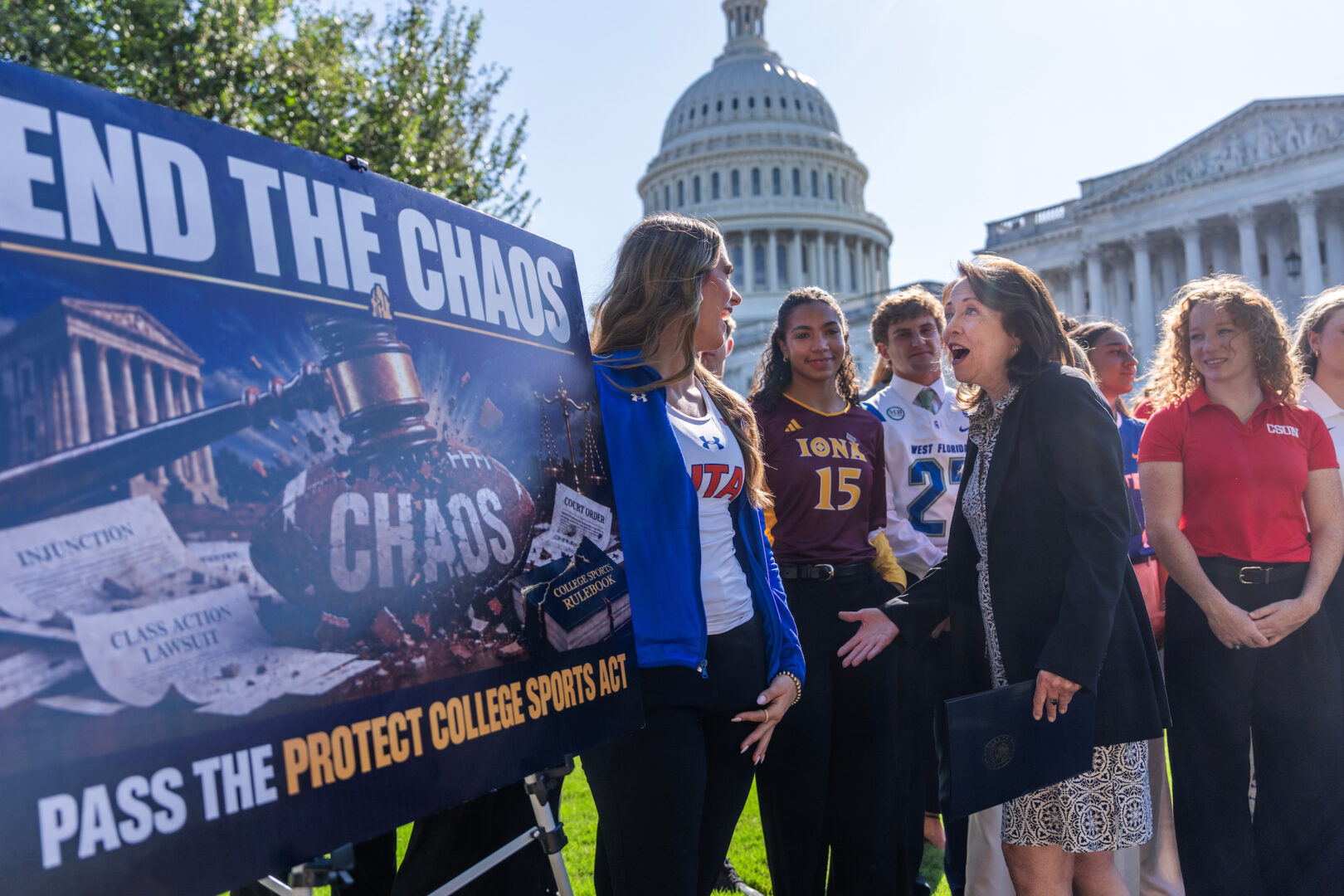
Cruz and other proponents of the legislation, joined by student-athletes and high-profile collegiate coaches, on Monday used a briefing outside the Capitol to try solidifying support. Commerce ranking member Maria Cantwell, D-Wash., contended the bill would make colleges and universities more financially solvent after a few years of runaway costs.
Cruz’s message was, if it clears both chambers and is signed by President Donald Trump, who has backed it publicly, the bill would bring some order to the system.
“The Protect College Sports Act provides a commonsense rule that every athlete is entitled to one free transfer. After that, you can have a transfer in narrow, specified circumstances — if your coach leaves, if your program is canceled, or if you’re the victim of sexual assault or sexual harassment,” he said. “Other than that, if you transfer a second time, you have to sit out for a year. You have to redshirt. That’s the way the rule used to be.”
The Commerce chairman on Monday sounded upbeat about the bill’s prospects in the Senate, telling reporters he had concluded that a “big, bipartisan” vote tally would create enough momentum for the legislation to also pass the House. He said that conclusion came following a conversation with House GOP leaders.
But Ohio GOP Sen. Jon Husted said on the floor Tuesday the bipartisan bill does too little to prioritize U.S. athletes, warning it could give foreign players a leg up. He said colleges and universities have been looking overseas more often “at the expense of student-athletes in this country,” adding Congress should “darn sure” put American athletes first.
And Sen. Cory Booker said he “strongly” opposes the bill. Booker contended the measure would give the NCAA too broad powers and featured too few protections for student-athletes. The New Jersey Democrat noted a number of prominent labor unions opposed the bill “because it is not protecting athletes,” adding the legislation would hinder players’ ability to make money.
Before the Senate left town for their annual summer break, Senate Majority Leader John Thune, R-S.D., had agreed to hold the procedural floor vote.
“Hopefully we’ll get on it, and I think if we can pass it and send it to the House, we got a chance of making law with it,” Thune told GOP commentator Scott Jennings in an interview on the sidelines of Republicans’ midterm convention in Dallas.
Next steps
The path from here is likely to be noisy.
That’s because the bill has become wrapped up in some GOP lawmakers’ concerns about transgender athletes competing in women’s collegiate sports, among other things. Missouri Sen. Josh Hawley introduced an amendment last month that would alter the measure to state it would not supersede state laws prohibiting “biological men from playing in women’s sports.”
Cruz, Cantwell and even Trump countered that the bipartisan bill would not open such a path. But their pleas were not enough to garner an agreement for an initial vote before senators departed for their summer recess.
Hawley on Tuesday voted in favor of invoking cloture on the motion to proceed, saying, “I voted to proceed on it because they fixed the preemption language that would have overturned Missouri’s law banning men and women’s sports, and I had said earlier that I could not support the bill in that form until that language was fixed.”
“I’m sure there’s more work to be done here, but I think we can now turn to work on some of the other issues,” he added.
Among the handful of Republicans to vote “no” on the procedural step was Sen. Ashley Moody, R-Fla. Before recess, she had filed what some college sports stakeholders and analysts calculated was a sort of legislative Hail Mary pass. She introduced an amendment that would have given colleges and universities 180 days after Trump potentially signs the bill to change conferences.
The move appeared aimed at Florida State University and the University of Miami, which have flirted with leaving the Atlantic Coast Conference for some time.
Democrats have heard from Big Labor, which argues the bill should include language making student-athletes employees of their colleges and universities.
Senators were unable before the August recess to strike a deal to bring the measure, drafted by Cruz, Cantwell, Schmitt and Sen. Chris Coons, D-Del., to a first vote.
During senators’ summer break, Cruz said he wants Trump to sign the bill into law on ESPN’s popular “College GameDay” Saturday morning pregame show program. The president has publicly endorsed the bipartisan bill multiple times.
National standards
The bipartisan Senate bill would, if passed by the House and signed by Trump, establish a federal regulatory structure for college athletics, creating national rules governing name, image and likeness deal-making and compensation.
Among its sweeping provisions, it would create the first nationwide standards for NIL agreements, establish guidelines for schools making direct payments to athletes and grant targeted antitrust protections to certain college sports governing organizations. The Senate measure would create a revenue-sharing pool from media rights deals that would be shared among institutions — but only if 75 percent of the 138 FBS schools decide to participate.
Among changes made in early August to win the support of the powerful Southeastern and Big Ten conferences was language making more clear the shared pool system was voluntary.
The Commerce Committee’s measure also would usher in new reporting and certification guidelines for NIL deals and give colleges and universities more flexibility on women’s NIL deals and deciding which Olympic sports to prioritize.
The measure’s path in the House could be trickier, but first it has to pass in the Senate.
Saving College Sports, a 501(c)(4) organization that’s been rallying public support for the bill and is tied to Texas Tech University booster and bill advocate Cody Campbell, has launched a new ad featuring Deion Sanders, the former NFL defensive back and now the head football coach at the University of Colorado. In the spot, which is running during college football games, Sanders asserts that the legislation gives student-athletes “a chance to shine on and off the field.”
Savannah Behrmann contributed to this report.