Amid surreal scenes, Trump flashes force and ‘friendship’ with China’s Xi
Chinese president stresses obligation to ensure AI is always ‘under human control’
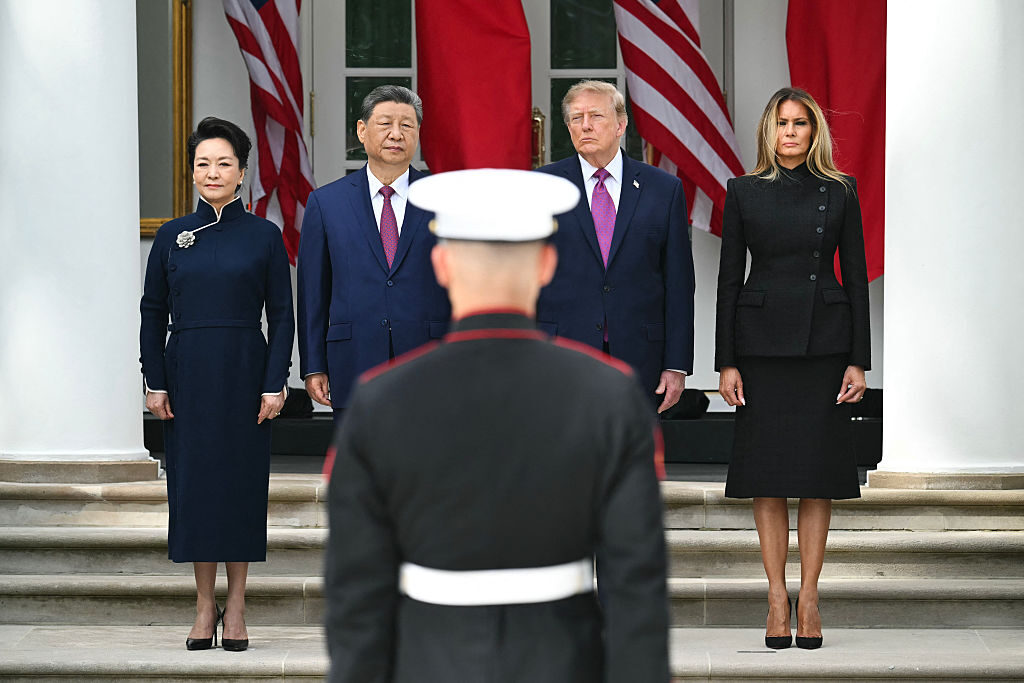
President Donald Trump and Chinese President Xi Jinping walked slowly Thursday into the White House Rose Garden to review U.S. military troops, a stride that matched the pace of talks on pressing issues and highlighted underlying tensions between the two rivals.
As the heads of the world’s largest economies stood shoulder-by-shoulder, an American bomber with four fighter jet escorts roared overhead. A U.S. Marine Corps team stood feet from Xi and conducted a rifle drill — should Washington ever be forced to defend Taiwan after a Chinese attack, the amphibious assault-expert Marines likely would be among the first American troops on the island.
The surreal scene all amounted to a show of force by Trump during Xi’s state visit, even as he has pulled the United States away from longtime allies and toward adversaries like China.
Speaking from the White House’s ornate Grand Foyer, Trump mentioned their “common interests” and his “truly great friendship” with his counterpart, adding: “The decisions we make in these areas today can promote peace and prosperity for decades and decades to come.”
Speaking moments later, Xi focused on economic benefits from building on the existing U.S.-China relationship. He spoke of “mechanisms for cooperation” and finding ways to “coexist in peace.”
“China keeps its door wide open, welcomes American companies wanting to invest and do business there,” he said. “We hope Chinese companies are treated fairly here in the United States. … Our interests are deeply intertwined, and there is vast room for cooperation.”
Their comments came as some GOP lawmakers have questioned the state visit spectacle and Democrats have demanded tangible progress from talks that typically end with the status quo in place.
Senate Armed Services Chairman Roger Wicker, R-Miss., in a Tuesday floor speech was skeptical the meeting would produce much, saying, “Perhaps some progress will be made.”
“Had the White House asked me for advice,” he said, “I would have suggested the president not invite Xi Jinping to Washington for such a lavish welcome here in the United States, based on all of the troubling issues we have with President Xi and the Chinese Communist Party.”
‘Human control’
Still, Wicker acknowledged the two leaders were meeting amid an artificial intelligence arms race.
Some U.S. lawmakers had called on Trump and Xi to use the summit to begin discussing a set of guardrails to curb AI development, warning the technology has been evolving too fast and could wreak havoc.
To that end, Xi sought to reassure that humans can and will mitigate the risk, understanding their obligation to ensure that AI “is always under human control.” That contrasted with Trump’s recent contention that warnings about potential AI calamity amounted to a “hoax.”
Rep. Gregory W. Meeks, the House Foreign Affairs Committee ranking member, and nearly 30 other Democrats wrote last week to Secretary of State Marco Rubio and Treasury Secretary Scott Bessent to argue that while AI could help Americans’ lives, it also poses “a broad spectrum of national security risks that could be harmful to the American public and our national interests.”
“AI models could be used to create a deadly pathogen, carry out a cyberattack on critical infrastructure, or destabilize societies in other ways. Models trained in one part of the world can be misused in another, with the consequences spilling far beyond a nation’s borders,” they wrote.
“To mitigate the risks of AI at home, we must also address the risks internationally, especially with China given its capacity to develop advanced AI models of its own. Though there is much we disagree on, our nations are also vulnerable to the same AI risks,” the group added. “Yet, right now, the two countries developing the most capable AI systems in the world have no reliable means to inform one another of or jointly address risks.”
That’s why the House Democrats said the summit should be used to “reduce risks of miscalculation and address the dangers that neither country can manage alone.”
But Trump has largely been an outlier on the matter, mostly dismissing concerns from lawmakers, other world leaders, tech executives and experts about AI’s dark side. He made clear during an address Tuesday to the United Nations General Assembly that he views the technology as lighter fluid for the still-flickering U.S. economy.
“The very same people who said we’ll all be dead in 12 years because of global warming — a name since reborn to climate change because the planet was cooling, not warming — and nobody was dead. These are the same people that are now saying that AI is going to kill us all, that robots are going to attack us, and that everything is going to be a total disaster,” Trump said.
“And now I say, whoever wins SI, whoever wins superintelligence, wins,” Trump said, using a new moniker for the technology that has failed to catch on. “And we’re leading now over China by a lot and everyone else and we’re going to keep it that way. We’re going to keep it very, very straight and very strong. I’m not going to stifle growth of something that will be bigger than the Industrial Revolution. Many say bigger than the Industrial Revolution or the Internet itself.”
‘He likes granite’
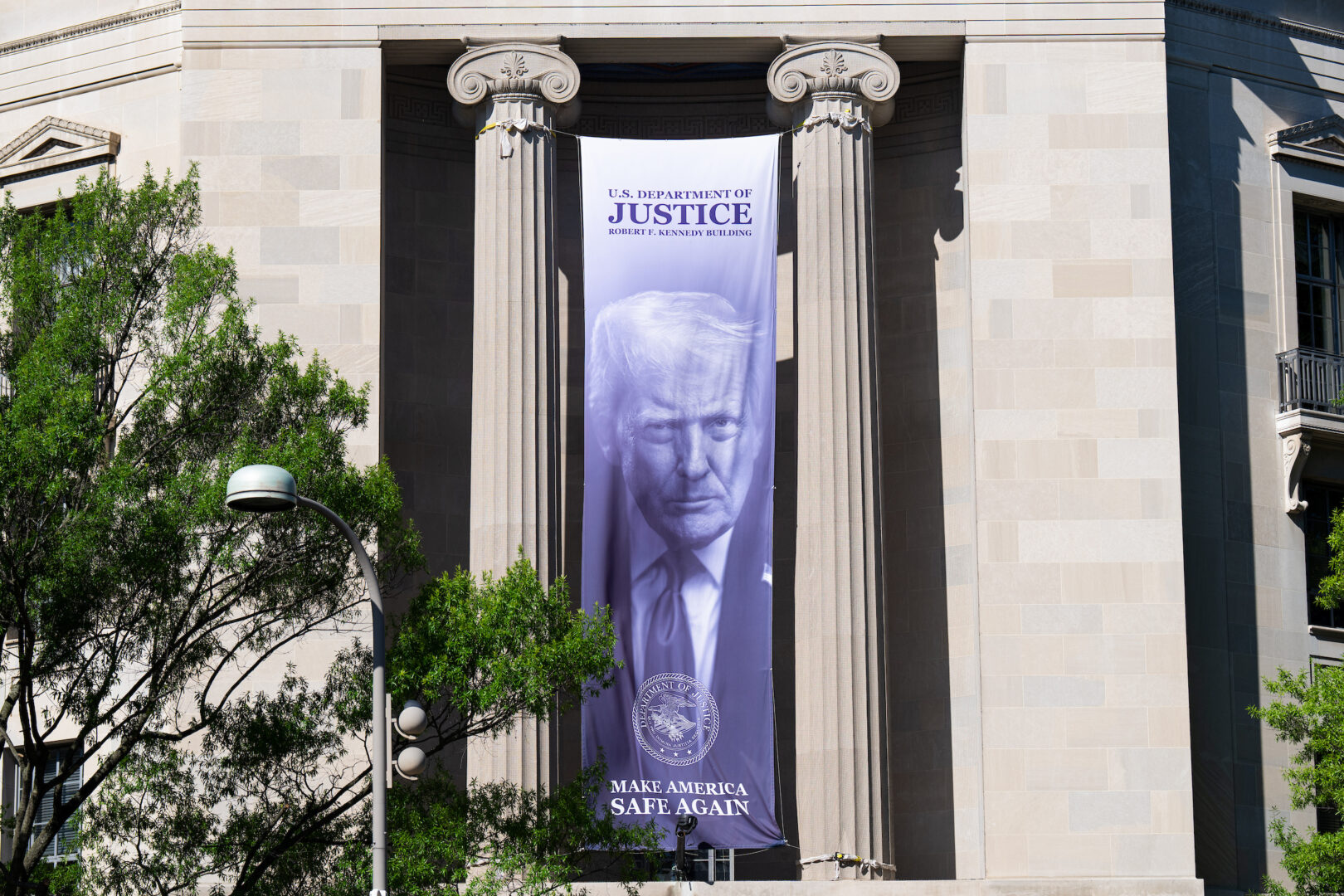
In recent days, Trump has said his administration would use the Justice Department to deal with any negative AI actions or fallout — but that agency is a law enforcement entity, not one versed in advanced technology development.
The Trump family’s reported investments in the rapidly emerging technology also could have something to do with the chief executive’s reluctance to slap on new restrictions.
Senate Health, Education, Labor and Pensions Committee ranking member Bernie Sanders, I-Vt., in a speech last week called on Trump and Xi to come away from the summit with a “comprehensive treaty” that would “establish a pause on advanced AI development and a ban on superintelligence” because “neither country benefits from an uncontrolled arms race to develop machines too powerful for humans to control.”
With the official delegations seated across from and facing one another in the Grand Foyer, Xi downplayed the need for a boundless conflict.
“There is no need for China and the United States to shy away from competition; however, such competition should be benign and bounded — a race where we strive to excel alongside one another, rather than a zero-sum gladiatorial contest,” he said. “Both sides must uphold the bottom line of avoiding conflict and confrontation, and we are fully capable of finding the right way for two major powers to coexist on this planet.”
After they and their underlings met privately for over an hour, Trump took Xi out to show him the new granite helipad he had built on the White House’s South Lawn — and the inside of the newest model of the Marine One executive helicopter.
“We had a great meeting, and he has great interest in granite. He likes granite,” Trump said of his guest as they headed back inside. “He’s an expert on stone, aside from many other things. And he loves good granite.”
Xi smiled — but said nothing.