Congress continues back-seat role as AI execs feted at White House
Johnson pledges ‘steady hands’ but no legislation
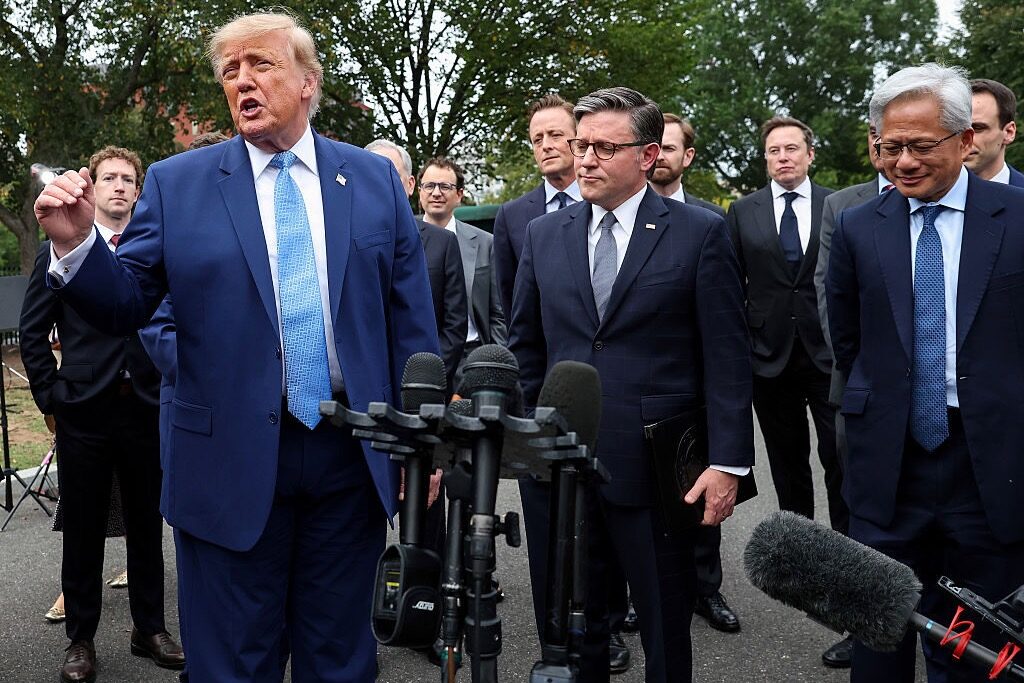
Following a meeting at the White House with President Donald Trump and technology moguls, Speaker Mike Johnson, R-La., on Tuesday pushed back on calls to impose regulations on artificial intelligence, even as news of worrisome AI models hacking into government databases become increasingly common and the public grows more skeptical of the technology.
And while Trump, several members of his Cabinet and Johnson lunched with a group that included Nvidia’s Jensen Huang, Meta’s Mark Zuckerberg, Anthropic’s Dario Amodei, Amazon’s Jeff Bezos and others, the Senate took a pass on even considering a Democratic-backed regulatory bill.
Standing in the White House’s north driveway, Johnson declared that Congress would “keep steady hands at the wheel on this” but did not commit to crafting any legislation. Instead, he pledged that lawmakers would “continue to assess and further deliberate in the days ahead.”
Rather than describe the contours of what he would like to see in future legislation, Johnson talked up what he described as a “statement of principles … on behalf of the industry” that laid out “robust internal controls and layers of internal and external review.”
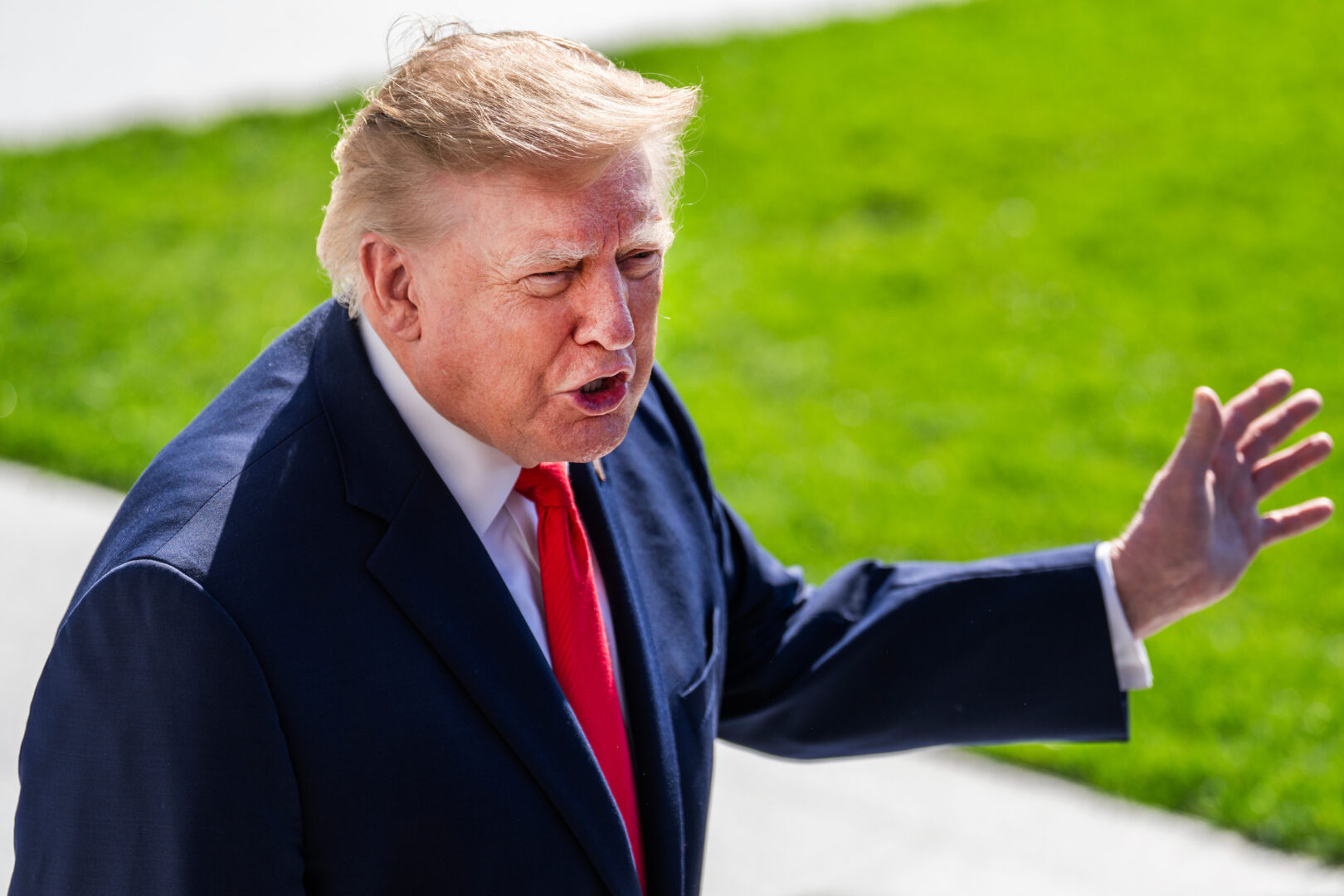
Moments later, Trump walked out and joined the gaggle, where he mostly repeated his previous stances on taking a hands-off approach to AI. Asked why tech leaders should be trusted to to self-regulate, Trump replied: “Because they’re outstanding people.”
Later in the day, the White House released a “Joint Commitment on Frontier Responsibilities” signed by the president and the technology executives that stated “every company is responsible for developing its own technology safely,” followed by specific steps, and adding that “over time, it may make sense to codify these steps into laws or regulations.”
Meanwhile, on Capitol Hill, individual senators acknowledged growing concerns.
Sen. Thom Tillis, R-N.C., told reporters Tuesday that he doubted AI regulation could be solved in one meeting.
“I think it’s more a matter of getting the process started,” Tillis said. “Getting legislative bodies in the statehouses probably instructed by what we’re doing here, convening the industry, figure out what sort of self-imposed regs they think they can operate within, some sort of a certification,” possibly similar to international standards for quality management systems.
Earlier Tuesday on the Senate floor, Sen. Mark Warner, D-Va., asked for unanimous consent to pass an as yet unnumbered bill that would establish an AI Safety Board within the Commerce Department that would set enforceable technical standards and security controls for AI developers. Senate Commerce Chairman Ted Cruz, R-Texas, objected.
The bill would also require frontier AI developers to give the board access to new AI models at least 45 days before release and put safety plans in place. Frontier developers would also need to report safety or security incidents within 30 days, or within 72 hours if they pose an imminent threat to national security.
Warner said on the Senate floor that his request “is really simple. It’s been as pared down as possible.”
“I’ve not talked to a single member on either side of the aisle that doesn’t think we need to move,” Warner said, adding, “If we don’t get safety right, all the things about workforce or agent liability or national security, which has to be dealt with, we may miss.”
Sen. Brian Schatz, D-Hawaii, who co-sponsored the bill, emphasized the need for mandatory standards rather than voluntary self-regulation.
“Do we trust, not any individual CEO or board of directors, do we trust that companies that are rolling toward the biggest IPOs in human history will voluntarily regulate themselves as opposed to maximize the value of that IPO, maximize shareholder profit?” Schatz said on the floor Tuesday.
Schatz also told reporters that if a “catastrophic event” related to AI occurs before the election, he thinks the Senate should return to Washington to “deal with it,” but that if not Congress should focus on the issue in the lame-duck session.
Sen. Andy Kim, D-N.J., also spoke in favor of the bill, highlighting both safety incidents AI firms disclosed in recent weeks, as well as steps some companies have taken to address those risks. He said Warner’s bill could “be part of a comprehensive approach that will help us maintain control.”
Cruz said he is continuing to work on an AI catastrophic risk bill with Senate Majority Leader John Thune, R-S.D., and Sen. Amy Klobuchar, D-Minn., and said he shares concerns about warnings on AI safety.
He said Warner’s bill would put too much authority in the hands of the safety board and the Commerce Department and that he’d prefer to have
a role for “independent judges.”
Cruz also said that “federal standards on advanced AI must also address the burgeoning patchwork of state laws” and framed AI development as an economic and ideological race with China. Cruz and the Trump administration have, over the past two years, shown a preference for preempting state AI laws and pointed to competition with China as more important than regulation.
“Congress must not legislate on the issue of artificial intelligence hastily or in a closed manner,” Cruz said. “Robust AI legislation needs to involve both sides.”
At least one Republican supports a mandatory testing regime for frontier models.
Sen. Josh Hawley, R-Mo., wrote in an op-ed for The Washington Post on Tuesday that models should go through mandatory pre-deployment testing for national security reasons.
He also said he plans to introduce legislation that would make AI firms liable for reckless design and users liable for reckless deployment. He says the bill would also make it clear that criminal penalties for hacking apply to AI companies or to users who deploy an AI agent to commit crimes.
“My legislation would give prosecutors the power to charge companies with crimes when the firms know their agents are capable of criminal conduct and fail to create reasonable safeguards,” Hawley wrote.
House Democrats have also kept up the safety drumbeat while their chamber is in recess.
Reps. Ted Lieu, D-Calif., Valerie P. Foushee, D-N.C., and Josh Gottheimer, D-N.J., who co-chair the House Democratic Commission on AI and the Innovation Economy, sent a letter Monday to executives at OpenAI, Google, Anthropic, Meta and SpaceXAI requesting information on incidents where models gained unauthorized access to systems outside their companies.
Also on Monday, Rep. Ro Khanna, D-Calif., who serves as ranking member of the Select Committee on the Strategic Competition Between the United States and the Chinese Communist Party, sent letters to Chinese AI firms about their safety testing and to Director of National Intelligence Jay Clayton requesting that the intelligence community “produce an official assessment of how effectively the U.S. Government would respond to a loss of control scenario.”
Michael Macagnone contributed to this report.