‘Toothless messaging’? Senate agenda caught up in midterm branding
Members make the most of votes on stock trading and data centers
As senators looked for the exits this week, Republican leaders forced votes on two hot-topic campaign issues: data center electricity costs and lawmakers’ ability to buy and sell stocks.
Democrats tried to label both as “toothless” last-ditch messaging bids, saying Republicans are merely trying to boost their sagging polls as they fight to retain their majority.
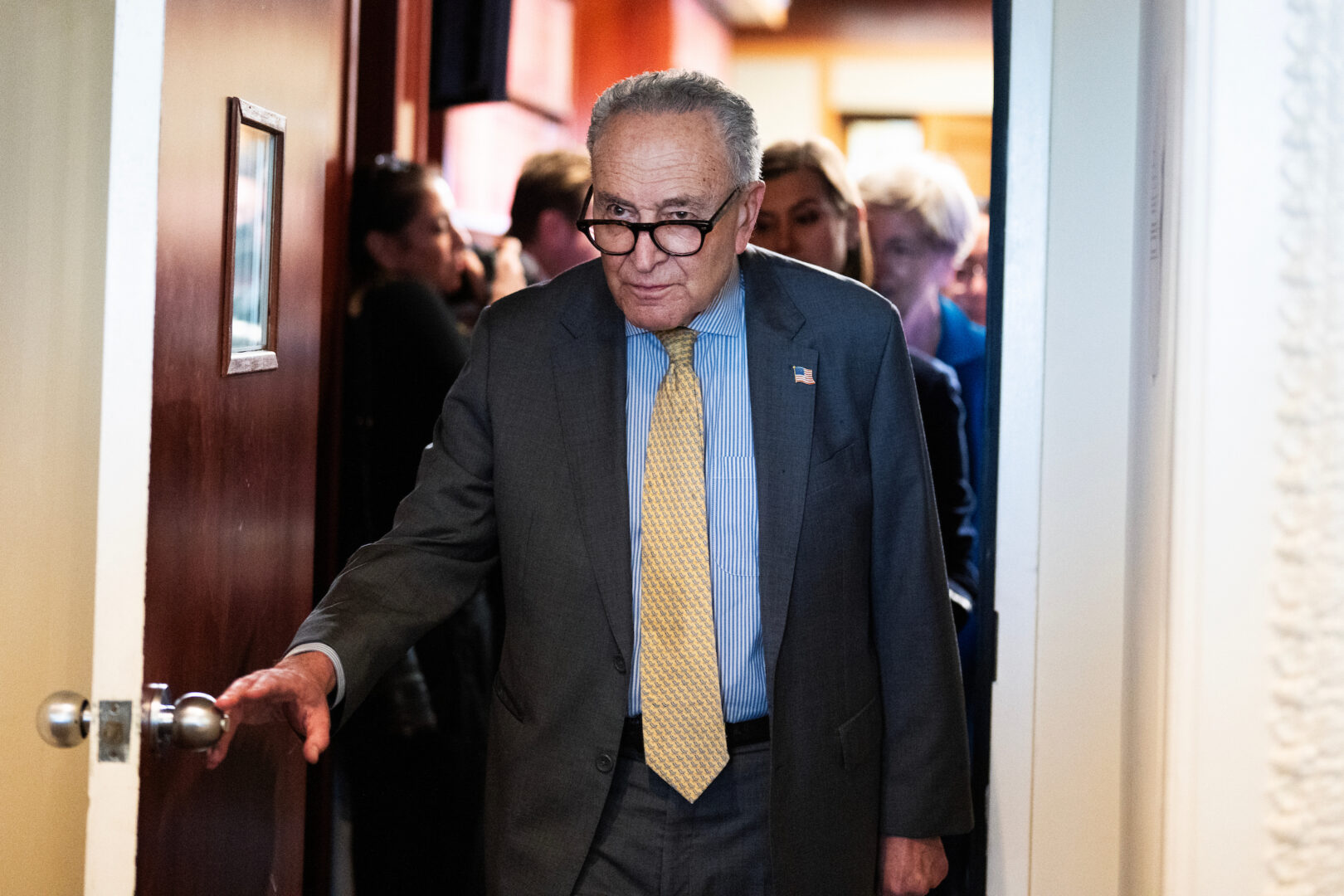
“At a time when Americans are calling out for real guardrails on AI, Senate Republicans are trying to secure an ineffectual participation trophy before they skip town,” Minority Leader Charles E. Schumer said on the floor this week.
But they were hard pressed to explain their opposition to the data center bill, which already passed the House with resoundingly bipartisan support. And the stock trading vote pulled some of their own turf out from under them, muddying the “anti-corruption” message that Senate Democrats have pushed this cycle.
“Good luck explaining to your constituents why you oppose a stock trading ban,” as Sen. Josh Hawley, R-Mo., put it after the vote.
The back and forth shows how the parties are battling for control of two issues that are likely to linger well past the midterms, as AI brings seismic changes around the country and public trust in Congress remains dismally low.
First up Wednesday was a procedural vote on what’s dubbed the Stop Insider Trading Act, which would prohibit members of Congress, their spouses and dependent children from buying new stocks. It was unable to clear the hurdle, with all Democrats voting against it.
The second bill is known as the Ratepayer Protection Act, which aims to address voter fears over data center costs by pressuring state utility regulators. It, too, was stopped in its tracks, despite four Democrats joining Republicans in support of a procedural motion.
The stakes are potentially high as senators head back to their home states. The data center bill has been touted by Sen. Jon Husted, R-Ohio, as his opponent — ex-Sen. Sherrod Brown, who is trying for a comeback — hammers him on the issue on the trail and airwaves. A recent Marist poll found Brown running ahead of Husted, 51 percent to 43 percent.
Brown recently ran an ad with a voter saying Husted “led the push to bring data centers to Ohio and gave billions of tax dollars to make it happen.”
“No one asked for that data center to be built here. And no one here is getting a damn thing from it, except higher electric bills,” the man says in the ad.
Before Husted was appointed to the Senate to replace Vice President JD Vance, he served in state government in Ohio, promoting data center investments and AI expansion during his time as lieutenant governor.
Similarly, the stock trade ban bill has been pushed by Sen. Pete Ricketts, R-Neb., as he faces a closer-than-anticipated challenge from independent Dan Osborn, who lost his 2024 race against Sen. Deb Fischer by 7 points and seems on track to make it uncomfortably tight again.
Osborn has been hitting Ricketts on his stock portfolio, pointing to reports that the senator “has made millions” since he came to the Senate in 2023.
“Wall Street Pete Ricketts is trying to clean up his image in an election year. This is like putting Bernie Madoff in charge of fraud prevention,” Osborn’s campaign said in a press release in March.
Senate Majority Leader John Thune insisted the procedural votes Wednesday were more than a ploy to help vulnerable GOP incumbents, even as he turned up the heat on Democrats and accused them of hypocrisy.
“They’re going to try and attack Republicans on” the same issues they had an opportunity to vote on, he said, returning to one of his favorite recent labels for his colleagues across the aisle: “the party of ‘no.’”
Democrats’ data center drama
As they railed against the data center bill, Democrats argued not that it was bad — but that it didn’t go far enough.
“We need real action on data centers, and what do Republicans decide all of a sudden to push forward? A bill that is totally optional. Optional is the operative word,” Schumer said.
The bill aims to ensure that the cost of electrical-grid upgrades driven by data centers are carried by the Big Tech “large-load” customers needing the extra power, instead of passing them on to other ratepayers’ utility bills. It would direct states to consider adopting federal standards but would not require them to do so.
Husted said the measure wouldn’t make it mandatory “because the states run the grids, and so you have to work with the states to do that.”
Earlier this month in the House, the proposal saw overwhelming bipartisan support with a 417-3 vote. The House Energy and Commerce Committee called it a “light touch” approach that “provides a federal recommendation” but ultimately lets states regulate their own energy markets.
While that “light touch” may not meet the expectations of voters calling for broad AI moratoriums, Husted said it followed past precedent.
“For them to say that is silly,” he said of Democrats’ complaints, adding the bill was the “only game in town” and the only one on the topic that could have gotten to “the president’s desk before we get to the election.”
“It will be up to them to determine whether or not they want to play politics or they want to solve affordability issues for the Americans,” Husted said ahead of the vote.
Asked Tuesday why Senate Democrats were whipping against a bill that almost all their colleagues on the House side had supported, Schumer argued that senators were in a better position to make a stand.
“In the Senate, you can do amendments. We have much stronger bills,” Schumer said, adding that his House counterpart, Minority Leader Hakeem Jeffries, had less leeway and had “no choice” but to vote for it.
According to Sen. Chris Murphy, D-Conn., “The bill is harmless. It does nothing, right? It literally restates current law. I mean, I wouldn’t be campaigning on this because it doesn’t do anything, but all of my [House] colleagues make different decisions.”
Sen. John Hickenlooper, D-Colo., called it a “pretty thinly veiled messaging attempt” by Republicans.
Still, Wednesday’s vote means Democrats will have to explain that logic on the campaign trail, diluting a topic where they see an opening and pulling focus away from their efforts to paint the GOP as beholden to the AI industry.
The fast-moving debate could move on quickly, though: “Trump is going to tweet 10 times between now and the election how much he loves data centers,” Murphy said.
‘Supposed crackdown on corruption’
Democrats in both chambers voiced similar objections to the stock trading bill, arguing it should go further.
“The bill doesn’t cover the president. Trump traded more stocks than all of Congress combined,” Schumer said. “Republicans carved the White House out of their supposed crackdown on corruption.”
In July, Schumer rolled out an anti-corruption platform meant to keep Trump in the spotlight ahead of the midterms and accusing the president of having “betrayed the American people by using our highest office not for the good of country, but to pad his own bank account, at the expense of working families.”
The measure wouldn’t do much to crack down on insider trading, some Democrats argued. While it bars members of Congress from buying new stocks, it allows them to keep and sell the ones they already own.
But the bigger problem for Democrats was an unrelated provision added to the bill before its passage in the House that would require voters to show photo ID at the polls. That has been a top demand from Trump and one piece of a sweeping push to reshape American elections, known as the SAVE America Act.
In a vote this summer, just 13 House Democrats voted in favor of the stock legislation. And on Wednesday, all Senate Democrats opposed it.
Sen. Brian Schatz, D-Hawaii, chief deputy whip for Senate Democrats, said Tuesday: “I think if they wanted to ban stock trading, [Republicans would] not attach voter suppression to it.”
Murphy agreed, saying it’s “obviously a sign that they don’t take the issue of insider trading” seriously. “If you wanted to get a stock ban done, you would put a stock ban on the floor.”
The National Republican Senatorial Committee wasted no time in leveraging Wednesday’s vote, targeting vulnerable Sen. Jon Ossoff, who is facing a tough challenge from Republican Rep. Mike Collins in Georgia.
“At the very rallies where Ossoff requires photo IDs, he claims he’s fighting corruption. But every time he has a chance to prove it, he goes back to Washington, flips on everything he claims to stand for in Georgia, and votes with Democrats,” said NRSC Regional Press Secretary Nick Puglia in a statement.
Ossoff is part of a core group of senators who have pushed to ban congressional stock trading. Last summer, a bipartisan bill that would bar members of Congress, the president and vice president from buying and selling stocks was marked up in the Senate Homeland Security and Governmental Affairs Committee. That bill, introduced by Hawley, has yet to see action on the floor.
Sen. Alex Padilla, D-Calif., ranking member of the Senate Rules and Administration Committee, said if Hawley’s bill had gone to the floor he would have supported it.
“Instead, they had this sham bill with the poison pill provisions,” Padilla said.
At least one Republican senator said he would have liked to see a cleaner vote on the topic to see where his colleagues would have landed. Sen. Thom Tillis, R-N.C., said the voter ID provision may have even given Democrats who would secretly prefer to keep trading stocks some cover to vote against it.
“I think strategically it gave them an out for a policy that I think is critically important,” he said. “That to me is a messaging exercise going bad.”
David Jordan contributed to this report.