Army findings inject urgency into air safety bill talks
Report finds “breakdowns across all layers of conflict management” in January 2025 collision
This week’s release of a U.S. Army investigation into the deadly 2025 air crash near Ronald Reagan Washington National Airport is fueling calls for congressional negotiators to default to the Senate’s position on aviation safety legislation that’s been stuck in a bicameral standoff.
The investigation, completed in May but only made public on Thursday, found that “breakdowns across all layers of conflict management” caused the midair collision that killed 67 aboard an Army Blackhawk helicopter and American Airlines passenger jet.
But one of the report’s key recommendations backs up the Senate’s position in the aviation bill talks: requiring the use of specific location-transmission technology on all aircraft, at least in congested airspace.
The main hangup in the House-Senate negotiations has been over the Senate-passed bill’s stipulation that aircraft be equipped with Automatic Dependent Surveillance-Broadcast equipment, which enables pilots and crew to receive weather, flight and traffic data — known as “ADS-B In.”
Aircraft operating in most areas subject to air traffic control already must be equipped with “ADS-B Out,” which transmits information about location, altitude, speed and other data to ground stations and other aircraft every second — much faster than traditional radar.
But under a 2018 agreement between the Federal Aviation Administration and Pentagon, certain military aircraft have been exempt from transmitting such data, which is largely done over unencrypted channels available to tracking apps like FlightAware. And the fiscal 2019 National Defense Authorization Act codified the Defense Department’s exemption from ADS-B transmission requirements.
The Senate bill would override that interagency agreement and repeal the older NDAA provision, allowing the FAA to grant exemptions only for “sensitive government missions.”
The Senate requirements gave both the military and authors of the competing House-passed bill pause. That version offers more leeway on the adoption of ADS-B, leaving it up to the FAA to prescribe standards, with some added carve-outs to exempt military aircraft for operational security reasons.
Thumb on the scale
The Army’s investigation doesn’t reflect the official position of the Defense Department, and it wouldn’t go as far the Senate bill would. However, it could carry significant weight with congressional negotiators since it moves in the direction of the National Transportation Safety Board’s recommendations.
The lead Army investigator, Lt. Gen. Michael C. McCurry, wrote in the report that the service should “require all flights in heavy urban environments to have a commercial-off-the-shelf … receiver to receive ADS-B In data to their [electronic management systems] while in flight which would enhance aircrew situational awareness.”
McCurry points out that the Blackhawk helicopter above DCA failed to transmit ADS-B Out data — partly due to equipment failure, but also that the crew was authorized to fly without using it. The report recommends the use of ADS-B Out in and around Washington and generally while operating in Class B airspace, which covers the busiest commercial airports.
The Army said in a statement Thursday that it was working to implement the investigation’s recommendations, distributing a fact sheet with actions taken thus far. They include inspections of all 3,585 Army rotary-wing aircraft “to verify settings supporting proper ADS-B Out functionality.”
The report “clearly shows that Army aircraft should be equipped with ADS-B In and ADS-B Out technology when in congested airspace,” Senate Commerce Chairman Ted Cruz, R-Texas, said in a Friday statement. “Had this been in place, 67 lives would have been saved in January 2025.”
Other Senate negotiators, including Commerce Aviation Subcommittee Chairman Jerry Moran, R-Kan., and ranking member Tammy Duckworth, D-Ill., released statements calling on both chambers to act. “This long-awaited Army investigation reaffirms what we’ve been calling for all along,” Duckworth said.
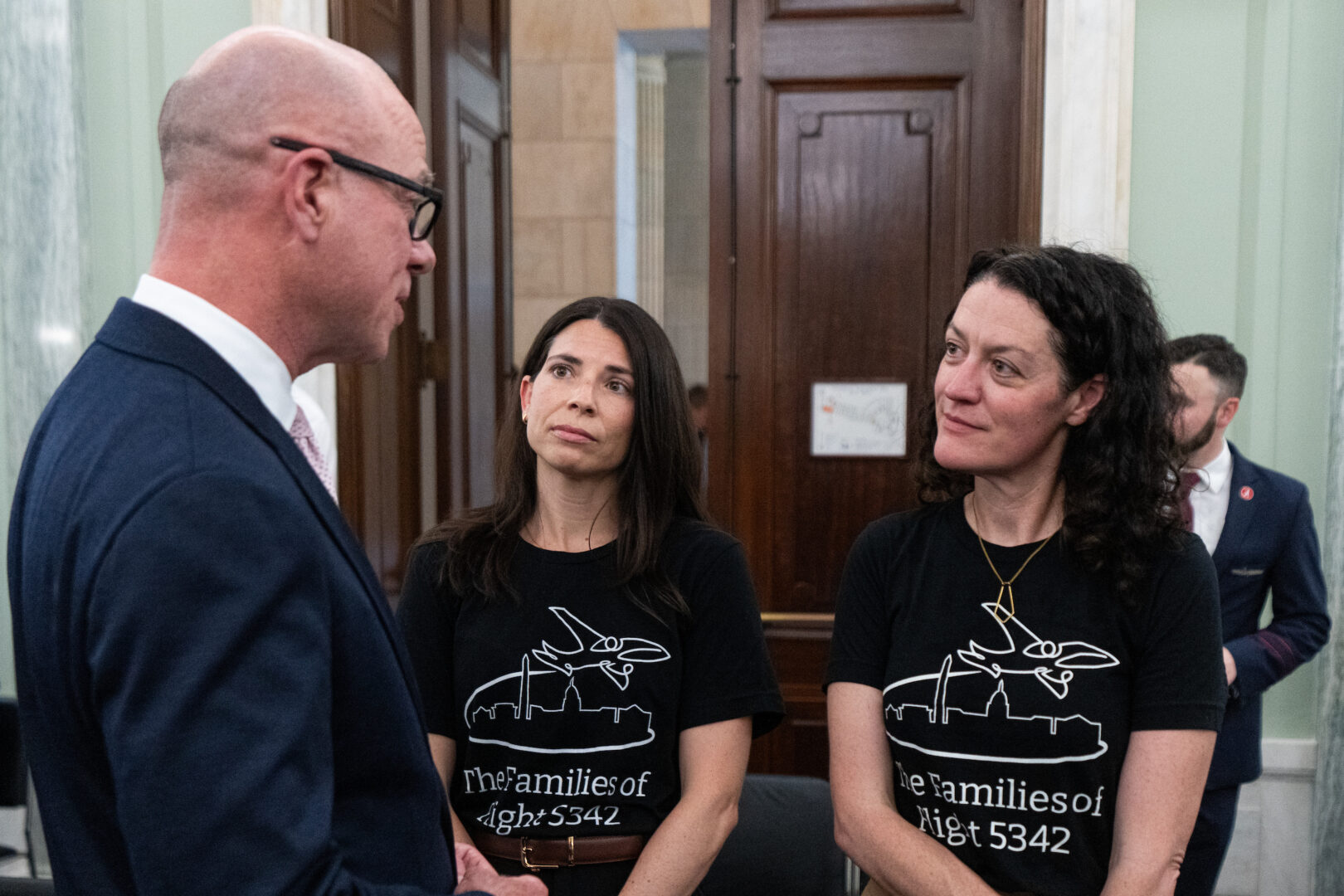
The families of American Airlines Flight 5342 victims, who distributed the report on Thursday after receiving a copy — the Army subsequently made it public — have long called for Congress to pass legislation along the lines of the Senate bill.
The Army report “demonstrates the urgent need for comprehensive aviation safety legislation requiring ADS-B In for all aircraft operating in busy airspace,” said Moran, who had seven constituents aboard the flight, which departed from Wichita, Kan.
“Over the summer, productive negotiations have taken place between the House and Senate, and we continue working with the administration to craft a bill that can pass both chambers and be signed into law,” Moran said.
Time is running short since lawmakers would need to start over from scratch next year if they don’t pass a bill during the lame-duck session.
National security concerns
Aides to House Transportation and Infrastructure and Armed Services Committee leaders, who co-wrote the less-prescriptive House bill, weren’t immediately available for comment.
T&I leaders were invited to appear at a September news conference hosted by Senate Commerce leaders, Flight 5342 family members and others. While they didn’t attend due to a markup, they released a statement at the time, read aloud at the event, saying they were committed to reaching a deal “before the end of this Congress.”
House Armed Services ranking member Adam Smith, D-Wash., and Transportation and Infrastructure ranking member Rick Larsen, D-Wash., joined almost all Democrats in his chamber to support the Senate bill when it reached the floor in February.
The vote was 264-133 in favor, but that wasn’t enough to pass under suspension of the rules, which requires two-thirds of members present and voting. Republicans split on the measure, with 77 in favor and 132 opposed — with Transportation and Infrastructure Chairman Sam Graves, R-Mo., and Armed Services Chairman Mike D. Rogers, R-Ala., among the latter.
“Requiring our fighters, bombers, and highly classified assets to regularly broadcast their location puts our men and women in uniform at risk by exposing operational planning, aircraft details, and patterns of life to our adversaries,” Rogers said during floor debate at the time. “For obvious reasons, we do not want our enemies to know where our bombers or fighters are or where we they are headed.”
Cruz, Moran and the Families of Flight 5342 group said they were willing to negotiate certain exemptions in the coming weeks. But in a statement after reviewing the Army report, the families group questioned what would possibly justify leaving out a location technology mandate.
Any agreement, they said, needs to have “an enforceable ADS-B In requirement, firm deadlines, narrowly defined military exceptions, and coordinated reviews of dangerous airspace interactions nationwide.”
Peter Cohn contributed to this report.