Omar home search raises fears about election-season probes
‘There’s lots of reasons to suspect this is politically motivated,’ one expert says
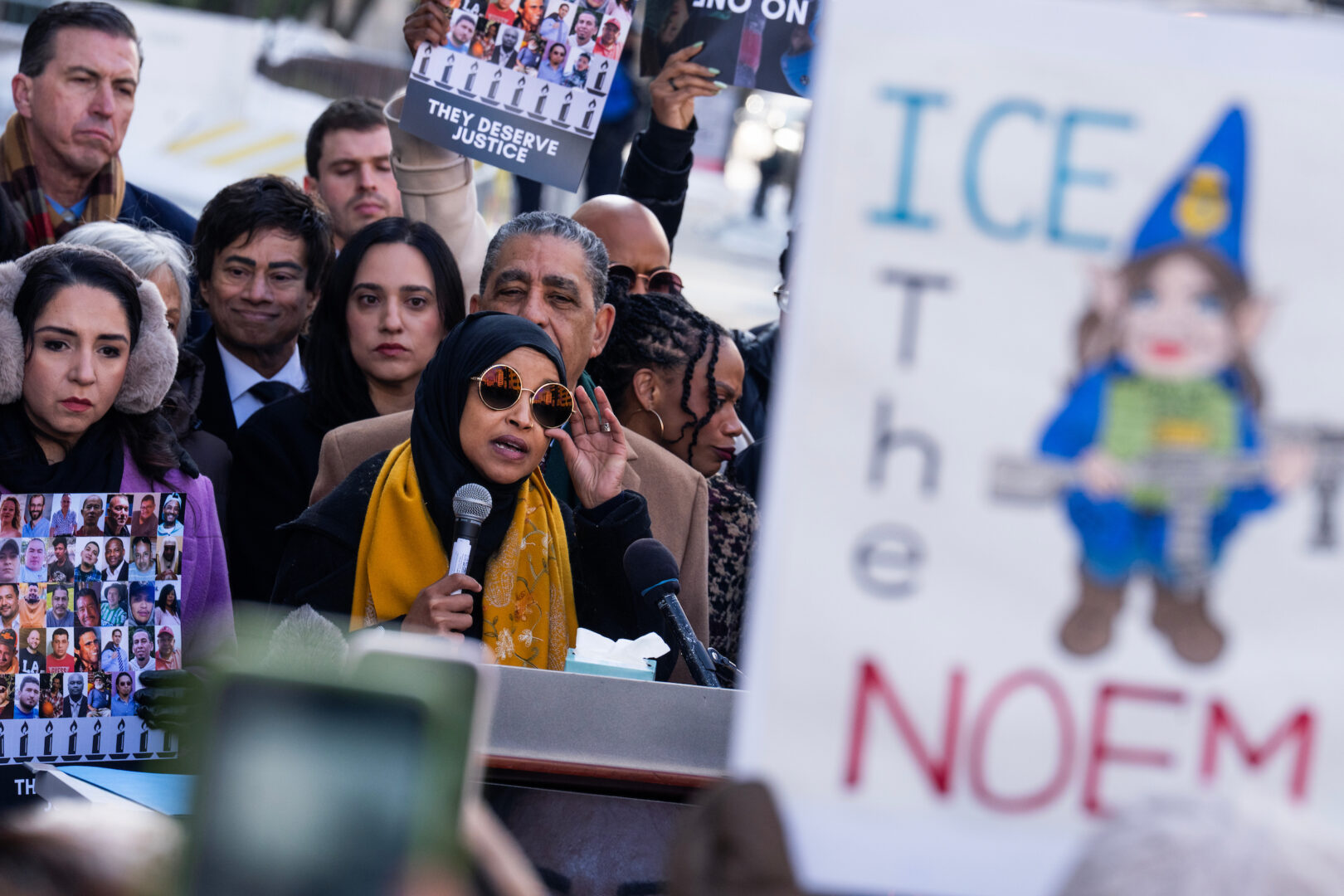
A search of Rep. Ilhan Omar’s home has sent shockwaves through electoral politics weeks before the midterms, as experts said it appeared to flout longstanding norms meant to keep prosecutors out of elections.
While the Minnesota Democrat herself has been on a glide path to reelection in a deep-blue district, some worry it could set a wider precedent for how the Trump administration handles investigations of other politicians.
Homeland Security Investigations agents carried out a federal search warrant of her D.C. home on Monday, according to Omar and officials. It comes as Republicans face an uphill battle to retain control of the House and after President Donald Trump has criticized Omar for years and publicly accused her of immigration fraud.
The timing of the search raises serious questions, according to several experts. David Sklansky, a professor at Stanford Law School and former federal prosecutor, said the search, even though it was conducted by Homeland Security officials, may have run afoul of two Justice Department policies, one formal and one informal.
“There’s lots of reasons to suspect this is politically motivated, and there’s very little evidence that it isn’t politically motivated,” Sklansky said.
The Justice Department manual states that federal officials should never direct the timing of an investigative step “for the purpose” of affecting an election and directs agents to consult the Public Integrity Section if an impact is possible. The Public Integrity Section normally handles cases involving public corruption and elected officials and has faced controversy in the second Trump administration.
Beyond the manual, Sklansky said the DOJ has an informal “60-day rule” where investigators are discouraged from taking actions close to an election. A 2018 inspector general report that criticized the handling of the probe of former Secretary of State Hillary Clinton in the days leading up to the 2016 election noted that there was no written guidance for such situations.
Gregg Nunziata, executive director for the Society for the Rule of Law and former DOJ counsel, said the search could undermine trust in the DOJ when it files a case.
“Congressmen, senators, members of an administration — they do break the law, they’re not above the law. It’s important that they be prosecuted when the facts and the law support a prosecution, but the public has to have confidence in those actions,” Nunziata said. “And when they’re so close to the election, the public can reasonably ask questions, particularly in an administration like this.”
Representatives for the Department of Homeland Security referred questions to the Justice Department, which sent a statement but did not answer questions about the proximity to the election.
“Homeland Security Investigations executed a judicially authorized search warrant secured by the Department of Justice,” the statement said. “This enforcement action is part of an ongoing federal criminal investigation.”
‘Abuse of power’?
Omar is a naturalized U.S. citizen and has lived in the U.S. since she was 12 after her family fled her native Somalia as a refugee. Omar’s office issued a statement Monday calling the search an “outrageous abuse of power” by the administration that has targeted political enemies.
“For a decade, Donald Trump has relentlessly targeted Congresswoman Ilhan Omar with inflammatory rhetoric, repeatedly putting a target on her back. Now, those attacks have escalated to a pointless federal raid. The Congresswoman has done nothing wrong. No president should be able to use the power of the federal government to intimidate his political enemies,” the statement said.
Democrats have roundly criticized the search as an attack on a political opponent. Rep. Jamie Raskin, D-Md., ranking member of the House Judiciary Committee, called it “no accident.”
“Just 22 days before the elections, this is blatant political intimidation and an attempt to interfere with the Congresswoman’s reelection. It is also the culmination of a smear campaign against Minnesota’s Somali American community,” Raskin’s statement said.
It comes after the DOJ sought an unsuccessful indictment for six sitting Democrats in Congress earlier this year for producing a video stating that soldiers did not have to obey unlawful orders. Raskin cited those and others to argue that Trump has turned the DOJ to producing “bogus charges.”
Sklansky also noted the search came the same day that Trump invoked Omar at a rally in Ohio, as the president’s supporters chanted “deport.”
“She’s a disaster. She comes in from a country without laws, without police, without military. All they do is shoot each other, and she comes into our country and she says, ‘I have a constitutional right,’” Trump said at the rally.
Earlier in the day, Trump said he had “nothing to do” with the search and said it was “up to the DOJ.”
A source familiar with the investigation said the DOJ consulted with the Public Integrity Section, which handles cases involving public officials, before the search.
The agency that handled the search, Homeland Security Investigations, has jurisdiction covering a range of legal violations, ranging from intellectual property theft and fraud up to criminal immigration violations and human trafficking.
Typically, search warrants are sought by federal prosecutors on behalf of an investigating agency and approved by a federal magistrate or district judge.
Vice President JD Vance told reporters Tuesday that he was not notified of the raid in advance and argued the DOJ has pursued cases independent of the White House.
“Now, I do know that there are some serious allegations against Ilhan Omar. We’re going to look into those. And again, if there’s a real case there, we’re going to follow the facts. If there’s not a real case there, then we won’t,” Vance said.
However, it’s not clear how much daylight exists between the White House and the DOJ. Attorney General Todd Blanche has asserted that Trump has the authority to direct federal investigations, including into political opponents. In April, while serving as acting AG, Blanche said Trump had a right to do so.
“It is true that some of them involve men, women and entities that the president in the past has had issues with and believes should be investigated. That is his right and indeed it is his duty to do that, meaning to lead this country,” Blanche said at a news conference.
Trump has in the past publicly directed officials to pursue criminal charges against his political opponents. Last year he posted publicly on Truth Social calling for charges to be filed against former FBI Director James Comey, New York Attorney General Letitia James and Sen. Adam B. Schiff, D-Calif.
Comey and James were later indicted, but those charges were dismissed after a judge found the prosecutor was illegally appointed. Comey has since been indicted again for an Instagram post that prosecutors assert was a threat against Trump. Comey has pleaded not guilty to those charges, and argued in court that he was targeted for his criticism of Trump.
In another unusual move Tuesday, U.S. Attorney for the District of Columbia Jeanine Pirro suggested on Fox News that there were “several investigations” into Omar, including over her financial disclosures.
Sklansky noted that Omar or others who were targeted by the administration may be able to fend off any hypothetical charges by claiming that they were prosecuted because of their criticism of Trump, by seeking dismissal through a doctrine called vindictive or selective prosecution. But it won’t help them on Nov. 3.
“One of the weaknesses of those doctrines is that they don’t protect against abuses of the investigatory process,” Sklansky said. “Those doctrines don’t even kick in unless there is a criminal charge in court, which there isn’t at this point.”