Trump says administration is weighing diesel export restrictions
Independent analysts argue any price relief from an export ban would be temporary at best
A diesel export ban is gaining steam as a possible lever the White House can pull, without the need for congressional action, to help contain skyrocketing prices that are causing economic shock waves and becoming a midterm campaign headache for Republicans.
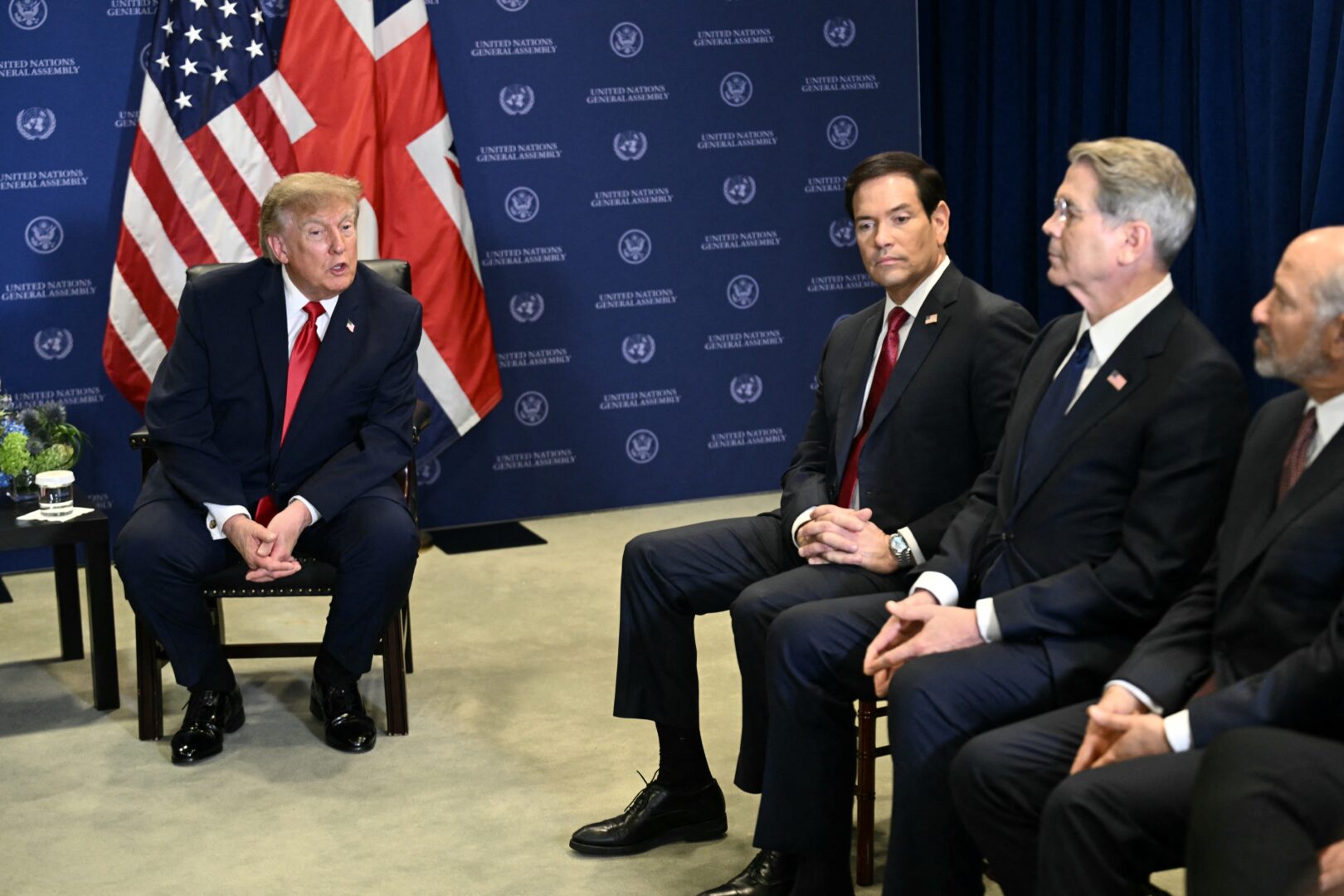
President Donald Trump said Tuesday that he personally supports the idea but that “it’s a balance” and his administration hadn’t yet reached consensus on it.
“I’ve said let’s not send out the diesel. We make a lot of diesel,” Trump told reporters at the United Nations General Assembly in New York. “I’ve called for it within my people. I’ve been talking about it.”
Appearing with Trump, Treasury Secretary Scott Bessent said the administration was looking at whether an export ban is “feasible in terms of the overall refining capacity and whether a full or partial ban would work.”
Under the Carter-era International Emergency Economic Powers Act, Trump could impose export restrictions without a vote in Congress — something now several of his GOP allies in tight races are calling for. That’s critical, because the House is gone for the rest of the midterm campaign and the Senate is expected to leave within the next week or so.
Previously, top administration officials including Energy Secretary Chris Wright and Interior Secretary Doug Burgum had argued against the idea, which is opposed by the oil industry and lawmakers from Gulf Coast petroleum-exporting states.
They say prices have risen due to extraordinary circumstances driven by the war in Iran and Ukraine’s continued attacks on Russian oil infrastructure, which have crimped global refining capacity.
“We understand the administration is looking at every option to deliver relief, but restricting U.S. energy exports would only compound the problem — exacerbating refining challenges and ultimately hurting consumers,” American Petroleum Institute President and CEO Mike Sommers said in a statement Tuesday.
And independent analysts argue that any price relief from an export ban would be temporary at best and localized in a few areas, counterbalanced by a longer-term hit to the U.S. economy and global standing.
“You would get a short-term, abrupt collapse in pump prices” along the Gulf Coast and in the Upper Midwest, Bob McNally, a top energy adviser in George W. Bush’s administration, said Monday on Bloomberg TV. “And the U.S. would shatter its reputation as a safe place to invest for a generation.”
Steady drumbeat
But the drumbeat of Republicans in tough midterm races calling for such a ban has steadily increased in recent days as diesel prices keep setting new records. The latest is Alaska Sen. Dan Sullivan, who is facing off against former Rep. Mary Peltola, D-Alaska, in a race that Inside Elections with Nathan L. Gonzales rates Tilt Republican.
“I’m calling for a temporary pause of American diesel exports so that we can rebuild our reserves ahead of winter and put American and Alaskan families first,” Sullivan said in a statement Tuesday. Average diesel prices in Alaska on Tuesday were $6.66, according to AAA, higher than the national average of nearly $6.53.
Since U.S. refiners produce far more than is needed to support domestic consumption, trapping that supply at home would, all else being equal, cut prices at home. But crude oil and petroleum product prices are set globally, so removing the roughly 1.6 million barrels of diesel the U.S. exports daily from the market would decrease overall supply and boost prices.
That leads to potentially uneven results across the U.S., with McNally and other analysts arguing the Northeast and West Coast could even see higher prices since they are more dependent on refined product imports.
Robert Kleinberg, an adjunct senior research scholar at the Columbia University Center on Global Energy Policy, said in an interview that adversely impacting blue states may be part of Trump’s calculus.
“There’s just not a lot of pipelines going over the Rocky Mountains … that means California prices will go up. So they will be in even worse condition than they are now,” said Kleinberg, who worked for SLB, the oil services firm formerly known as Schlumberger, for nearly four decades. “On the other hand, let’s look at the political side of it. What is Trump thinking? Does he really care about diesel prices in California? I don’t think so.”
That’s not the case in states like Iowa and Michigan where diesel prices have become a potent campaign issue and where an export ban arguably could help, at least temporarily.
McNally, who as of Monday — before Trump’s latest comments — assigned a 35 percent probability to an export pause, said in the Bloomberg interview that any relief may only last a matter of weeks.
“I don’t know of an economist inside the administration … or a policy adviser who thinks banning exports of diesel or gasoline would be a good idea,” McNally said. “The risk is the president in desperation may choose it to get that short-term few weeks of a lower pump price.”
Midwest races
Prices are lower than average in Iowa, but with the farm economy heavily reliant on diesel, lawmakers and candidates there are calling for action to lower prices. Sen. Charles E. Grassley, R-Iowa, did so over the weekend and again on the Senate floor Tuesday.
“I encourage President Trump to put a temporary embargo on diesel exports through executive actions. It will help family farmers who feed and fuel the world,” Grassley said in a floor speech.
The diesel price issue is front and center in the Iowa Senate race between Democratic state Rep. Josh Turek and GOP Rep. Ashley Hinson, who are vying for the open seat being vacated by Republican Sen. Joni Ernst.
Polls have generally been close, with Hinson holding a slight lead until a Marist University poll released Tuesday showed Turek with an 8-point advantage.
Turek in recent days has been hammering Hinson over diesel prices, expressing his own support for an export ban and accusing her of being in the oil industry’s pocket. Hinson on Monday came out in favor of an export ban along with several other options for reducing prices, including suspending the federal diesel tax.
The latter is no longer an option since the House adjourned for recess, however, and even before they left GOP leaders declined to take up a motor fuels tax suspension bill given opposition within the conference.
Senate Majority Leader John Thune, R-S.D., last week said of the two policy levers, the “export ban honestly makes probably more sense to me.”
While he explained the “best thing” would be to reopen the Strait of Hormuz that has stymied the global oil and gas market, the Senate will look at any “viable solution.” Added Thune: “If we have the supply in this country and we’re exporting it right now, that that might be one way of getting at it.”
In trying to keep the Senate from flipping while offsetting potential losses elsewhere, Thune and GOP campaign operatives are keeping a close eye on Michigan and the tight race between ex-Rep. Mike Rogers, R-Mich., and Democrat Abdul El-Sayed.
Diesel prices on Tuesday were averaging $6.88 in Michigan, among the nation’s highest, exacerbated by a major ExxonMobil refinery outage. Rogers on Monday came out for an export ban as well as an end to the Iran war; El-Sayed accused him of “flip-flopping” in part due to record-high diesel prices.
Inside Elections calls the Michigan race a Toss-up.
Longer-term ramifications
While the issue is gaining political salience, analysts are warning of the longer-term ramifications of such a move. A snapback to higher prices once refiners start cutting production given the mismatch with domestic consumption would be just the beginning, they said.
“Signaling that exports can be controlled for political convenience or to ‘drive prices down’ discourages investment and will accelerate the refinery closures underway. … More closures weaken future supply security,” wrote Patrick De Haan, head of petroleum analysis at price-tracking app GasBuddy, in a blog post.
De Haan added that it would signal to U.S. customers in South America and Europe that they should “diversify away from U.S. refineries and U.S. supplies, softening long-term demand for U.S. product and forgoing political leverage.”
Kleinberg, who argued an export ban could work temporarily in some places, concurred with De Haan on his latter point.
“The U.S. has spent sort of considerable effort making itself a reliable supplier of petroleum products,” Kleinberg said. “Once you cut off the exports, even if it’s temporary, then countries will start naturally looking elsewhere.”
Savannah Behrmann, John T. Bennett and Peter Cohn contributed to this report.