At the Races: AI voted?

Welcome to At the Races! Each week we bring you news and analysis from the CQ Roll Call campaign team. Know someone who’d like to get this newsletter? They can subscribe here.
Fears about unregulated artificial intelligence are not showing signs of overtaking economic concerns as the top issue for voters this year.
But dire warnings, like Anthropic CEO Dario Amodei’s recent admonition that a “swarm” of AI agents “could be capable of taking over the entire internet” in as little as six months from now does beg the question: What about an October surprise?
It might not take something as catastrophic as disabling the internet to cause enough chaos to compete with economic concerns on the minds of voters.
A new Politico poll found that 63 percent of Americans think there’s at least a “moderate risk” that “advanced AI could destroy humanity.”
And the latest New York Times/Siena University poll found 61 percent of likely voters at least somewhat opposed to the construction of data centers to support AI development in the United States. And while campaigns and committees talk about the consumer costs associated with data centers and as AI-generated content features in campaign spots, ads about AI risks haven’t hit the airwaves as much.
One exception is Democratic Sen. Mark Warner, who is up for reelection in Virginia and released a new ad on AI this week.
“We need to keep human beings in charge of technology, not the other way around. And just as important, we need to make sure working Americans — not just the giant tech companies — are the ones who stand to benefit,” Warner said in a memo about the spot, which references the senator’s telecommunications background.
The AI threat is already making for some odd coalition building, with Vermont Sen. Bernie Sanders teaming up with none other than longtime Trump adviser Steve Bannon. They appeared at an event Tuesday with many other advocates for enhanced AI safety.
But as CQ Roll Call’s Allison Mollenkamp and Savannah Behrmann reported, President Donald Trump is taking a different approach.
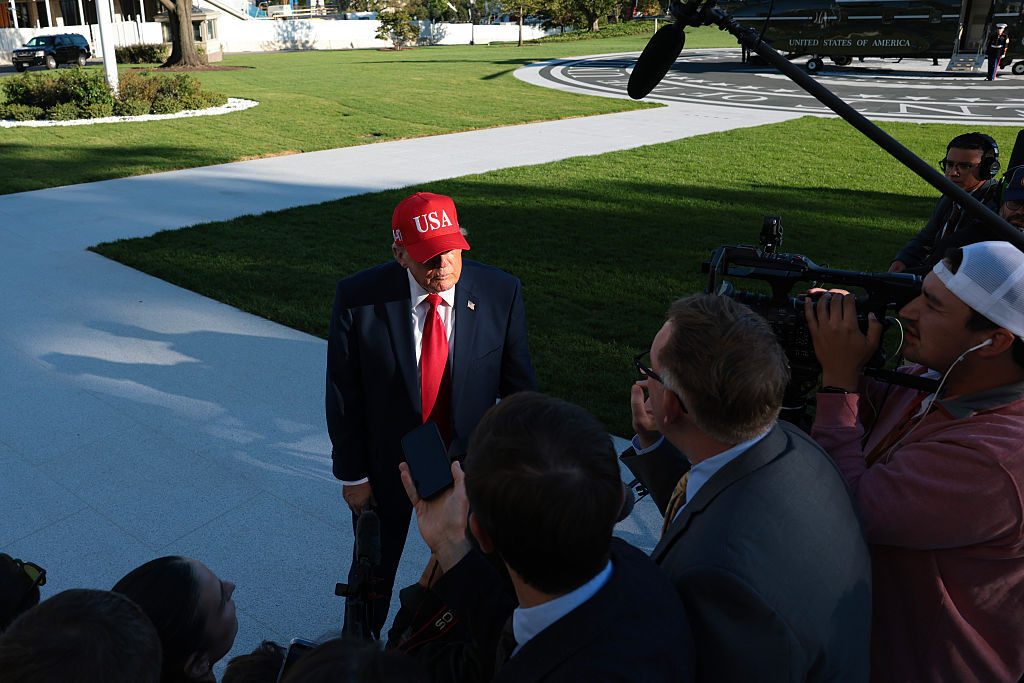
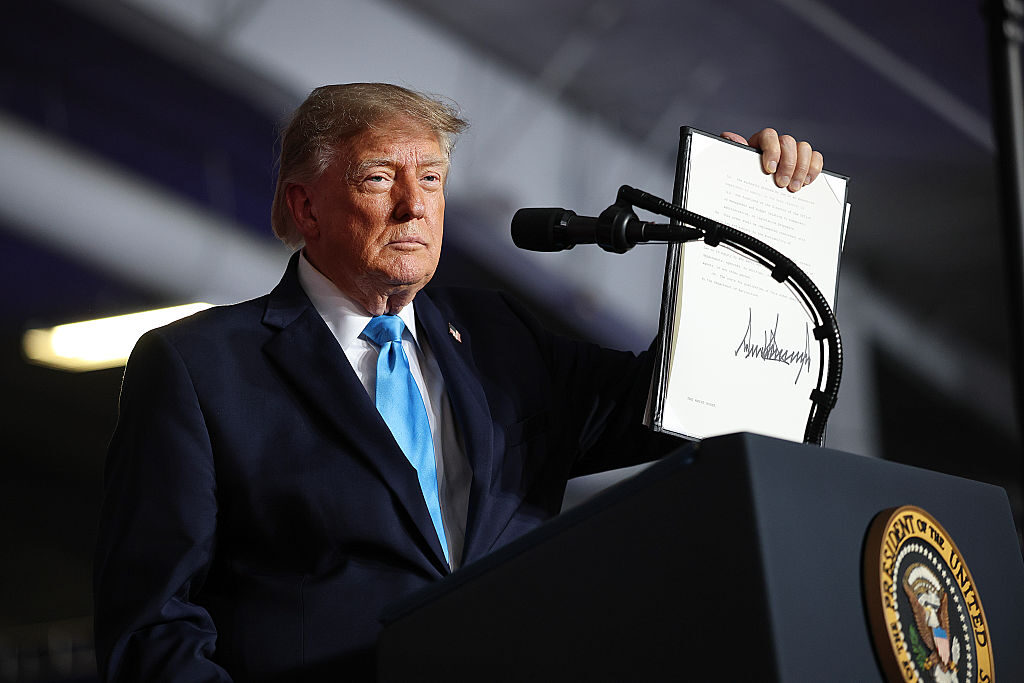
Trump has called the issue a “hoax” and “sick conspiracy” on social media, and he’s expressed opposition to new action by Congress to impose restrictions on American AI companies.
“The only control or ‘guardrails’ that AI needs is a STRONG AND SMART (High IQ!) PRESIDENT, and the U.S.A. has that, in spades!” he posted Monday. “We already have tremendous CRIMINAL and REGULATORY power over these companies!”
Starting gate
Leaning in to law and order: Trump delivered a blistering attack Wednesday on former North Carolina Gov. Roy Cooper, accusing the Democratic Senate nominee of embracing policies that have made the state less safe. Trump was in deep-red Gastonia, outside Charlotte, to rally support for Republican nominee Michael Whatley, our colleague John T. Bennett reports.
#TX35: On paper, the contest between Democrat Johnny Garcia and Republican Carlos De La Cruz for a redrawn San Antonio-area district shouldn’t be all that competitive: Trump would have carried it by 10 points in 2024. But in the final sprint to November, the race for a seat calibrated to give the GOP a decisive advantage has evolved into a costly dogfight.
Still the one: The post-Trump era looms, but, at the Republican midterm convention in Dallas last week, party die-hards were not quite willing to move on from the president.
Red to bluer? An independent running in red-leaning Alaska, a progressive seeking a battleground seat in Michigan and an emergency room nurse competing in a Solid Republican race in Wisconsin are the new additions to the DCCC’s “Red to Blue” program for top recruits.
Black voter outreach: The Congressional Black Caucus Institute has launched a new effort to turn out low-propensity Black voters and rural voters, seeking to use new organizing tools to reach voters in new ways.
Door-knocking season: A pair of environmental groups kicked off new canvassing efforts that take advantage of a new FEC advisory that allows them to coordinate with the campaigns of the Democrats they’re supporting.
ICYMI
Crossing party lines: Former West Virginia Sen. Joe Manchin III, a Democrat-turned-independent, has endorsed Republican Susan Collins, his former Senate colleague running for reelection in Maine. In New York, vulnerable GOP Rep. Mike Lawler announced an endorsement from New Castle Town Councilwoman Ally Chemtob, a Democrat. Conservative columnist George Will is backing South Carolina Democrat Annie Andrews for Senate over newly minted Republican incumbent Darline Graham. And longtime GOP consultant Karl Rove wrote in a Wall Street Journal op-ed that he would vote for the Democratic nominee for the Texas Railroad Commission over Republican candidate Bo French. (More on that race below.)
Endorsements: Winning For Women Action Fund, which supports conservative women running for Congress, is backing former sports broadcaster Michele Tafoya in Minnesota’s open Senate race and Louisiana Board of Regents Chair Misti Cordell in the jungle primary for the state’s open 5th District. The political arm of the Blue Dog Coalition of centrist Democrats has endorsed educator Jake Johnson in Minnesota’s 1st District; former Columbia, Tenn., Mayor Chaz Molder in Tennessee’s 5th; emergency room nurse Mitchell Berman in Wisconsin’s 1st; and commercial fisherman Bill Hill, the independent candidate seeking Alaska’s at-large House seat.
Emergency landing: Wisconsin Rep. Tom Tiffany, the Republican nominee for governor, was the only passenger on a plane that was forced to make an emergency water landing on a lake last weekend. Tiffany said he and the pilot made it out with only minor injuries.
Ad watch: Florida Rep. Maria Elvira Salazar released a campaign ad Thursday criticizing Trump’s immigration enforcement policies. “The same Hispanics who helped you get to the White House in 2024 feel betrayed today,” the third-term Miami Republican says in the direct-to-camera spot. Salazar faces Democrat Eliott Rodrigeuz, a fellow former television news anchor, in November.
There’s always a tweet, Republican edition: Thomas Smith, the GOP challenger to Rep. Kristen McDonald Rivet in Michigan’s 8th District, deleted social media accounts in which he used “inflammatory and conspiratorial rhetoric,” including appearing to call for the death penalty for Trump’s political opponents, according to CNN’s KFile.
Badger State boundaries: The Wisconsin Supreme Court heard arguments Wednesday in two cases challenging the state’s congressional map as the justices decide whether to allow the challenges to go forward, the Milwaukee Journal Sentinel reported. The plaintiffs are seeking to have a new map before the 2028 elections.
#MSEN: End Citizens United announced a $1 million ad buy to support Democrat Troy Jackson’s Senate campaign in Maine, the group’s largest expenditure for a single race since 2022.
Nathan’s notes
Roll Call elections analyst Nathan L. Gonzales explores whether midterm conventions may become a new election tradition for the two parties going forward or if last week’s Republican gathering in Dallas may have been a one-time thing.
What we’re reading
Polling problems: Primary polls turned out to be wrong in a handful of key races this summer, but, as The New York Times reports, pollsters say general election surveys are different, with November results typically ending up closer to what polls predicted.
Here come the billionaires: America’s ultra-wealthy are flooding midterm races with cash — and the bulk of it is flowing to Republicans, an analysis of campaign spending by the Financial Times found. While it’s not unusual for megadonors to favor the GOP, the balance of spending this year is especially skewed, one expert told the newspaper.
Team effort: The Boston Globe profiles the unorthodox political team behind democratic socialist David Morales’ win over Providence Mayor Brett Smiley last week.
Behind the tweet: The Dallas Morning News caught up with two of the University of Texas students who were depicted in a racist social media post by Bo French, a Republican running for Texas railroad commissioner. His remarks drew fierce condemnation from Texas Sen. John Cornyn, among other Republicans.
The count: 9 points
That’s the latest generic ballot advantage for Democrats, according to a New York Times/Siena College poll released this week, with 51 percent of likely voters favoring the Democratic candidate in congressional races and 43 percent favoring Republicans.
Among all registered voters, Democrats held a 7-point lead, up from just 2 points a year ago.
Eight percent of registered voters who favored Republican candidates said they were unlikely to cast their votes in November. Just 4 percent of those supporting Democrats said the same.
Trump’s approval rate among registered voters is a net negative of 22 points. Among those planning to vote, that net disapproval margin grows to 25 points.
The president has urged his supporters to “pretend I’m on the ballot” this year, but his pleas don’t seem to have helped Republicans narrow the divide so far.
Among voters favoring Republicans, just 1 percent said they were doing so to support the president, while 19 percent of Democrat-leaning likely voters said they were mainly driven by their opposition to him.
– by Roll Call’s Ryan Kelly
Key race: #MISEN
Candidates: Former Rep. Mike Rogers, the 2024 Republican Senate nominee in Michigan, is back again, taking on Democrat Abdul El-Sayed for the state’s other Senate seat.
Why it matters: Michigan is expected to be among the most competitive Senate races this fall and represents one of Republicans’ best pickup opportunities in a year in which their party is playing a lot of defense. El-Sayed, a progressive who narrowly won the Democratic nomination over Rep. Haley Stevens last month, has also emerged as a favorite bogeyman for the GOP. Vice President JD Vance reportedly told House Republicans this week to bring up El-Sayed if their Democratic opponent is “not that crazy.”
Cash dash: El-Sayed has been the race’s fundraising leader, bringing in $14.5 million through July 15, when he had $2.6 million banked. Rogers, who didn’t have to contend with a primary, had raised $10.9 million over the same stretch and had $4.5 million on hand. After a Democratic primary that drew more than $80 million in total spending, outside groups have continued to pour money into Michigan. The GOP-aligned Senate Leadership Fund has spent $15 million on the race so far, while Democratic group WinSenate has spent $6 million. No Going Back PAC, which is reportedly tied to Trump’s super PAC, MAGA Inc., has spent $4 million.
Backers: El-Sayed, who met Wednesday with Senate Democrats on Capitol Hill, has the support of the usual party groups, and Democrats who met with him said they were prepared to back him. He is set to campaign with former Vice President Kamala Harris next week. A major question has been whether El-Sayed can win over Jewish voters given his strong criticism of Israel. The New York Times reported Thursday that more than 500 people identifying as Jewish leaders or voters in the state released a letter vowing to support him. Meanwhile, Rogers is backed by Trump and the traditional GOP groups. The Detroit News editorial board endorsed him this week, while Manchin again broke with his former party to say he is supporting Rogers.
What they’re saying: Rogers has argued that his opponent is too far left for Michigan and has made overtures to Democratic voters who feel El-Sayed doesn’t “represent your values.” Rogers released an ad this week going after the pharmaceutical industry, and he also defended his decision to skip a debate with El-Sayed this week, saying the moderator had “picked his candidate” and noting that the candidates have two debates scheduled for next month. El-Sayed told reporters on Capitol Hill that he would focus on the price of “gas, groceries, how hard it is to see a doctor.” Questioned about his association with Hasan Piker, he said Michigan voters don’t ask him about the controversial streamer, whom he campaigned with during the primary.
Terrain: Trump carried Michigan by a little over a point in 2024, while Democrat Elissa Slotkin defeated Rogers in the Senate race by less than a point. Inside Elections with Nathan L. Gonzales rates the Senate race a Toss-up.
Wild card: Rogers is one of two repeat Senate candidates from 2024, along with Ohio Democrat Sherrod Brown. If elected, they’d join a list of more than a dozen senators who’ve served alongside a colleague who had previously defeated them in an election, as Inside Elections’ Gonzales reported last month.
– Roll Call’s Savannah Behrmann contributed to this entry
Coming up
The House has departed for its pre-election campaign recess, but some lawmakers will be in town next week for the Congressional Women’s Softball Game. The annual event, which raises money for breast cancer research and support, is scheduled to take place Wednesday and pits female members of Congress against a team of female journalists dubbed the “Bad News Babes.”
Photo finish

Subscribe now using this link so you don’t miss out on the best news and analysis from our team.